Table of Contents
When the Debate Over Pad Prices Turned Into a Public Service
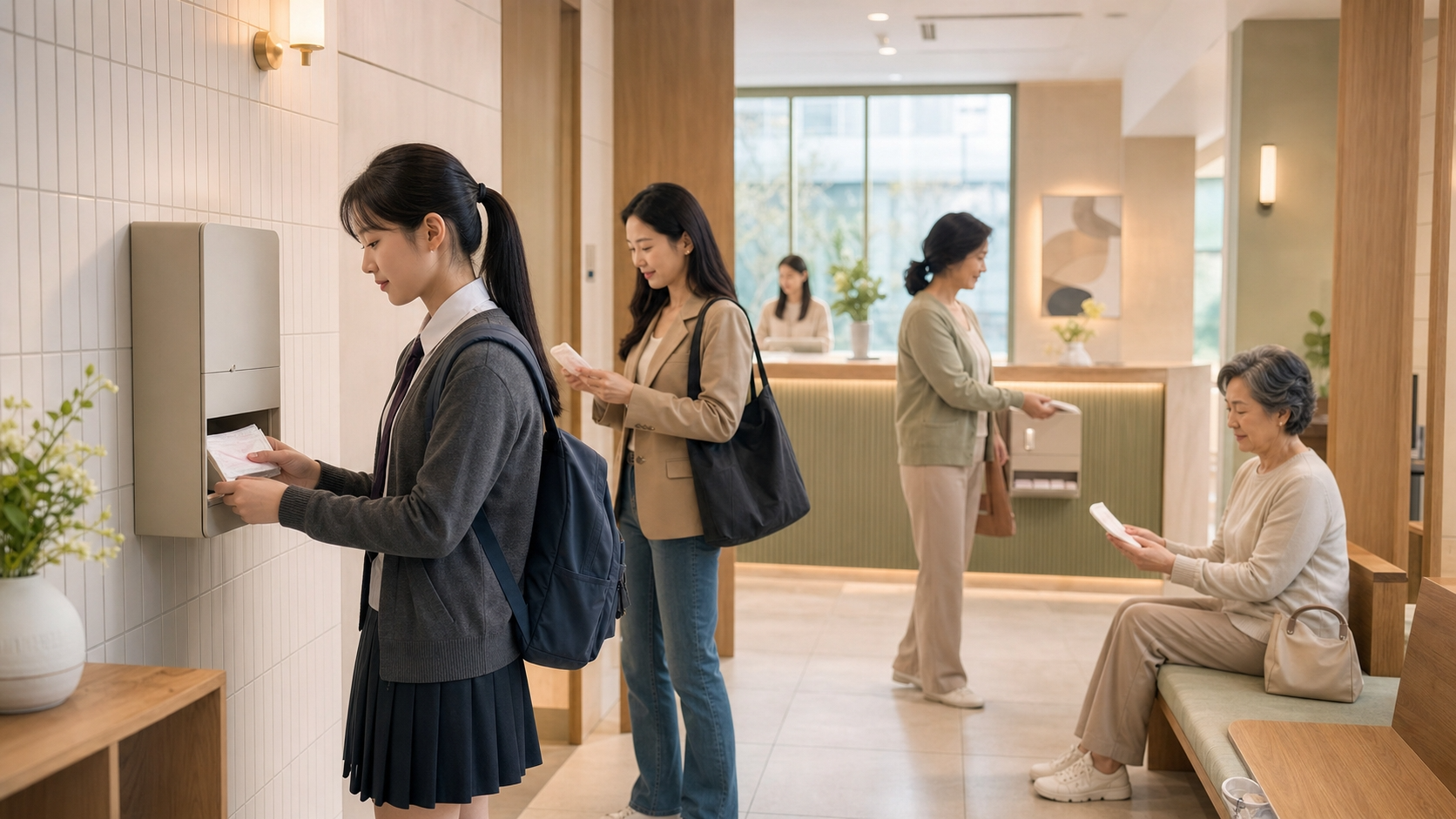
In South Korea, support for menstrual products has long been framed as a welfare policy for low-income female adolescents. But starting this year, the government launched a new experiment: instead of screening recipients by income or age, anyone who needs a pad at a public facility can get one. The official name is the ‘Public Sanitary Pad Dream’ program, but the dispensers themselves carry the phrase ‘Everyone’s Sanitary Pads.’
The policy’s backdrop is the cost of pads. Last December, President Lee Jae-myung raised the issue of high domestic menstrual product prices, prompting retailers to introduce low-cost options around 99 or 100 won per unit. Beyond price competition, the government concluded that a public access system was necessary for situations where someone suddenly needs a pad—regardless of their financial status.
The Ministry of Gender Equality and Family reported the pilot plan at a Cabinet meeting in March. Initially, the idea was to launch in 10 local governments in the second half of the year. After a public application and review process, 12 local governments were selected, and dispensers began operating on July 6, depending on each facility’s readiness.
Different from Existing Vouchers in Target and Approach
Existing menstrual product support isn’t going away. The government currently provides a monthly voucher worth about 14,000 won for female adolescents aged 9 to 24 who belong to basic livelihood security recipients, statutory near-poverty groups, or single-parent family support households. That system is a targeted benefit allowing individuals to buy products of their choice.
The public pad pilot starts from a different premise. It requires no income proof, age verification, or prior application. It’s designed so that any woman who needs a pad can get one immediately from dispensers installed in public facilities. This isn’t a full replacement of targeted support with universal coverage—it’s a layer added on top of existing vouchers to address urgent accessibility.
That’s why the government chose a facility-based model. Delivery or individual application methods work for regular support but fail when someone unexpectedly needs a pad while out. Placing dispensers in libraries, community centers, youth facilities, health centers, and transit hubs—places within daily living zones—focuses on reducing access time rather than product price.
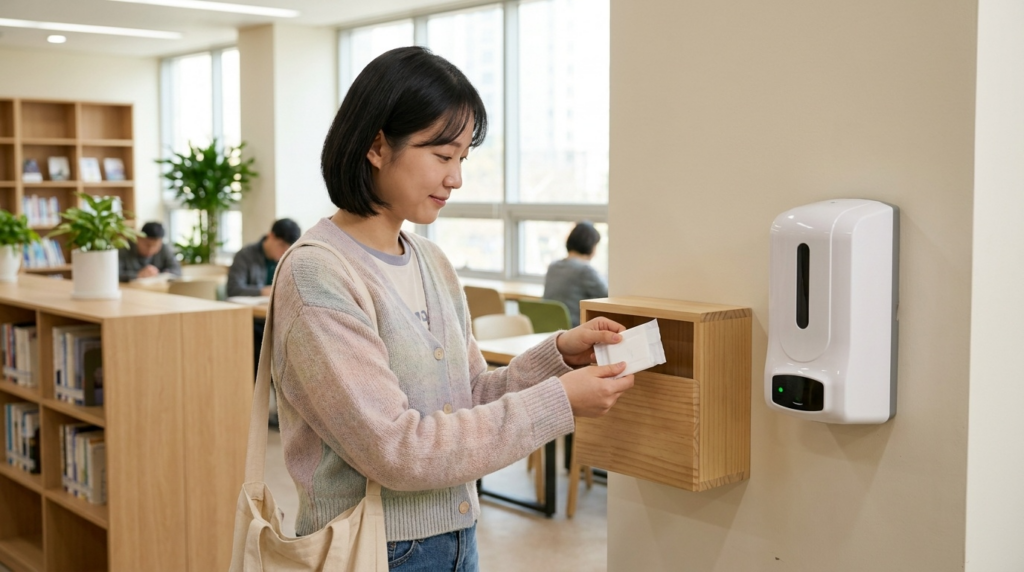
Starting With About 700 Dispensers Across 12 Regions
The pilot regions are Gwangjin-gu and Eunpyeong-gu in Seoul, Gwangmyeong and Suwon in Gyeonggi Province, Jung-gu in Daejeon, Seocheon in South Chungcheong, Jeongeup in North Jeolla, Mokpo in South Jeolla, Buk-gu in Gwangju, Gumi in North Gyeongsang, Geochang in South Gyeongsang, and Jeju City on Jeju Island. The Ministry selected these 12 from 32 applicant local governments after reviewing regional conditions and operational plans.
The government plans to install about 700 dispensers in stages, focusing on public facilities, university areas, transit hubs, and commercial districts. Depending on facility size and foot traffic, both automatic dispensers and manual storage boxes will be used. As of just before the service launch, about 500 locations—including community centers, libraries, and youth facilities—were included in the first wave.
Usage is straightforward. Each dispenser provides a pack of two medium-sized pads. Exact locations are available on the websites of the Ministry and participating local governments. The government has also said it will introduce a service to let users check nearby dispenser locations and stock levels.
Local Experiments Paved the Way for Central Government Action
Public facility pad placement isn’t entirely new in Korea. Some local governments, like Dalseo-gu in Daegu and Ulju-gun in Ulsan, had already installed free dispensers in public or youth facilities. However, early efforts often targeted female adolescents as the primary policy focus.
Gyeonggi Province offers a broader reference. It has been placing menstrual products in multiple public facilities under its own program, with an official guide page listing locations like libraries, parks, youth centers, and public offices, along with usage instructions. In Goyang, dispensers have operated at venues like KINTEX, Lake Park, and Sinwon Library.
These examples show that public pads aren’t just about income support—they’re tied to everyday convenience in spaces like restrooms, libraries, and parks. Just as toilets have toilet paper and soap, menstrual products can be seen as basic hygiene items needed in emergencies. The central government’s pilot is essentially a larger-scale test of these local experiments.
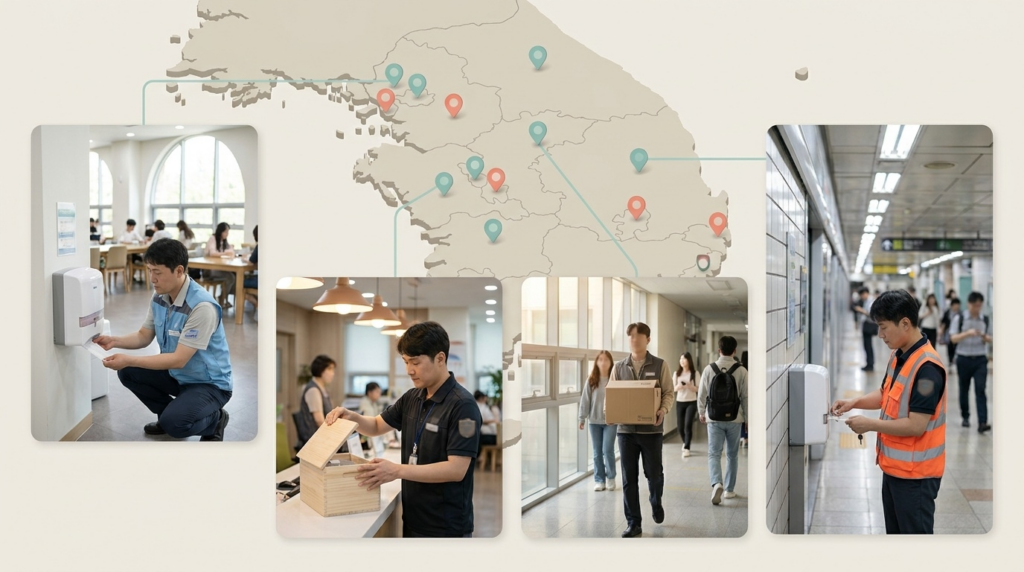
Success Hinges on Operational Metrics, Not Just Dispenser Counts
This year’s pilot budget is 3.2 billion won, fully funded by the central government. After analyzing results, the government plans to push for a national rollout starting next year. But a nationwide shift depends on the pilot’s performance and budget negotiations. What’s confirmed now is the 12-region pilot; national implementation remains a policy goal.
The first key metric is actual usage rates. Even if dispensers are installed, accessibility drops if users don’t know where they are, stocks run out frequently, or the process feels inconvenient. Conversely, steady use in high-traffic transit hubs, libraries, and administrative welfare centers will validate the public facility approach.
The second is regional operational disparities. Some areas already have experience and management systems for public pads, while others are starting from scratch. Consistency in restocking cycles, facility staffing, signage, and safe product procurement across regions will be critical. The success of universal support depends not on declarations but on whether products are actually available when needed.
Korea’s public pad program is still a pilot across 12 local governments. But the policy question is clear: Should menstrual products be seen as personal items that individuals must always prepare in advance, or as hygiene necessities that should be urgently accessible in public spaces? The usage rates, stock management data, and regional satisfaction metrics that will soon be released will offer the first answers to that question.
Sources: Ministry of Gender Equality and Family public pad pilot announcement, June–July 2026; Jung Jong-hoon, Korea JoongAng Daily, June 2026; Kim Won-jin, Kyunghyang Shinmun, March 10, 2026; MBC News, July 4, 2026; Gyeonggi Province public pad placement status.