
Table of Contents
A Bag of Ramen Crosses Borders Faster Than It Used To
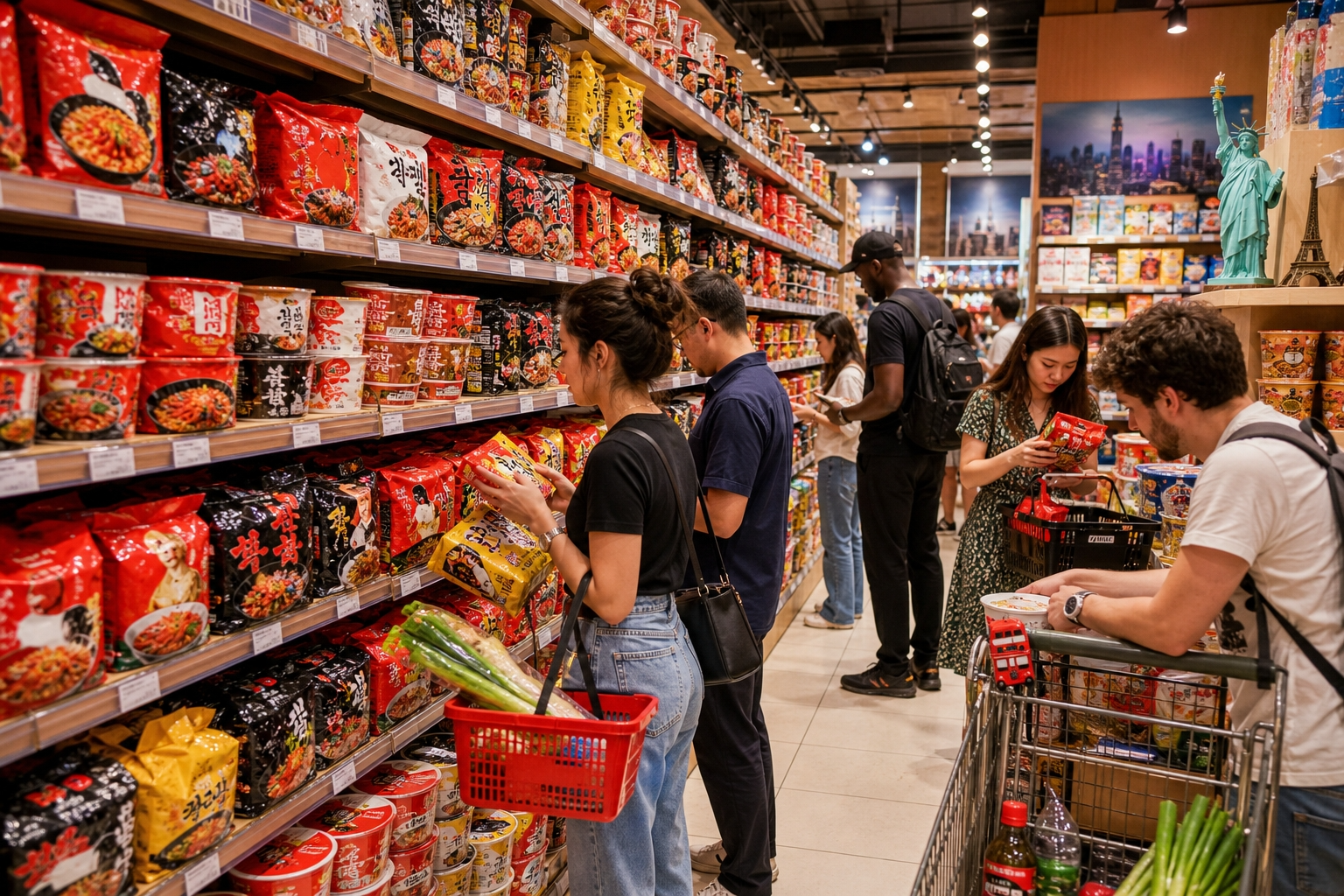
Stand in front of the ramen aisle at a grocery store abroad these days and it’s a little startling. Where you used to see a few varieties of Shin Ramyun and maybe a kimchi ramen, now there’s a long lineup: multiple flavors of Buldak Bokkeummyeon, Chapagetti, Jin Ramyun, cup noodles, stir-fried noodles, even cheese-flavored ramen. There are several spice levels, and the packaging doesn’t look all that different from what you’d see at a Korean convenience store. It feels like K-ramen is shifting from “an exotic food to try once” into something people put in their everyday shopping cart.
The food industry expects that in 2026, overseas ramen sales from major Korean makers — Nongshim, Samyang Foods, Paldo, and Ottogi — could reach 5 trillion won for the first time. There’s an important distinction here: that 5 trillion won figure isn’t just export revenue tallied by Korea Customs. It’s an industry estimate that combines exports shipped out of Korea with sales from local factories in places like the U.S. and China that produce and sell within those markets.
Some numbers are already confirmed, though. According to Korea Customs, ramen exports in 2025 came to US$1.52 billion, roughly 2 trillion won — a record high, up 21.8% from the previous year. Exports in the first half of 2026 came to US$935.39 million, about 1.3861 trillion won, up roughly 28% year over year. Even looking at just the first half, ramen is one of the hottest categories driving K-food exports.
5 Trillion Won Is a Forecast, Not a Confirmed Result — Yet
A headline like “overseas ramen sales surpass 5 trillion won” can sound like something that’s already happened. It isn’t, not yet. According to a Maeil Business Newspaper tally of major companies, these firms’ combined overseas ramen sales rose from 2.6073 trillion won in 2023, to 3.3131 trillion won in 2024, to 4.12 trillion won in 2025. The claim that this year will hit 5 trillion won is an industry projection based on first-half growth rates and expanding local production, not a confirmed final number.
So it’s most accurate to read this figure two ways. One, K-ramen really is growing fast. Two, the 5-trillion-won figure isn’t a locked-in number until the year-end tally is done. Rather than stating flatly that “5 trillion won has been achieved,” it’s more accurate to say the industry is targeting or forecasting 5 trillion won.
Still, the reasoning behind the forecast is fairly solid. Nongshim’s overseas sales in the first quarter of 2026 came to 415.1 billion won, up 19.9% year over year, while Samyang Foods’ exports over the same period came to 585 billion won, up 38%. With the two companies that account for a large share of overseas ramen sales maintaining strong growth, there’s a real basis for the industry floating the 5-trillion-won figure.
Buldak Lit the Fuse, and Shin Ramyun Widened the Road
It’s hard to talk about the K-ramen boom without mentioning Buldak Bokkeummyeon. What started as buzz around the spicy “Fire Noodle Challenge” videos expanded into cheese, carbonara, and sauce variations, and has become something like a shared language among people who love heat. Samyang Foods posted 1.8838 trillion won in exports in 2025, and 2026 exports are projected to top 2 trillion won.
But K-ramen’s growth can’t be explained by Buldak alone. Nongshim’s Shin Ramyun has expanded its overseas distribution as something close to the standard for spicy noodle soup, and the Shin Ramyun brand’s overseas sales topped 1 trillion won in 2025. Ottogi’s Jin Ramyun reached global consumers by featuring BTS’s Jin as its face, and Paldo’s “Doshirak” cup noodles have built their own long-running, distinct market centered on Russia.
Ramen’s strength abroad isn’t just about taste. It cooks fast, keeps at room temperature, and costs far less than eating out. As dining-out prices have climbed in the U.S. and Europe, more consumers are looking for food they can prepare simply at home. On top of that, repeated scenes of people cooking and eating ramen in K-pop content, dramas, and variety shows have naturally taught audiences how it’s actually eaten.
Exports Alone Weren’t Enough, So Factories Are Going Up Abroad
A bag of ramen looks light, but shipping huge volumes across the ocean requires factories, ports, warehouses, and distribution networks all working together. So companies are expanding local production facilities even as they grow exports. Nongshim expects that once it completes an export-dedicated factory in Noksan, Busan, in October, its domestic ramen production capacity will grow from 700 million units a year to around 1.2 billion.
Samyang Foods is building its first overseas factory, in Zhejiang, China. Once complete, it will be capable of producing up to 840 million units of Buldak Bokkeummyeon a year. Ottogi is also preparing a U.S. factory and an export-focused ramen plant in Gumi. Local production shortens delivery times and makes it faster to test products tailored to local palates.
That doesn’t necessarily mean more local factories will reduce exports from Korea. Products made in Korea still carry the image of being “the authentic original from Korea,” while locally made products can help stabilize inventory and pricing in large markets. Exports and local production function less like competitors and more like two engines pushing K-ramen further out into the world.

If You’re New to K-Ramen, Start With Your Taste, Not the Spice Level
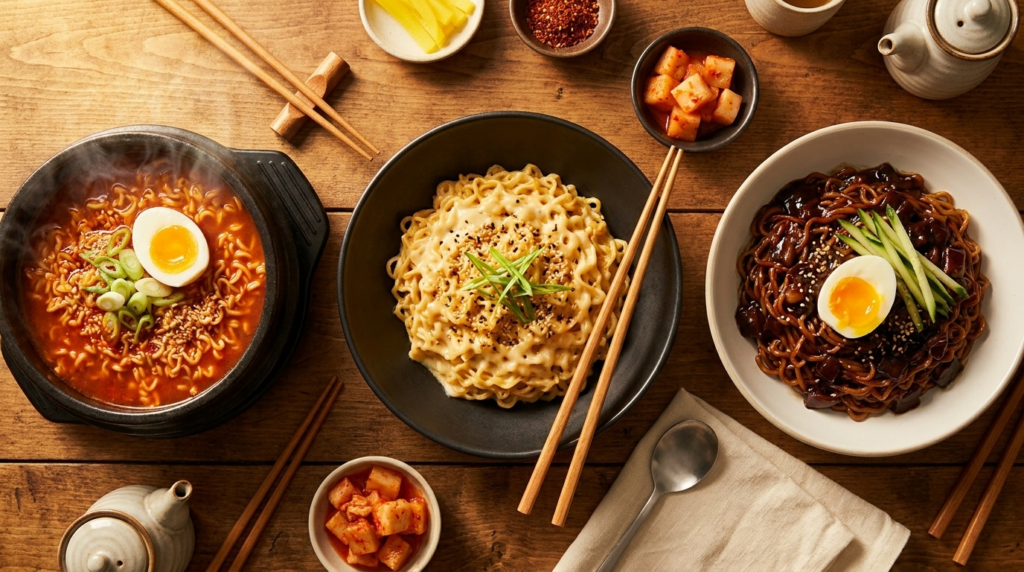
If you’re picking K-ramen for the first time at a store abroad, you don’t have to jump straight to the spiciest option. If you like a soupy noodle, start with something like Shin Ramyun or Jin Ramyun, where you add water and boil. If you like stir-fried noodles, start with a carbonara-style Buldak or a jjajang-flavored option. If you’re worried about the heat, cheese, milk, egg, or mayonnaise can help mellow it out — though adding milk won’t make the spiciness disappear entirely.
Ramen is great for a quick meal, but many varieties are high in sodium. Skipping the last of the broth and adding egg, vegetables, or tofu makes for a much more balanced meal. With spicy stir-fried noodles, try mixing in about half the sauce packet first and adjusting from there, rather than dumping in the whole thing right away. Eating in a way that suits your own taste and body matters more than following the “correct” method.
On its own, K-ramen’s 5-trillion-won overseas sales figure can sound like a story about corporations. But that number is really built up from countless small moments — someone deciding what to eat tonight at a convenience store in New York, a supermarket in São Paulo, an Asian grocery store in Paris. Next time you’re picking out a bag of ramen, look past the spice level and think about whether it’s a soup or a stir-fry, and what you might pair it with. That small choice is also part of how K-food is making its way around the world right now.
Source: Korea Customs Service import/export trade statistics, 2025 and first half of 2026; Ministry of Agriculture, Food and Rural Affairs, July 2026; Maeil Business Newspaper, July 28, 2026; CNBC, January 19, 2026.