
Table of Contents
The Room Where Hangeul Is Taught Now Exists in 89 Countries
A language, more often than not, crosses borders by following the people who carry it. It is there in the first words an immigrant family teaches a child, and it is there in the slower unfolding by which an unfamiliar sound, encountered through trade or study abroad or a drama or a song, becomes one day an ordinary curiosity. But for a language to take root and remain, an individual’s enthusiasm alone is rarely enough; what is required is a teacher, a textbook, a room in which a class can be held, and a path along which a learner might advance toward whatever comes next. For more than two decades now, this has been the quiet task of the King Sejong Institute — to lay, city by city across the world, the foundations on which a language might be built to last.
In June 2026, Korea’s Ministry of Culture, Sports and Tourism and the King Sejong Institute Foundation designated 29 new King Sejong Institutes across 23 countries. With this latest round of designations, the network has grown to 273 locations in 89 countries. A program that began in 2007 with 13 locations across three countries has, in the years since, grown into an educational web stretching from Europe to Africa, threading its way through Asia and into Latin America. Where once a person who wished to learn Hangeul had little choice but to come to Korea, Korean-language education has, in its place, begun arriving in the learner’s own city.
Names Newly Placed on the Map: Greece, Rwanda, Sri Lanka
What stands out most in this round of expansion are the countries opening a King Sejong Institute for the very first time. Greece, Rwanda, and Sri Lanka each receive their first Institute under this new round of designations, and the significance of these three names extends beyond the mere filling in of blank spaces on a map. What they demonstrate is that Korean-language learning is no longer a phenomenon confined to major cities where demand was already broad and evident, but is instead extending itself into regions carrying histories and linguistic circumstances entirely their own.
In Greece, Aristotle University of Thessaloniki will operate its King Sejong Institute in partnership with Hankuk University of Foreign Studies. In Rwanda, International Covenant College in Kigali will join hands with the Embassy of the Republic of Korea. In Sri Lanka, the teaching will be carried jointly by the University of Ruhuna in Matara and Dongwon University of Science and Technology. This manner of dividing responsibility — a local university or educational institution paired with a Korean university or institution, each taking up its own share of the task — carries a far greater likelihood of enduring than the mere opening of an overseas course might. A language, after all, tends to root itself more deeply not simply through a translated textbook, but through the educational environment already native to the community in which the learner lives.

Korean Universities, Too, Step Onto the Path of Language Education
Of the 29 newly designated King Sejong Institutes, 19 will operate in partnership with domestic Korean institutions, and among them, nine universities — Seoul National University included — are participating in the operation of a King Sejong Institute for the first time. This suggests that Korean-language education is ceasing to be the specialized domain of a narrow set of institutions and is instead becoming woven into the broader international exchange and educational activity of a growing number of universities. A university, after all, is not merely a place where a language is taught; it is also where teacher training, curriculum research, and the design of cultural programming come together under one roof.
To a foreign learner, Korean first presents itself through the shape of its letters and the sound of its syllables. The structure of Hangeul, in which consonants and vowels combine to form a syllable block, is comparatively transparent — yet once one steps into actual communication, honorific speech, particles, and vocabulary that shifts according to context all lie in wait. The Korean word jeong (情), for instance, contains within it an accumulation of relational time and emotional weight that no single dictionary entry can adequately carry across into another tongue. This is, in part, why the King Sejong Institute pairs its language classes with instruction in Korean culture: grammatical precision and cultural context are not separate subjects but two doors that open, each, onto an understanding of the other.
What 239,020 Learners Reveal Is the Scale of Demand
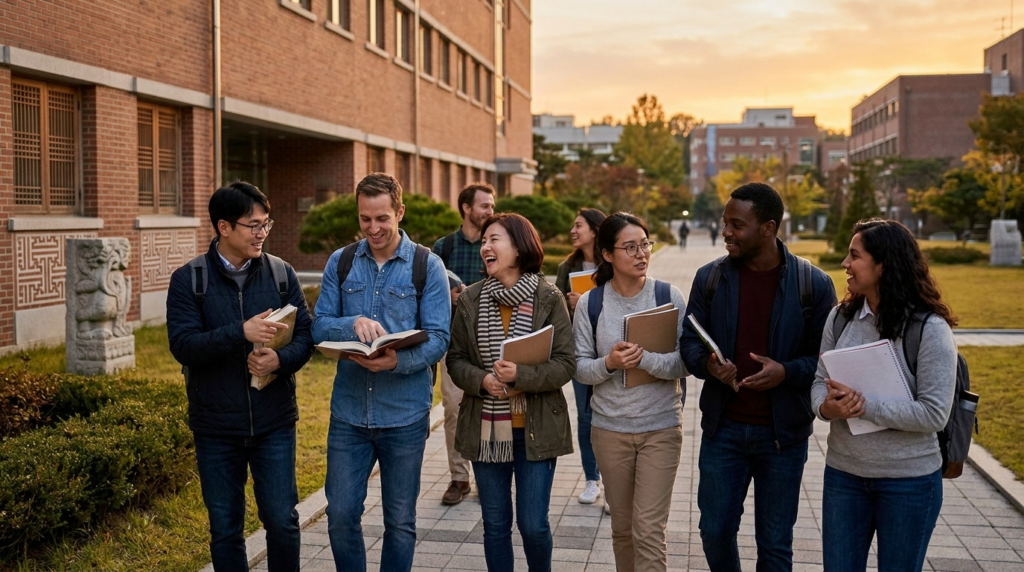
Across 2025, a combined 239,020 students studied Korean language and culture through the King Sejong Institute, whether online or in person — the largest number the program has recorded to date. Taken at face value, the figure might seem a straightforward consequence of the global popularity of Korean content. It is certainly true, in many cases, that the first spark of learning comes from a wish to sing along to a K-pop lyric, or to follow the dialogue of a Korean drama without the crutch of subtitles. But converting that initial curiosity into sustained study belongs to an entirely different order of difficulty.
A language learner rarely stops at knowing a handful of trending phrases. Some are preparing for employment or study abroad; others are acquiring the vocabulary of a workplace in order to do business with a Korean company; still others are returning to a language once spoken within a Korean family of their own. One person may begin with the words of a favorite singer, only to find themselves, in time, writing letters, speaking on the phone with a friend, or sitting through a university lecture, all in Korean. That enrollment at the King Sejong Institute has risen, then, is perhaps best read not as proof that consumers of Korean content have become, in a single step, users of the Korean language, but rather as evidence that the pathway by which people carrying these varied purposes might choose formal instruction has simply widened.
Expansion Will Be Completed Not by Numbers, But by the Continuity of Teaching
This year’s call for new designations drew applications from 102 institutions across 45 countries, the largest field in five years. The Ministry of Culture, Sports and Tourism and the King Sejong Institute Foundation have said that the 29 final institutions were chosen after an evaluation of each applicant’s operational capacity, educational environment, and local demand. That so many institutions applied is itself a signal that interest in Korean-language education has broadened considerably. Yet whether a given Institute ultimately succeeds or falters will be decided not by the scale of its opening ceremony but by whether, some years hence, classes continue steadily in that same city, and whether a beginning learner is able to rise, in due course, into the intermediate and advanced levels.
The name Sejong calls to mind a king who believed that more people ought to be brought closer to knowledge through the written word. The figure of 273 locations across 89 countries is, by any measure, an impressive one — but the moment in which that figure takes on its true meaning will arrive only when a single learner, working with an unfamiliar script, sets down the first sentence built from a thought of their own. Whatever sentences begin to take shape in a lecture hall in Greece, an educational institution in Rwanda, or a classroom in Sri Lanka will, in time, reveal whether Korean can become something more than a means of introducing Korea to the world — whether it might yet serve as a language that draws different worlds into conversation with one another.
Source: Ministry of Culture, Sports and Tourism press release, “29 New King Sejong Institutes Designated for 2026, Expanding to 273 Locations in 89 Countries Worldwide,” June 30, 2026; eToday, June 30, 2026; Seoul Economic Daily, June 30, 2026.