
Table of Contents
Four Days, Split Between Buyer Meetings and Shopper Experience
“K-Food Fair 2026” ran in the Delhi National Capital Region, and looking back at how it was structured, it really shows where Korean food’s push overseas is actually headed these days. It ran four days, July 30 through August 2 — the first two days were a B2B export consultation event with India’s import and distribution industry, and the last two flipped into a pop-up event meeting everyday consumers directly.
Even the venues split by purpose. On July 30 and 31, the business-to-business meetings were held at the Pullman New Delhi Aerocity, and on August 1 and 2, things moved to Ambience Mall in Gurugram for the consumer-facing K-food experience, sales, and promotion programming. Splitting one event across two locations wasn’t just an operational choice — it’s a way of stringing together the spot where you confirm whether a deal is possible and the spot where you actually watch how consumers react, all as one continuous export marketing flow.
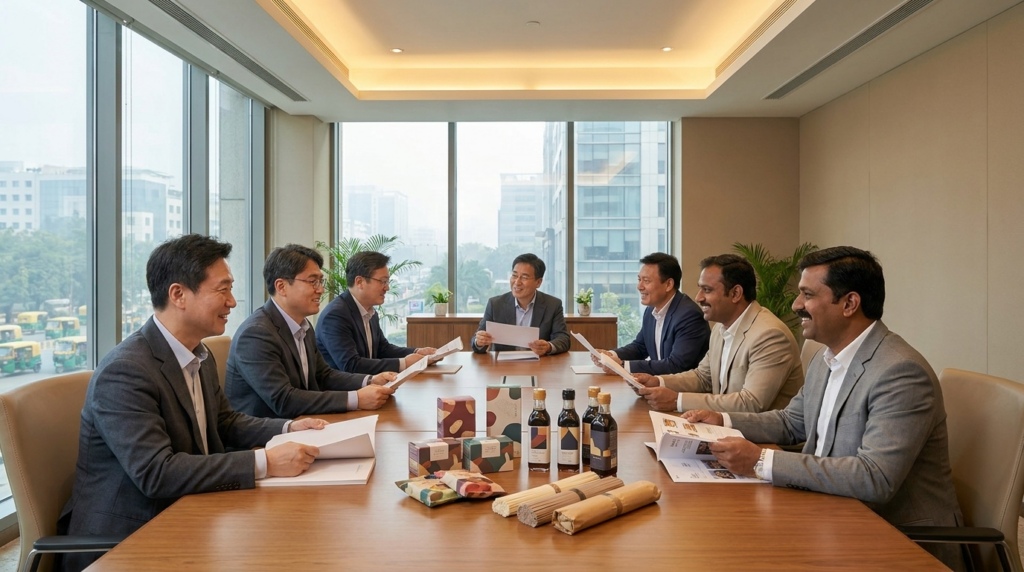
The event was hosted by Korea’s Ministry of Agriculture, Food and Rural Affairs and the Ministry of Oceans and Fisheries, and run by the Korea Agro-Fisheries & Food Trade Corporation (aT). About 30 Korean food companies and roughly 50 Indian buyers took part in the B2B program, talking through importing, distribution, retail placement, and how far products would need to be localized. Companies weren’t just there to lock down contract terms — they were also looking into what kind of product lineup would actually work in the Indian market.
The Question at the Trade Table Shifted From ‘Can We Import This?’ to ‘How Do We Actually Sell It?’
Buyer meetings are usually the centerpiece of overseas food trade shows. An exporter pitches a product, and a buyer weighs price, volume, distribution networks, and customs conditions to decide whether a deal is even possible. That process matters, but honestly, reactions across a meeting table alone can’t tell you whether a shopper is actually going to pick the product up — or come back for a second purchase.
The B2B program at the India K-Food Fair felt like a first step toward covering that gap. The venue had one-on-one business meetings, exhibition space, and food demonstrations and tastings all set up. Participating companies negotiated supply and distribution routes with Indian buyers while also fielding direct questions about ingredients, packaging, price points, and local consumption habits.
In the Indian market especially, how a product tastes isn’t the only thing that decides whether an export succeeds. You have to account for whether it’s vegetarian, how ingredients are labeled, spice preferences, religious and cultural food standards, and how distribution differs city by city. So the conversation at these meetings ends up leaning less toward “can we import this” and more toward “how exactly do we introduce and sell it.”
The Mall Pop-Up Was Where You Could Read Shoppers’ Reactions in Real Time
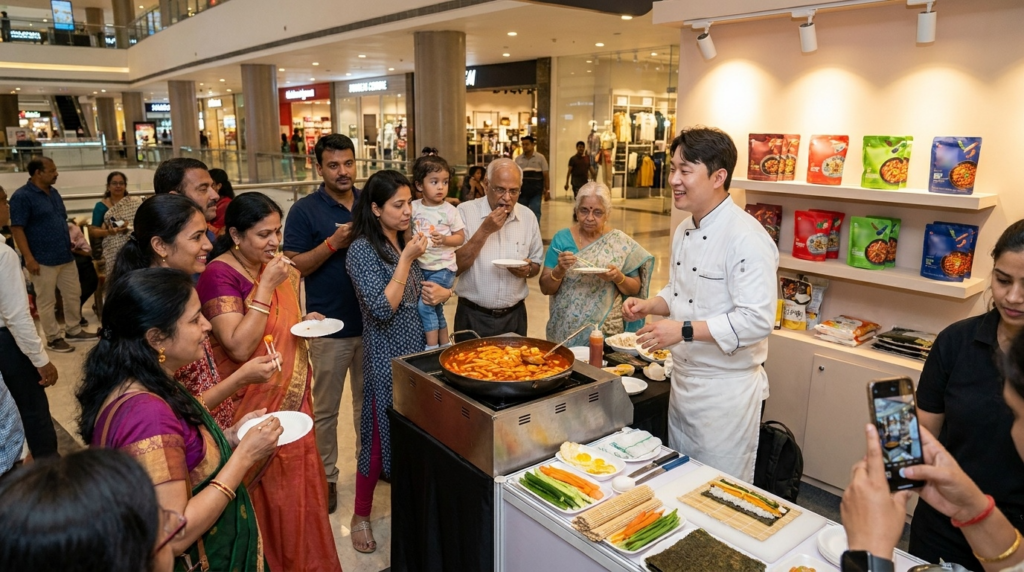
Once the B2B schedule wrapped and things shifted to Ambience Mall, the consumer program became the place where that same question got its answer in real time. Visitors browsed the K-food market section and got a hands-on taste of Korean food through open-kitchen cooking demonstrations and tastings. Cooked dishes like kimbap, tteokbokki, and kimchi fried rice showed up alongside a wide range of noodles, snacks, sauces, drinks, and rice-based products.
The event also folded in cultural programming beyond just food — a K-noodle station, a K-pop cover dance competition, game booths. It’s probably more accurate to read this less as a device for turning food into an accessory of cultural content, and more as a way of lowering the barrier for shoppers encountering unfamiliar ingredients and cooking methods for the first time. Familiar music and activities keep people around longer, and inside that window, they end up tasting and buying naturally.
The value of a consumer pop-up is hard to judge by sales figures alone. You can also watch which products people linger in front of, whether a tasting turns into an actual purchase, whether the packaging and product descriptions are easy to understand, and which flavors local shoppers find overwhelming. That kind of on-the-ground reaction can become real material for adjusting product lineups and localization strategy in follow-up negotiations with buyers, too.
From 20 Companies in Mumbai to 30 in the Delhi Area
The event also grew from last year. Last year’s K-Food Fair in Mumbai drew around 20 Korean companies; this year’s Delhi-area event brought in roughly 30. The bigger number of participants stands out, but what’s honestly more striking is how the format itself expanded — from a two-day, B2B-only program into a four-day event combining B2B and B2C.
The lineup participating companies brought wasn’t limited to noodles and kimchi, either. It stretched across beverages, health foods, convenience meals, snacks and confectionery, sauces and seasonings, fruit and fruit products, rice-based goods, and seaweed. Companies leaned on products already somewhat known in the Indian market while also signaling that Korean food exports aren’t going to lean on the popularity of just one or two items.
Having more items on the table doesn’t guarantee successful distribution, though. You still have to match local tastes and price points, cooking convenience, and food labeling standards. That’s why going through both steps this time — confirming distribution terms in buyer meetings, then watching consumer reactions on the mall floor — seems genuinely useful for cutting down on trial and error when entering a new market.
The Trade Show’s Job Is Shifting From ‘Introduce’ to ‘Test’
What really mattered about the India K-Food Fair wasn’t showing off a lot of Korean food. The real point was bundling a trade consultation and a consumer pop-up into one event, so exporters got to meet both their business partners and their actual end customers, back to back. You get to confirm, right there on the ground, that what a buyer needs in terms of distribution terms and what a consumer actually wants in taste, price, and usability can be two completely different things.
Watching how this played out, you can see overseas trade shows moving away from being a one-off, introduction-focused event and turning into more of a testing ground for actually breaking into a market. For exporters, it’s a chance to look past whether a buyer might place an order and see what consumers actually choose. For buyers, it’s a chance to watch, firsthand, the moment a product meets a local customer.
Korean food’s push into India has reached the stage where curiosity sparked by K-content now needs to turn into actual purchases — and repeat ones. Getting there takes more than buzz. It takes local distribution partners, clear product information, adjustments tailored to local food culture, and the ability to fold consumer reactions back into business strategy quickly. These four days in the Delhi area were, in a lot of ways, a test run of exactly that connection.
Source: Korea Agro-Fisheries & Food Trade Corporation (aT) KATI, “2026 K-Food Fair India Additional Recruitment Notice”; The Statesman; Asian Community News; Financial News (India coverage).