
Table of Contents
The First Episode, Where Cast Members Named Their Illness Before Their Name
On the debut episode of SBS’s dating reality show “My Remaining Love,” which aired on August 3, the cast introduced their illnesses before their names. Leukemia, stomach cancer, lymphoma, brain tumor, bone cancer — each was named in turn. It was the moment eight people met for the first time and shared their “medical journals” with one another.
A trailer released before the broadcast showed one cast member reading from her own illness journal aloud. As lines like “I became a stage 4 cancer patient” and “I had my entire stomach removed” followed one another, the hosts in the studio fell silent for a moment. It was an opening rarely seen in the first episode of a dating show.
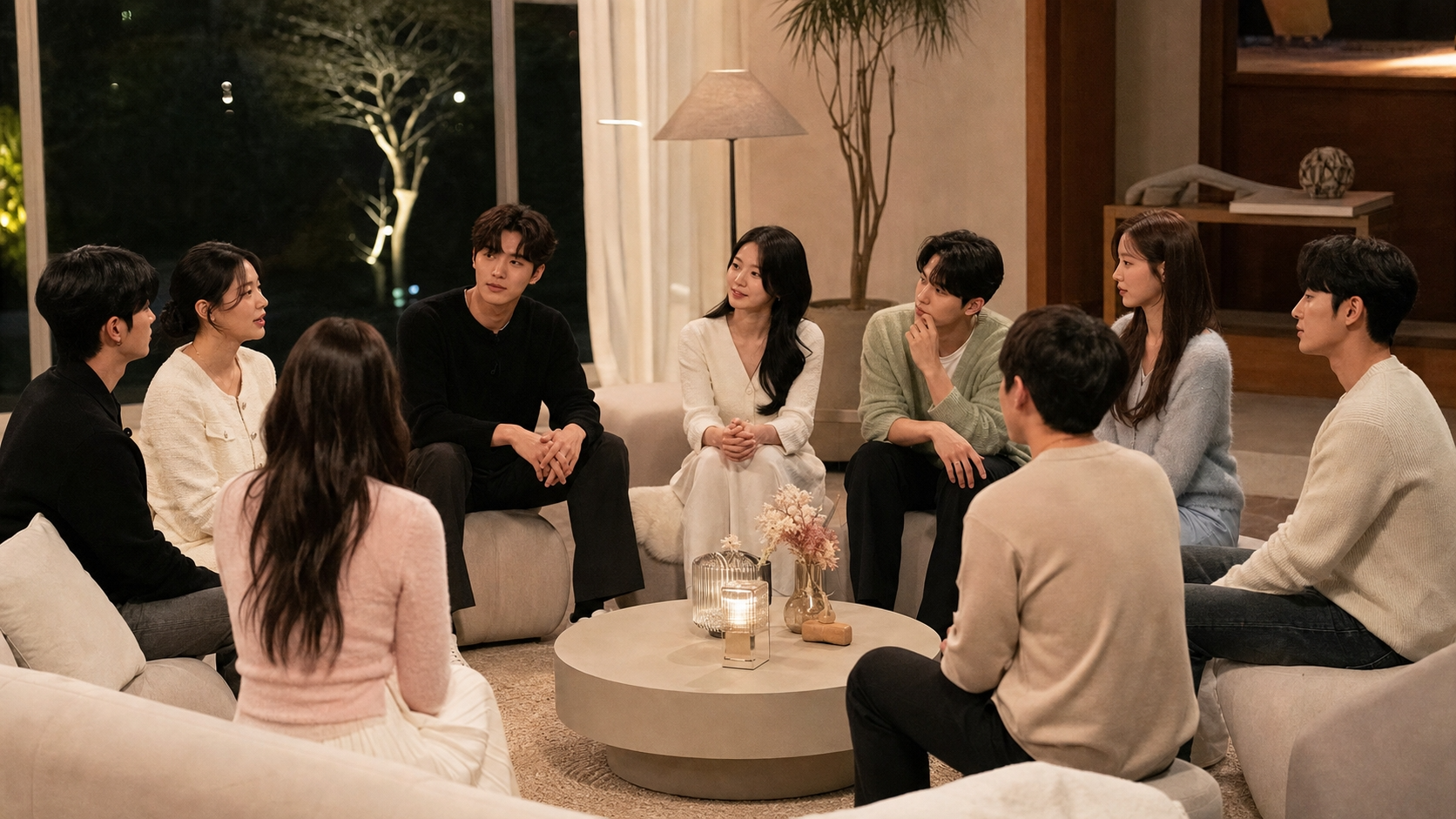
“My Remaining Love” follows eight people in their 20s and 30s — each of whom either received a terminal diagnosis or came close to death during treatment — as they search for love again. The cast consists of Kim Seon-ho, Jung Ye-ji, Han Do-gon, Seo Ro-bin, Kim Ryun-gi, Kim Jong-eun, Kang Min-young and Kim Na-young. It airs Monday nights at 10 p.m., hosted by actor Lee Se-young, singer Jung Yong-hwa, Seventeen’s DK, and Choi Ye-na.
Ratings and Streaming Rankings Told Different Stories
According to Nielsen Korea, the first episode drew a nationwide rating of 0.9%. The second episode, aired on August 10, matched that 0.9%, keeping the show under 1% for two straight weeks — well below the 2.5% rating the previous show in the same time slot posted for its finale.
A different metric told a different story, though. Right after its debut, “My Remaining Love” entered Netflix’s Korea Top 10 series list at No. 9, landing in the upper ranks in its very first week — a divergence between its terrestrial broadcast ratings and its streaming performance.
In Korea, TV ratings are calculated by Nielsen Korea from real-time viewing among sample households, while Netflix’s rankings are based on viewing hours within a given country. Because the two metrics measure different things in different ways, they can diverge — and it’s hard to say with confidence which one comes closer to the show’s actual reach.
What Sets It Apart in a Saturated Dating-Show Market
Dating reality is already close to being its own genre industry in Korea. Just since May, JTBC’s “Love Wars” (June 23), SBS’s “Let My Kids Go Season 2” (June 25), and Netflix’s “Solo but Wants to Date, Season 2” (July 7) all premiered in succession, with “My Remaining Love” following on August 3.
When shows cluster together like this, the pressure to stand out grows. There’s also been ongoing criticism that provocative love-triangle setups and conflict-driven editing have become an unofficial formula for the genre. A premise built around illness and recovery runs in the opposite direction from that trend.
The production team introduced a matching device called the “Room of Time”: every night, cast members give and receive 100 minutes with one another, so the question of who to spend one’s remaining time with — and how — is built directly into the rules. The show is directed by PD Lee Eun-sol, who previously made “Shaman’s Love,” about shamans dating. Gathering a group who share a specific condition and watching how that condition shapes their relationships is the same underlying structure as her earlier show.

Overseas Streaming Deals Were Signed Before It Even Aired
Before its domestic debut, the show had already secured pre-broadcast licensing deals with major streaming platforms — Japan’s ABEMA, Taiwan’s friDayVideo, and Hong Kong’s Viu. SBS described the deals as evidence of high interest in the program.
On Japan’s ABEMA, which has roughly 30 million weekly users, the show streamed simultaneously with its Korean broadcast. It also rolled out in Taiwan and Hong Kong around the same time, letting audiences in all three regions watch the show at nearly the same moment as Korean viewers.
One interpretation is that illness and loss are subjects that need no translation, regardless of language or cultural background. But that’s an outside industry read, not a fact — platform-specific viewership data hasn’t been released, and there’s no available data yet on how much the show is actually being watched abroad.
What’s Left to Debate: Authenticity Versus Consumption
In the second episode, it emerged that cast members Kim Seon-ho and Jung Ye-ji had exchanged private blog comments six years earlier while both were undergoing treatment, supporting each other through it. Kim brought up the connection during a bookstore copying date.
A storyline like that draws viewers in deeply, but it also raises the emotional stakes of watching. Whether turning one’s own illness into material for a dating show leaves a burden on the cast members themselves is something that can only be assessed once the series has finished airing.
The third episode airs on August 17. Its trailer shows cast members whose expectations don’t quite line up, wavering as new dates unfold. How the production team balances authenticity against editing in the episodes still to come looks set to determine how this show is ultimately judged.
Source: Seonae Kang, SBS Entertainment News, August 6, 2026; Nielsen Korea ratings data, August 11, 2026.