
Table of Contents
26,700 Viewers on Opening Day Put a Korean Film Back at No. 1
Director Kim Jung-hoon’s “Final Interview” opened on November 4 and drew 26,700 viewers that day, enough to top the overall box office. It was the first time a Korean film had led the daily chart since “Assassin(s)” on October 13, a gap of 22 days. Counting preview screenings, its total stood at 42,574. In a market where foreign films had been leading, a Korean psychological thriller about a corporate job interview came out in front.
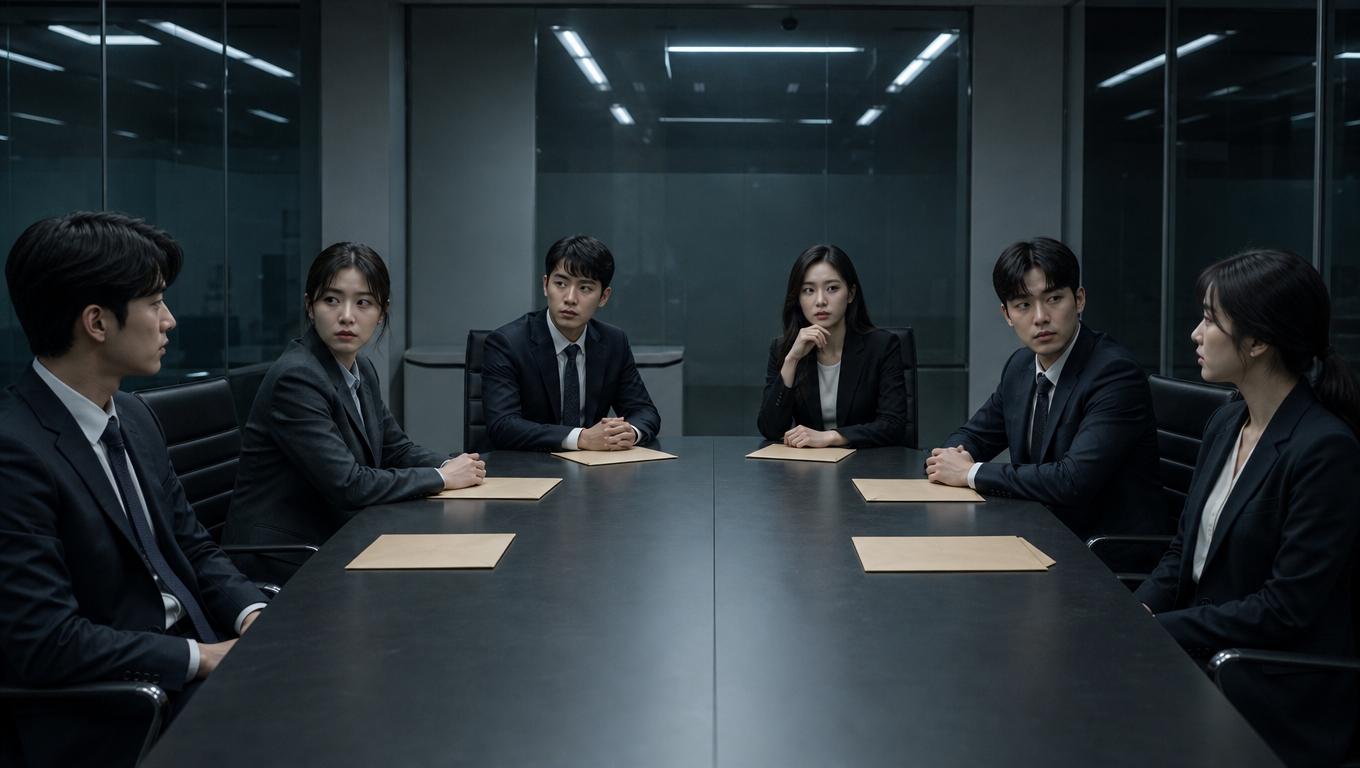
The film’s premise is simple to state. Six candidates reach the final round of a corporate interview and are told to debate among themselves and pick the one person who gets the job. Then they find mysterious envelopes holding each person’s secrets and failings, and the interview turns into a room full of suspicion. A hiring evaluation and a whodunit run side by side in the same space. The film takes the job competition Korean audiences know well and puts it under strange new rules.
On opening day the film scored 96% on CGV’s Golden Egg index and 9.2 points in Lotte Cinema audience reviews. Comments about its twists and the cast’s chemistry drove early word of mouth. Rankings alone, though, do not explain why the premise lands. To see where the tension comes from, it helps to look at the setting of a final interview, the way the competition is structured, and how a Japanese novel was turned into a Korean film.
A Japanese Novel, Moved Into a Korean Interview Room
The story comes from Akinari Asakura’s Japanese novel “Six Lying University Students,” published in 2021 and made into a Japanese film of the same name in 2024. The Korean “Final Interview” uses that source to build a battle of nerves among young people trying to land a job at a large company. Covenant Pictures produced the film and NEW distributed it. In moving the story to Korea, the new version puts teamwork alongside the competition.
In Korea, gongchae, or open recruitment, means a company opening a formal hiring round and selecting candidates through set stages. The interview is the stage where applicants explain their experience and abilities and are judged by the company. “Final” means the last gate in that process. The film takes this familiar routine and hands part of the evaluator’s job to the applicants themselves. People who were being judged together now have to judge each other.
In the film, the candidates have come through a 5,000-to-1 competition to reach this room. That ratio is part of the story’s setup. Having made it to the last stage, each of them badly wants the job, and there is only one opening. Respect for a rival’s ability runs straight into the urge to protect one’s own chances. An everyday hiring step becomes a thriller device because the applicants have to work out that conflict in the same room.

On Set, the Six Actors Worked as a Team
Cho Yi-hyun, who plays Moon Hye-in, told Yonhap News that she did not read the novel or watch the Japanese film before shooting. When she did see the source material after filming, she felt the Korean version focused more on teamwork. That is the actor’s own reading of the adaptation. Apart from following the original plot, the relationships among the people in the interview room are a useful way into the Korean film.
The cast includes Cho Yi-hyun, Kim Jae-won, Shin Seung-ho, Kang You-seok, Kwak Dong-yeon and Bae Kang-hee. In a story about six candidates watching one another, each line one character says depends on how the others react. The listener’s expression matters as much as the speaker’s argument. The emphasis on teamwork shows in how the scenes with all the rivals together are built, and the tension sits in the gap between moments of trust and moments of doubt.
For international viewers, one interesting point is that cooperation and competition never come apart. To run the debate, the candidates have to listen to each other and reach a shared decision, and that decision will give the job to only one of them. The film builds a paradox in which personal interest shows through in a setting that rewards looking cooperative. The reasons to act like a good colleague and the reasons to stay on guard come from the same assignment.

The Envelopes Change What Is Being Judged
Once the envelopes appear, the interview’s focus shifts. Instead of the introductions and answers the candidates prepared, information exposing their failings moves to the center. A room meant to assess ability turns into one where the question is how far anyone’s word can be trusted. The closed room is a genre device that keeps the characters from getting away from one another.
In an interview with Seoul Shinmun, director Kim said he set out to make all six look like the culprit, so that the real one would be hard to predict. He chose not to steer suspicion toward any single character. Viewers have to keep revising their judgments as they watch what the candidates say and how they act. The same room can look quite different depending on whose account a viewer believes.
The setup also raises a question about what an interview measures. Fluency, cooperation, a revealed past and present conduct can each point to a different choice. Anyone who has been through a job search knows the pressure of explaining yourself in a short, fixed time. The film adds sudden exposure to that pressure and follows what happens when a prepared self-presentation starts to crack.
The Rankings Moved Daily, and the Race Went On
After the opening, the chart changed from day to day. On November 5, “Final Interview” fell to second behind the new Japanese animated feature “Detective Conan,” which opened only in CGV theaters, and on that day three of the top five films were Japanese animation. On November 6 it returned to first with 22,751 viewers. Leading on opening day and retaking first place on day three are separate results, and together they show how new releases and rival openings kept reshuffling the daily order.
According to box office data reported by News1 on November 8, “Final Interview” placed second on Saturday, November 7, with 44,616 viewers, for a total of 129,687. The animated “Chiikawa” movie took first place that day, and the Brad Pitt film “Heart of the Beast” also ranked near the top. The new Korean release is finding its audience between Japanese animation and a Hollywood title.
Those numbers also show that a film can slip in the rankings while drawing more people. “Final Interview” sold more tickets that Saturday than on its opening day and still placed second, because a daily rank depends on how the other films do. Its early run is best read on two levels: the symbolic first-place finish for a Korean film after 22 days, and whether daily attendance holds up.
The Lasting Question Is How People Judge Each Other
“Final Interview” runs 107 minutes, is rated for viewers 15 and older, and was an official selection at the 31st Busan International Film Festival. Audience reviews mention one twist after another and advise going in knowing as little as possible. For a locked-room mystery, the setup is more useful to know than the ending: six people, one job and envelopes no one can explain.
Viewers who know little about Korean hiring culture can still feel the pressure through this setup. A final interview is where you sell yourself to win a chance, and in this film it is also where you decide other people’s chances. Cho’s comment that the Korean version leans into teamwork while building on the Japanese original points to that double role. The people you have to solve the problem with are the same people competing with you for the job.
What remains to be seen is whether the premise and the mind games carry the film past its early reviews and keep audiences coming. First place on opening day shows how it started, and the attendance figures in the coming weeks will show how it holds. The question the film asks will stay with it either way: under pressure and with only partial information, what do we use to judge the person across the table? A job interview puts that question in its most compressed form.
Source: Money Today, November 5, 2026; Yonhap News, November 2 and November 6, 2026; Seoul Shinmun, November 3, 2026; News1, November 8, 2026 (citing Korean Film Council box office data for November 7).


