
Table of Contents
A teacher who grades test questions now has to write them
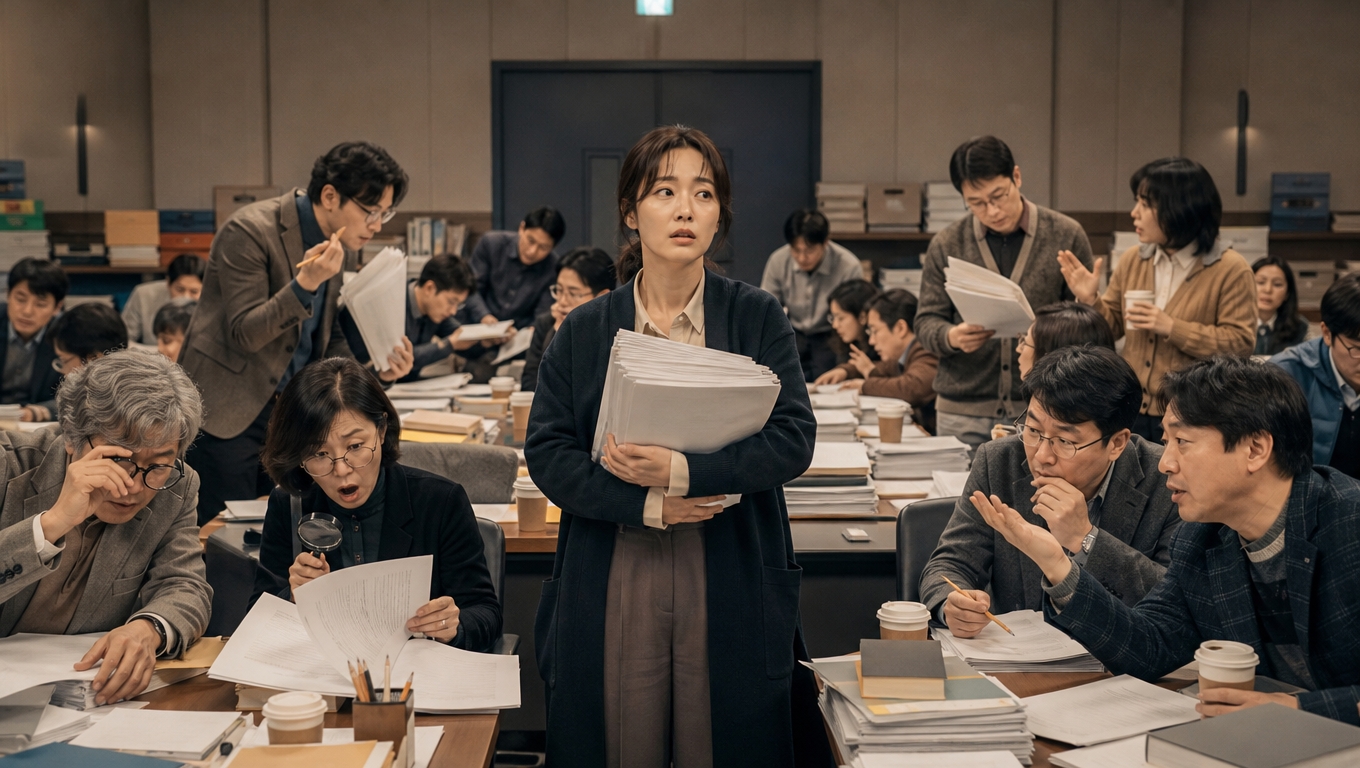
Maeng Bo-ram, a Korean-language teacher from a small provincial town, is sent to the headquarters where the Suneung, Korea’s national college entrance exam, is written. A woman who has spent her career teaching students how to answer questions now has to write them. And once inside, she cannot go home at the end of the day. The comedy “Suneung, Chuljeui Bimil” (roughly, “The Secret of Writing the Suneung”) follows a group of people sealed off from the outside world for 40 days with one job: produce a test with no typos and nothing anyone can dispute. It puts the adults who write the exam at the center, instead of the nervous students who take it.
Lee Sun-bin, who plays Maeng, told Money Today that she first assumed this kind of isolated life was pure fiction. Everyone knows the exam, she suggested, but she had never thought about how the people who write it actually live. Her reaction is a good way into the film. The exam’s name and stakes are familiar, but how it gets made is invisible. The film fills that gap with characters and friction, and tries to show how a strict, serious job can turn into comedy.
The setup is the film’s own invention, not a scene the editorial team observed. Its basic premise, though, has a real basis: question writers really do work inside isolated residential facilities. The more interesting part is what they have to produce in there. Many different people must agree on a single exam, and every question has to treat every test-taker by the same standard. The source of the laughs and the weight of the job sit in the same room.
Turning the students’ exam into a story about the adults
The College Scholastic Ability Test, known in Korea as the Suneung, is the exam used in the university admissions process. For audiences unfamiliar with Korean schooling, even the name needs explaining. It measures whether students have the abilities they need for university study. In the film, it becomes a group project: a set of error-free questions that must be finished by a fixed deadline. Shift the point of view from the person solving the test to the people making it, and a familiar exam produces a different kind of tension.
The mission is not simply to write hard questions. The plot hinges on making questions with “no typos and no disputes.” A typo is a mistake in the text; a dispute is an argument over a question or its answer. The writers need sentences that read precisely and answers that stand on solid ground. That goal gives the characters plenty of reason to clash over small wording choices. A short line on the test paper can become a long debate for the people who write it.
Being cut off from the outside keeps all of that conflict in one place. The characters cannot step away from the job and go back to their normal lives for a while. People who share a goal do not necessarily share a way of working, so the film reads as both an exam story and a workplace story. Even for overseas viewers who never sat the Suneung, a situation where professional responsibility collides with personal relationships is easy to follow.
No. 1 among Korean films on opening weekend, third overall
The film opened on October 28 and drew more viewers than any other Korean film over its first weekend. Etoday, citing the Korean Film Council’s integrated ticketing network, reported 44,800 admissions from October 30 to November 1. That put it third at the overall weekend box office, and cumulative admissions reached 71,768 through November 1. Opening day drew 14,332 viewers. Those are three different counts: the weekend, the running total and a single day.
The overall No. 1 that weekend was “Chiikawa the Movie,” with 221,657 admissions, and second place went to “Heart of the Beast,” with 162,795. The Suneung film’s No. 1 spot is a ranking among Korean films, not the top of the overall chart. The early numbers show how big an audience a homegrown live-action comedy could draw in its first weekend. They do not tell us which scenes people laughed at.
The timing also matters. According to the Korea Institute for Curriculum and Evaluation’s basic plan for the exam, posted by the Ministry of Education, the Suneung for the 2027 academic year will be held on November 19, 2026, about two weeks after this article’s November 4 publication date. The film arrives just before the real test, but it is not about how to solve the questions. It is about how the questions are made, briefly turning attention from the students to the responsibility carried by the people who write the exam.
The real lockdown exists to stop leaks
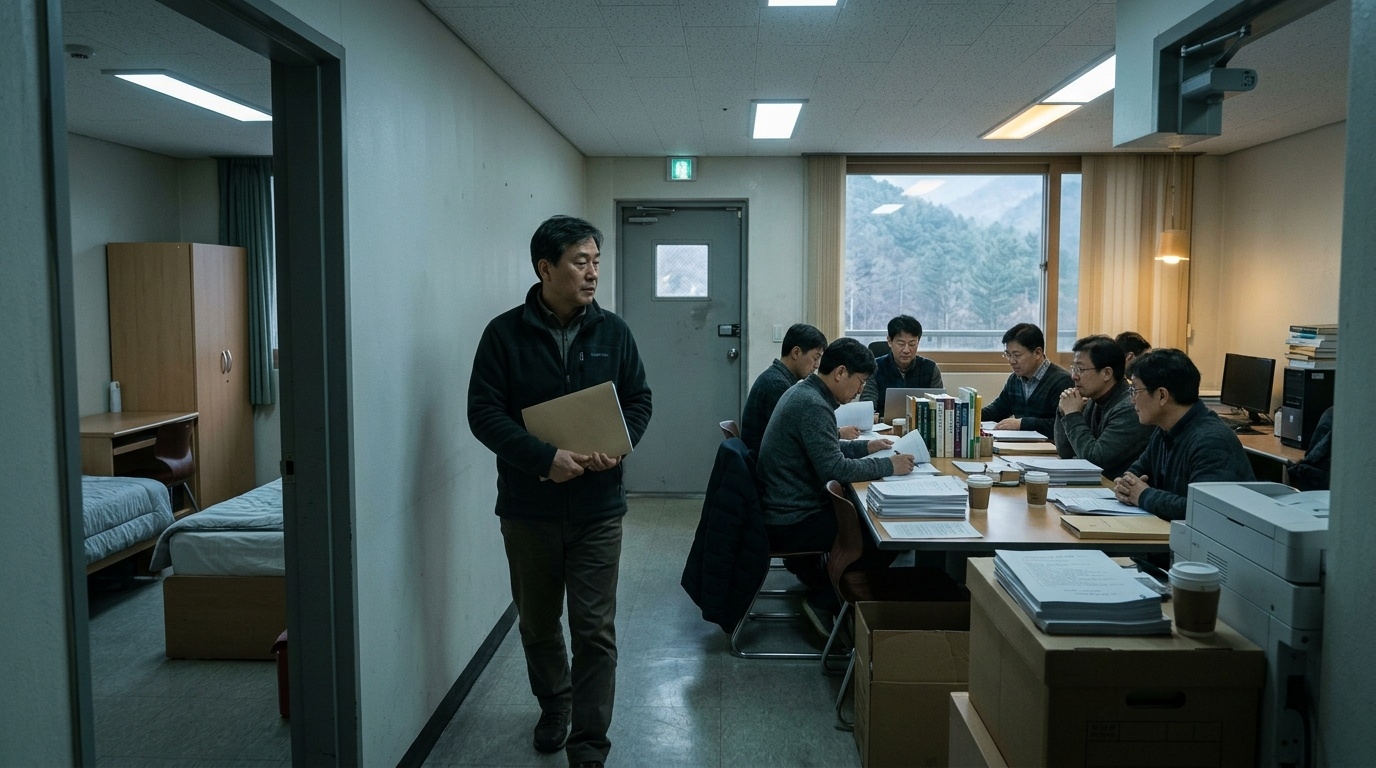
In real life, the isolation exists to keep the questions from leaking. Newsis, reporting on explanations from the Ministry of Education and the Korea Institute for Curriculum and Evaluation, said that question writers and reviewers are restricted from leaving and from using communication devices during the residential period. Wired and wireless devices cannot be brought in, and internet use is limited to looking up information needed for writing and reviewing questions. The exact location of the facility and the details of the process are also kept confidential. It is nothing like a normal job where people contact the outside world freely.
That description comes from reporting on how the 2025 exam was run. The film’s “40 days” cannot be applied to every participant as the actual length of this year’s residency. What the reporting does confirm is the basic structure: question writing and review happen over several weeks in residence, with outside contact and communication controlled the whole time. According to the same report, the actual writing period was 36 days in 2021, 39 in 2022, 38 in 2023, 40 in 2024 and 38 in 2025. The film’s 40 days is within the real range rather than an exaggeration.
The restrictions are not meant to make the writers’ lives difficult. They are there so that no one sees the questions before exam day. Students get the test on the morning of the exam, but the writers know its contents weeks earlier, and that gap is why the flow of information has to be controlled. The isolation that the film uses for comedy works, in the real system, as a way of managing who knows what about the exam.
Inside the security, the questions still have to fit the curriculum
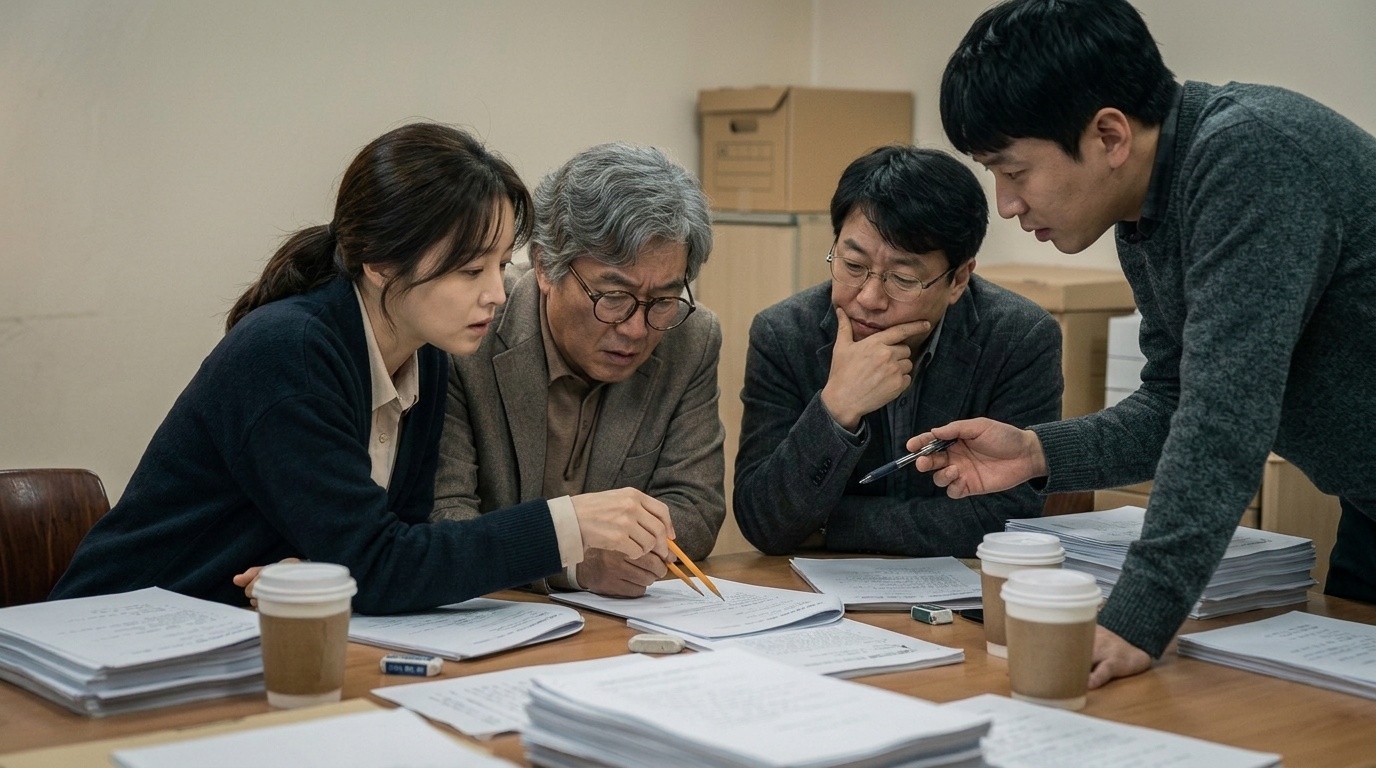
If security draws the outer boundary of the process, the curriculum and assessment standards set the conditions for the questions inside it. The institute’s plan for this year says the exam will consist of questions students can solve if they have faithfully followed school lessons within the public curriculum and supplemented them with the linked study materials and lectures. It also promises an appropriate level of difficulty and stable question-setting. So the job is about deciding what to test, as well as keeping secrets.
That is where the film’s goal of a “problem-free problem” makes sense. The exam needs technical accuracy, with not a single wrong character, and accuracy in assessment, with a clear sense of what each question asks students to show. Put the film next to the real system and the question writer becomes someone who knows the answer and must also be able to explain exactly why it is the answer. That is why writing an exam question is different from listing what you know.
The phrase “a Grade 2 state secret,” used in the film’s promotional material, is presented as a way to convey how strict the headquarters is. For understanding the real exam, the more useful facts are that question writers’ communication and movement are restricted and that writing and reviewing are run as separate steps. The finished test paper, made out of sight, reaches students as an ordinary printed booklet. The film is about the work and the clashes of the people in between.
A cast that also lived on set
Director Lee Yong-jae wrote the screenplay for “In Our Prime” and makes his feature directing debut with this film. According to the Busan International Film Festival’s official listing, it was produced by Joy Rabbit, runs 99 minutes and is rated for viewers 12 and older. Lee Sun-bin, Yoo Jae-myung, Kim Young-min and Jeon Seok-ho star. The subject is an exam, but the format is a comedy about characters bumping into each other in a confined space.
In her Money Today interview, Lee Sun-bin said the cast and crew shot the film while living together for two and a half months at a resort in Muju, North Jeolla Province. She added that having the lodgings close to the set helped her stay focused on the work. That was the production schedule, not the length of any real exam residency. For a film about people who cannot get away from each other, the actors also stayed in one place and built their rhythm together.
The way it was shot helps explain the film’s sense of space. In a limited location, relationships between characters carry on even as scenes change. The laughs are more likely to come from dialogue, reactions and different ways of handling the work than from new settings. For a director’s first feature, one thing to watch is how he sustains the tension of a single space through the actors’ interplay, alongside the novelty of the exam itself.
Back to Maeng Bo-ram
Distributor By4M Studio plans a second week of stage greetings by the cast on November 7. The release just before the exam and the cast’s appearances are the immediate context for the film. The questions it raises go beyond its opening week, though, because it uses comedy to show what the people who actually write and cross-check the questions are responsible for, inside a process built to keep the exam fair.
Maeng Bo-ram, the teacher from the opening scene, is not there to peek at the secrets of a famous exam. She is there to finish it. The moment she enters the sealed-off building, the weight of the job changes. The mission the film sets stays simple to the end: make a test with no typos and no disputes. What makes it complicated is that a whole group of people has to get there together.
For overseas viewers, the film can be an entry point into the strict security culture around the Suneung. The isolation is only part of it, though. The film places the faces of the adults who are responsible for the exam right behind the faces of the students who take it. How convincingly it connects those two points of view, and how it handles the writers’ responsibility through humor, is what remains to be seen.
Sources: Money Today and Etoday, November 2, 2026; Busan International Film Festival official film listing, accessed November 2, 2026; Korea Institute for Curriculum and Evaluation basic plan, posted by the Ministry of Education, March 31, 2026; Newsis, November 13, 2025.