Table of Contents
Three Cosmetics Manufacturers, One Record Quarter
Korea’s three leading cosmetics ODM (original design manufacturing) companies — Kolmar Korea, Cosmax, and Cosmecca Korea — each posted record-setting results for the second quarter of 2026. With Korea’s cosmetics exports topping $7 billion in the first half of the year for the first time ever, the growth reached beyond the consumer-facing brands to the companies that research, develop, and manufacture the products behind the scenes.
Kolmar Korea’s consolidated Q2 revenue reached 861.3 billion won, up 17.8% year over year, while operating profit climbed 50.2% to 110.3 billion won — the first time the company’s quarterly operating profit has topped 100 billion won. The rise in operating profit outpacing revenue growth points to gains in both sales volume and profitability at once.
Cosmax posted revenue of 794.9 billion won and operating profit of 73.7 billion won, up 27% and 21% respectively — both figures a quarterly record for the company, with an operating margin of 9.3%. Its cumulative first-half revenue reached 1.4769 trillion won. Cosmax’s U.S. subsidiary also turned a profit for the first time since it was founded, pointing to improving profitability in its overseas business.
Cosmecca Korea reported revenue of 226.1 billion won and operating profit of 32.1 billion won, up 39.8% and 39.3% year over year. With all three companies growing revenue and operating profit together, rising demand for Korean cosmetics is translating into improved profitability, not just higher production volume.
The Manufacturers Behind the Brand Names
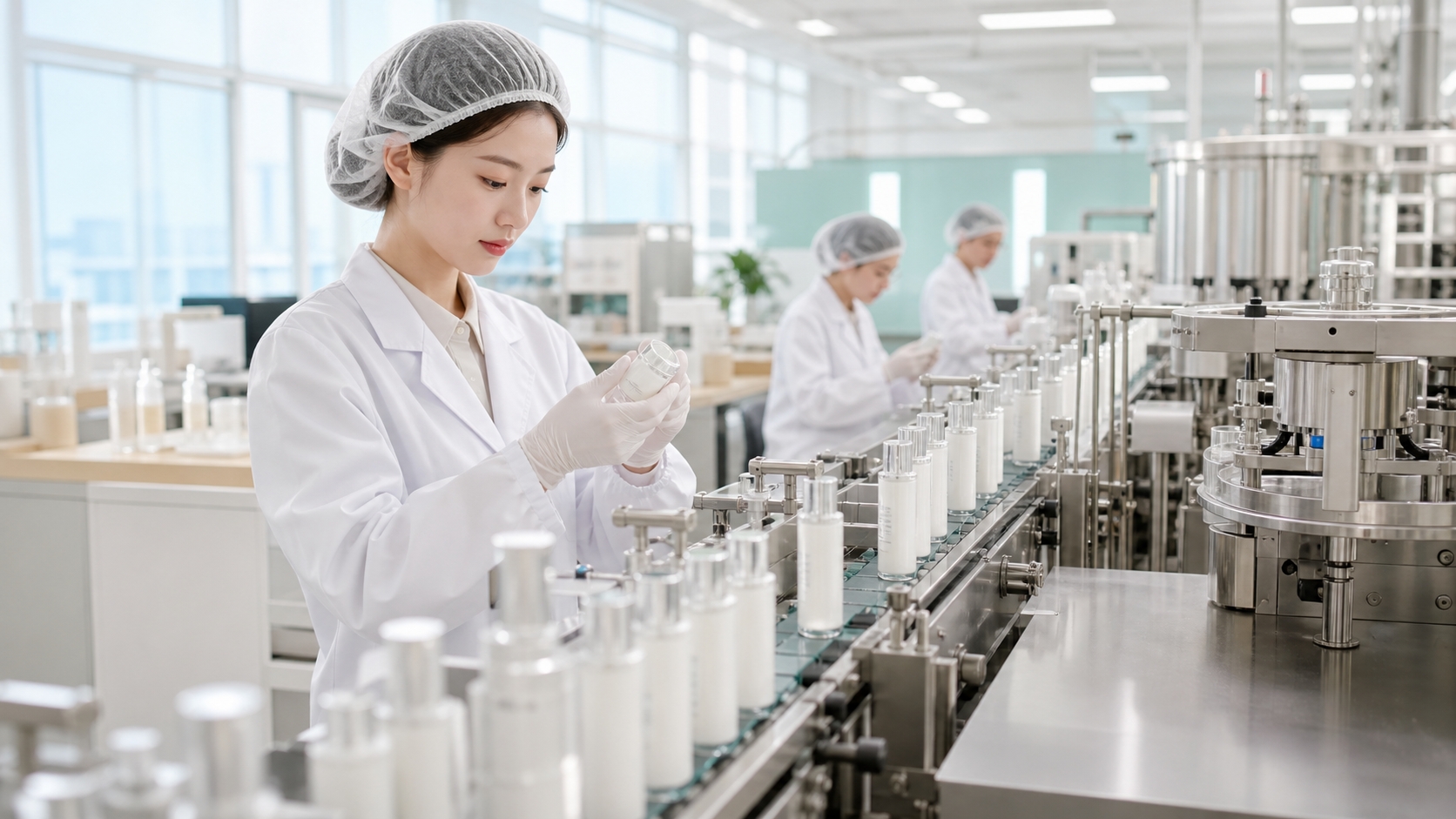
ODM, or original design manufacturing, is a model in which a manufacturer researches a product’s formula, ingredients, and production process on a brand’s behalf and delivers the finished product. It’s widely known by the acronym ODM. Compared with OEM (original equipment manufacturing), where the manufacturer mainly handles production to a brand’s specifications, ODM gives the manufacturer a much larger role at the research and development stage.
This structure matters especially for indie brands that lack their own factories or large research teams. While a young brand focuses on product planning, marketing, and overseas sales, the manufacturer handles formula development, quality control, and mass production. Because a single manufacturer typically serves multiple brand clients, rising success at any one brand can translate into more orders for the manufacturer.

What Two Government Datasets Show About the Growth
According to Korea’s Ministry of Food and Drug Safety, the country’s total cosmetics exports reached $7 billion in the first half of 2026, up 27.3% year over year — the largest first-half figure on record. Second-quarter exports came to $3.9 billion, up 25.8% from the first quarter’s $3.1 billion. The U.S. share of total exports also crossed 20% for the first time, reaching 20.7%.
Separately, the Ministry of SMEs and Startups reported that cosmetics exports from small and medium-sized enterprises reached $5.069 billion in the first half, up 30.7% year over year. The overall export figures come from the Ministry of Food and Drug Safety, while the SME-specific data comes from the Ministry of SMEs and Startups — two different datasets that, taken together, show small and medium-sized companies, including indie brands, playing a significant role in export growth.
What Comes Next: Capacity and Global Readiness
As exports rise, brands selling overseas place more orders with their manufacturers. This has raised the importance of manufacturers that can quickly develop and produce a wide range of products as more indie brands expand into markets like the U.S. and Europe. Cosmecca Korea pointed to growth in dermatology-focused skincare exports and an expanding roster of client brands as drivers of its performance.
All three companies are expanding their production and international operations to keep pace with rising orders. These results show that K-beauty’s global popularity isn’t limited to a handful of well-known brands. Going forward, how quickly manufacturers can scale capacity and quality to match export growth — while adapting to cosmetics regulations that vary by country — will likely determine whether this momentum holds.
Source: Ministry of Food and Drug Safety press release, July 2, 2026; Ministry of SMEs and Startups export statistics, July 23, 2026; company disclosures, August 10-12, 2026.