
Table of Contents
Experiencing Korean Food Beyond the Restaurant
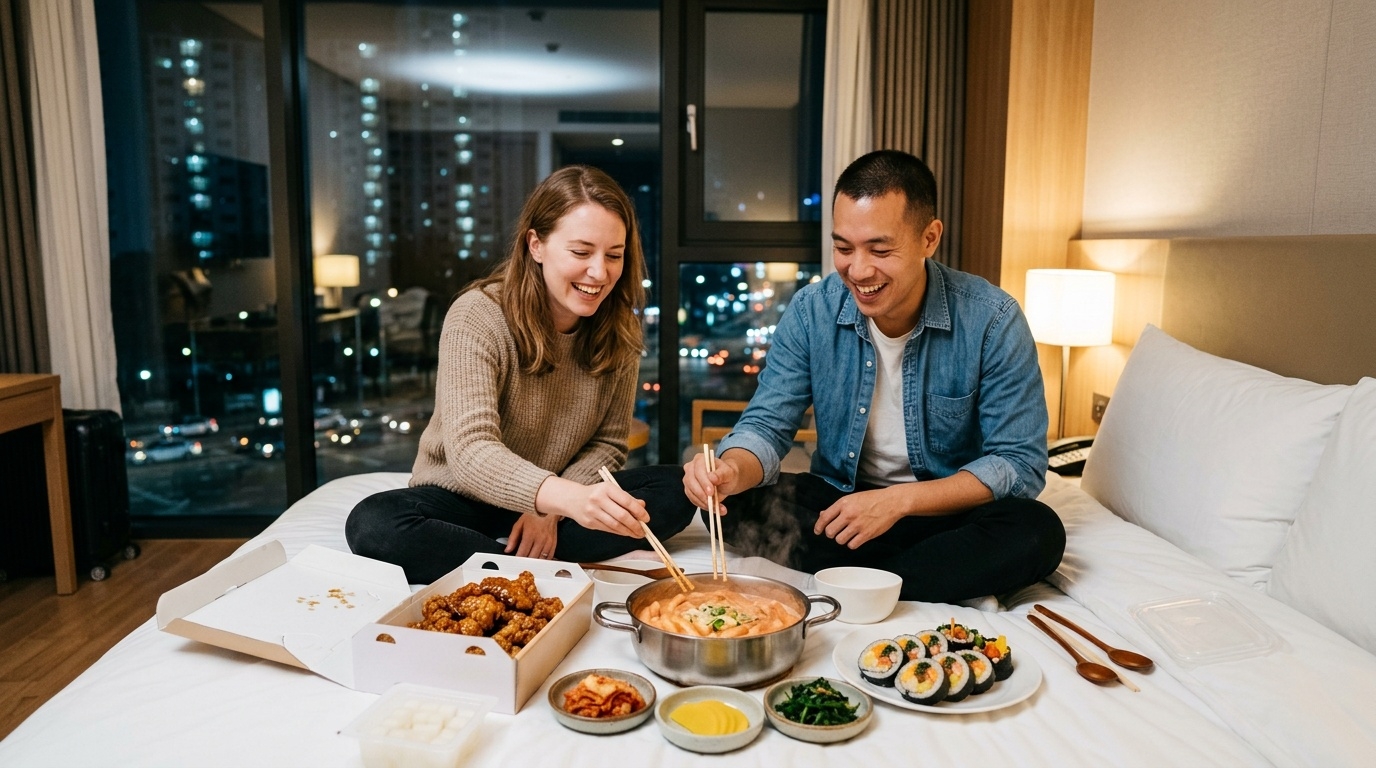
A foreign tourist returns to their accommodation after a day of sightseeing in Korea and opens a delivery app to order food they first saw in a Korean drama or on social media. Dishes like fried chicken or rose tteokbokki, made familiar through content, arrive not at a restaurant table but at a hotel or short-term stay. What is a routine way of ordering food for Koreans becomes, for foreign tourists, a piece of Korean culture experienced firsthand during their trip.
This so-called “K-delivery” trend is a different experience from simply eating Korean food. Instead of traveling to a restaurant, tourists choose a menu from wherever they are staying and wait for delivery. It is not just the food itself but the entire Korean way of consumption, ordering through an app and receiving it at a chosen location, that becomes part of the experience.
Rather than competing with existing K-food tourism, this approach widens the scope of the food experience itself. A restaurant visit lets travelers experience a specific space and atmosphere, while delivery lets them access Korean food even after the day’s itinerary has ended. As a tourist’s lodging becomes another dining space, the time and place for encountering Korean food expands beyond the restaurant. Being able to choose where to eat based on the day’s schedule is another feature delivery adds to the traditional dining experience.
Baemin’s Foreign Payments Rose 3.7x in Q1
The rise in delivery use among foreign visitors also shows up in the numbers. According to Woowa Brothers, which operates the Baedal Minjok (Baemin) delivery app, foreign-card payments in the first quarter of 2026 rose about 3.7 times compared with the same period a year earlier. That is a pace of growth difficult to explain by a simple rise in tourist numbers alone, pointing to a rapid expansion in spending by foreign users through the delivery app.
Over the most recent month tracked, in April 2026, the scale of foreign payments rose roughly 14-fold from the same month a year earlier, an even sharper jump than the 3.7x increase for the quarter overall. Together, the two figures suggest that delivery use among foreign visitors is not a handful of isolated cases but a rapidly accelerating trend. Whether the pace of growth continues at the same rate, however, remains to be seen.
Behind the rise in delivery spending is demand from foreign tourists eager to actually taste food they first encountered through Korean content. Dramas and social media introduce the names and images of dishes first, and delivery apps then turn that curiosity into an actual order. It is a structure in which curiosity sparked by content turns into consumption during a trip.
4.76 Million Visitors and New Food Demand
Foreign arrivals to Korea in the first quarter of 2026 reached about 4.76 million, a record high for a first quarter. As the overall number of visitors grows, so does the potential demand from foreigners who are staying, eating and moving around the country. Delivery has quickly emerged as one of the ways these visitors consume Korean food.
Visitor numbers and delivery payment figures are separate statistics, and the two cannot be directly treated as cause and effect. Still, it is notable that foreign delivery payments rose sharply during the same period that visitor numbers climbed. From a tourism-industry perspective, it is becoming just as important to look at what services visitors use and where they spend money during their stay as it is to track the number of arrivals.
Foreign visitors’ experience of Korean food has traditionally been explained mainly through well-known restaurants, traditional markets, or commercial districts near tourist sites. The growth of K-delivery shows that tourists no longer need to travel to a specific restaurant to experience Korean food. Lodging and delivery services have become a new point of contact for food-focused tourism.
Beyond Myeongdong and Hongdae, Into Everyday Neighborhoods
Delivery use among foreign visitors is clearly visible in areas like Myeongdong and Hongdae, both well-known tourist destinations where lodging, shopping and dining converge. Delivery demand in these areas is tied to the pattern of tourists continuing to seek out Korean food from their accommodations after finishing their outside itinerary.
More recently, orders have also been spreading to Yeonhui-dong, Jayang-dong and Yeoksam-dong. Yeonhui-dong has a notable foreign resident population, Jayang-dong is linked to international students, and Yeoksam-dong is tied to medical tourism and business travel. This shows delivery use appearing not just in traditional tourist areas but also in neighborhoods where foreigners actually live or stay for extended periods.
This spread across different neighborhoods also shows that foreign visitors cannot be treated as a single, uniform consumer group. Short-term tourists, foreign residents living in Korea, international students, and people visiting for medical treatment or business each have different patterns of stay. But the basic appeal of being able to order food from outside a restaurant applies to all of these groups, regardless of why they are in Korea.
From K-Content to Actual Orders
The growth of K-delivery also illustrates the relationship between Korean food and Korean content. Foreign tourists encounter Korean food through dramas and social media even before arriving in the country. Dishes that appear in content are remembered through images and scenes of people eating them, even if viewers do not know their names, and become something travelers want to taste for themselves once they arrive.
Delivery apps bridge the gap between what viewers see on screen and what they can actually consume. Tourists are no longer limited to seeking out a dish at a specific restaurant; they can order it to their accommodation instead. As content builds interest in food and delivery services widen the choice of when and where to eat, a new channel for experiencing K-food is taking shape.
The popularity of dishes such as fried chicken and rose tteokbokki should be understood in this context. What matters is not just the popularity of specific menu items, but the broader trend of tourists bringing food they first saw in content to wherever they happen to be staying. Delivery, an everyday part of Korean consumer culture, is becoming part of the tourism experience alongside the food itself.
K-Delivery Meets the Han River ‘Bamping’ Festival
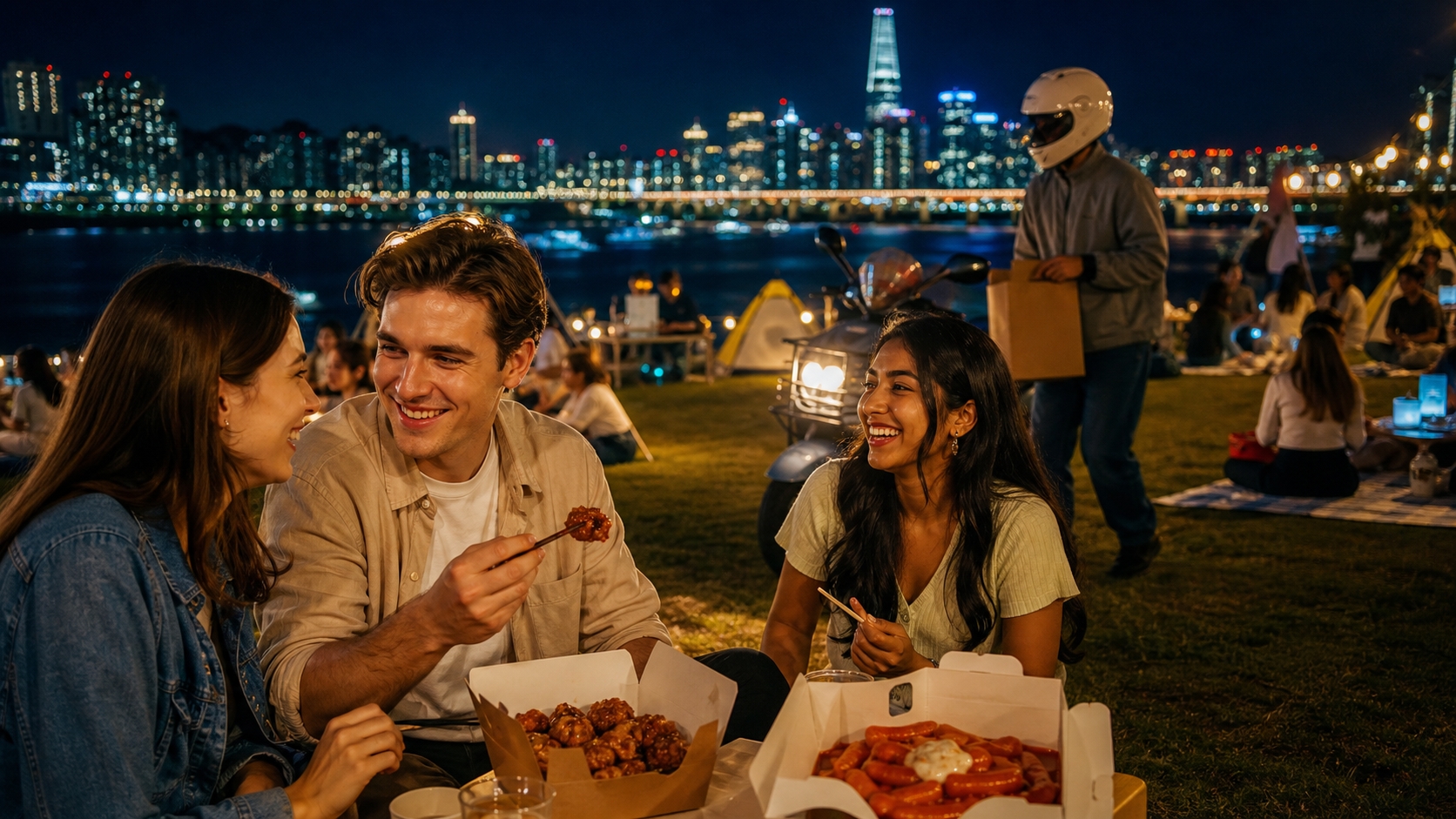
The Seoul Metropolitan Government has signed a partnership with Woowa Brothers to run a K-delivery experience campaign throughout August 2026, tied to the “Han River Bamping” festival. The initiative connects a delivery culture that foreign tourists are already using in Korea with the city’s nighttime tourism program along the Han River, presenting it as a unified experience.
Ordering delivery food at a Han River park offers a different experience from ordering at a hotel. While delivery to accommodations typically resolves a meal after the day’s itinerary is done, ordering by the river combines nighttime sightseeing and food consumption in the same location, giving it a more clearly tourism-oriented character.
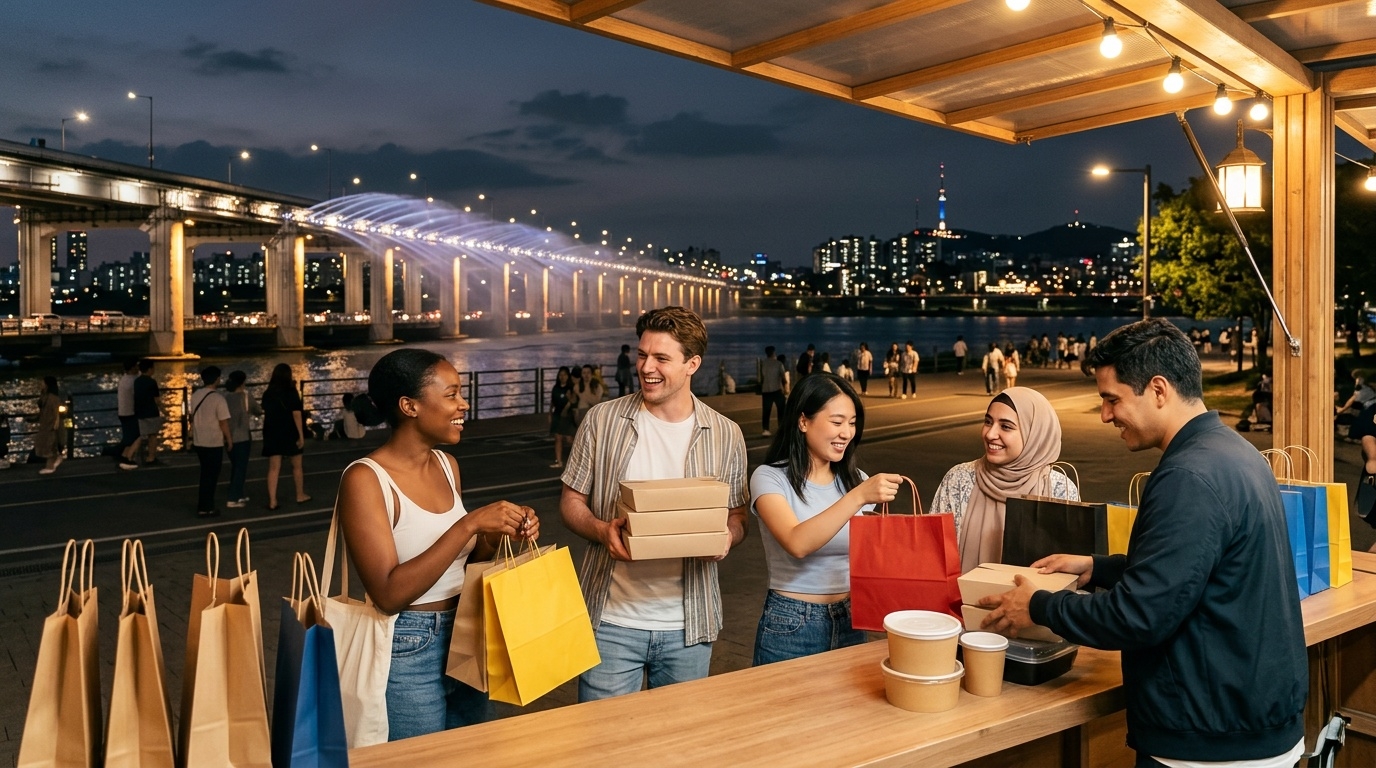
During the festival period, the city is operating night-time delivery pick-up zones and providing foreign-language guidance for tourists. Given the size of the Han River parks, knowing exactly where to meet a delivery rider is essential to a successful pickup. The pick-up zones and accompanying guidance form the basic infrastructure that lets foreign tourists use K-delivery on site.
What It Takes for a Daily Convenience to Become a Tourism Channel
The partnership between the city and Woowa Brothers is an attempt to move the rise in foreign delivery use beyond a private platform’s payment figures and turn it into an actual tourism experience. By connecting orders that once happened informally from hotel rooms with the Han River’s nighttime festival, K-delivery can expand from a personal way of eating into a cultural experience actively introduced to tourists.
There is also potential for new connections with local businesses. If foreign tourists order not only from well-known restaurants near major attractions but also from establishments in the neighborhoods where they are staying or near the Han River parks they visit, that spending could extend to restaurants outside the usual tourist areas. The spread of usage to Yeonhui-dong, Jayang-dong and Yeoksam-dong suggests this shift is no longer confined to a handful of tourist hotspots.
At the same time, rapid growth in payment volume alone is not enough to conclude that K-delivery has become a stable tourism channel. How easily foreign visitors can understand the ordering and pickup process, whether experiences like Han River Bamping continue once the festival ends, and whether increased orders spread to businesses across different neighborhoods, are all things that still need to be watched.
Ordering food discovered through Korean content back at a hotel, and picking up delivery at a night-time zone by the Han River, show K-delivery becoming a new scene in the Korean travel experience. What matters going forward is less the 3.7x and roughly 14-fold growth figures themselves, and more whether this usage settles into a repeatable part of the travel experience, one that can expand both convenience for foreign visitors and business opportunities for neighborhood restaurants.
Source: Asia Business Daily, May 13, 2026, and other reports.