Table of Contents
A Company That Can’t Be Explained by One Sunscreen’s Success
If you’ve shopped K-beauty from abroad, you’ve probably run into Beauty of Joseon’s rice-and-hanbang image. Its sunscreen in particular built strong recognition through North American online retail, known for translating traditional ingredient imagery into modern textures and simple packaging. But it’s getting harder to describe Goodai Global, the company behind Beauty of Joseon, as a single-brand company. Starting from Beauty of Joseon, it has acquired multiple K-beauty brands and grown into a multi-brand platform now pursuing an IPO.
According to reporting from EToday and investment banking industry sources, Goodai Global has begun IPO procedures, selecting Mirae Asset Securities, NH Investment & Securities, Citi, and Morgan Stanley as lead underwriters. The target valuation being discussed in the market is up to 10 trillion won. That figure, though, isn’t a confirmed offering price or an already-recognized market value — it’s a target level the company and the market still need to test through the listing process. You don’t need to treat “10 trillion won” as a quality guarantee when you’re picking out a product. This is consumer news, but it’s investment and corporate strategy news at the same time.
Goodai Global Calls It Korea’s Answer to L’Oréal
Goodai Global’s strategy doesn’t stop at growing sales while one product is trending. Alongside Beauty of Joseon, it has folded Tirtir, Skinfood, and Seorin Company — which runs Round Lab — into its portfolio, broadening its reach across different skin concerns, price points, and country-by-country distribution channels. Tirtir is known for base makeup with an unusually wide range of shade options, Round Lab for skincare built around its birch-water line, and Skinfood for long-standing brand recognition and a food-ingredient sensibility — each drawing a different type of customer.
If this structure works, one brand’s slowdown can be covered by another brand’s momentum. It’s a similar approach to how L’Oréal, the global cosmetics company, runs skincare, makeup, and haircare across separate brands at separate price points. But sharing a similar playbook doesn’t make two companies the same. Each brand still needs its own product development strength, local distribution, inventory management, ad spending efficiency, and customer loyalty. Buying up several brands may be the easier part — running them so they don’t lose their appeal after the acquisition can be the harder job.
Over 90% of Revenue From Overseas — Why It Wants Its Own Distribution
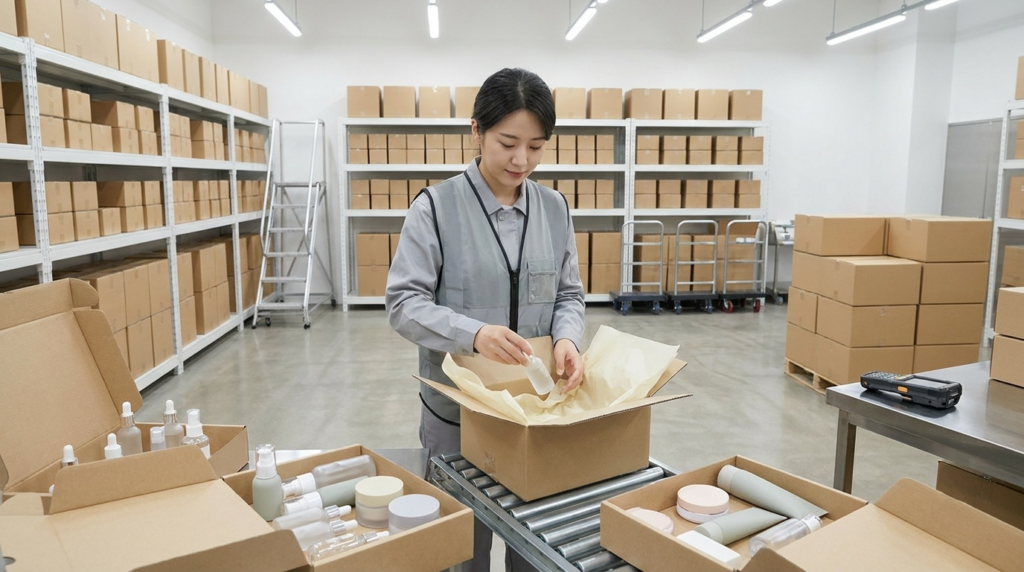
Goodai Global reportedly draws more than 90% of its total revenue from overseas — an unusually high overseas share even among K-beauty companies. Simply making products in Korea and listing them on overseas platforms has its limits for growth, so how directly the company manages local distribution, inventory, and promotion has become important. That’s the backdrop for the company’s acquisition of Hansung USA, a North American distributor. It can be read as a move to manage its relationships with major retail channels like Ulta Beauty and Costco more closely.
For you as a consumer, this strategy could affect the buying experience. If local inventory stabilizes, shipping times shorten, and there’s a better chance that authentic distribution channels and customer service become clearer. On the other hand, a strategy centered on large distribution networks doesn’t necessarily work the same way in every country. Whether textures, shades, and price points popular in the U.S. will also work in Europe, Southeast Asia, or Latin America is a separate question. Overseas expansion should be judged less by how many countries appear on a map and more by whether repeat purchases are actually happening in each market.
A ₩10 Trillion Valuation Comes With Both Growth Hopes and Acquisition Risk
Goodai Global’s 2024 consolidated audit report reportedly showed net income of about 108.6 billion won. EToday also reported market expectations that if the acquired brands’ performance is fully reflected, 2025 revenue could reach roughly 1.7 trillion won. That expectation is part of what’s driving discussion of a valuation of up to 10 trillion won. Still, projected revenue, actual performance, and a listing-stage valuation are three different numbers. Valuation can shift considerably depending on growth rate, how sustainable the profits are, comparisons with competitors, market sentiment, and the timing of the offering.
A company with this many mergers and acquisitions is also worth watching for goodwill. Goodwill is an asset recorded on the books that reflects a brand’s perceived value and expected future earnings at the time of acquisition. Goodai Global reportedly booked around 147.1 billion won in goodwill tied to its acquisitions as of the end of 2024. If an acquired brand doesn’t grow as much as expected, that can lead to a goodwill impairment loss — an accounting loss recorded when the book value turns out to be higher than what the asset can actually recover. It’s an unfamiliar term for most consumers, but it’s an important line item when judging the profitability and reliability of a company heading toward an IPO.

What You Should Watch Isn’t the ₩10 Trillion Number, But Whether the Brands Keep Getting Better
If you’re a Beauty of Joseon fan, it makes more sense to watch whether the substance of the products changes rather than focus on the IPO itself. The formula and sunscreen labeling of its popular products, new ingredient disclosures, price increases, inventory stability, and customer service at official retailers are more direct signals to track. Check whether sibling brands like Tirtir, Round Lab, and Skinfood keep their own distinct identity, too. Even if multiple brands share the same distribution network, data, and production efficiency, the multi-brand strategy loses its edge if the differences consumers actually feel start disappearing.
The IPO plan is a test of whether Goodai Global can turn K-beauty’s fast-moving popularity into a longer-lasting corporate structure. If it succeeds, overseas consumers could see more stable distribution and a wider range of product choices. If brand integration weakens each brand’s individual strengths instead, or if excessive growth expectations put pressure on pricing and marketing, the consumer experience could suffer too. For now, it’s best to treat the “up to 10 trillion won” figure not as a settled outcome, but as a lens for watching what kind of company K-beauty can become in the global market after Beauty of Joseon’s single breakout hit.
Source: Sim Young-ju, EToday, February 19, 2026; reporting citing Goodai Global and related audit disclosures.