
Table of Contents
What a cruise passenger gets in 6.7 hours in Busan
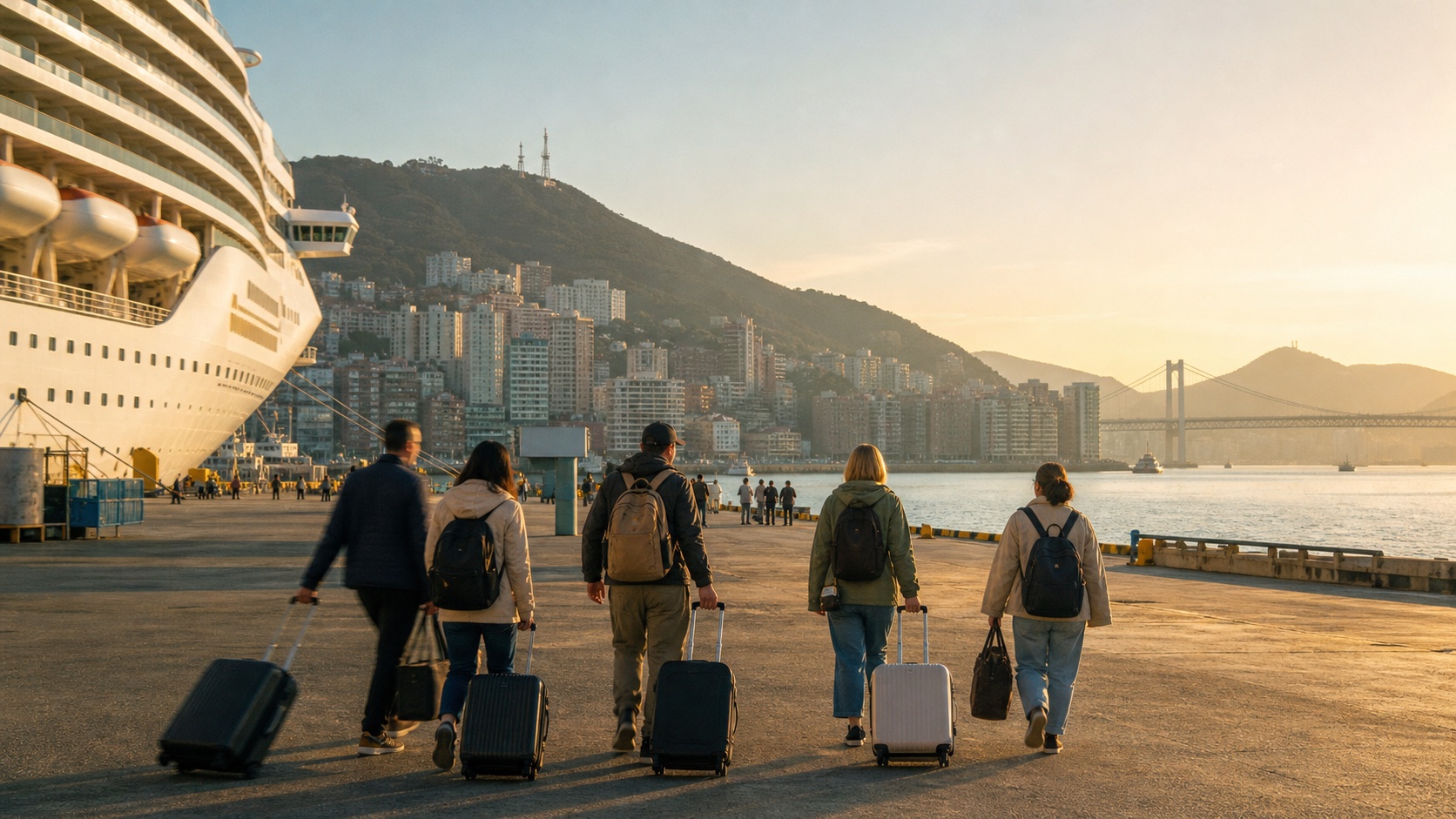
Cruise passengers whose ships call at Busan spend an average of 6.7 hours in port. The figure, from data the Korea Tourism Organization submitted to the National Assembly, shows cruise tourism from a different angle. More passengers can arrive at a port while each one spends only a short time in the area. For travelers, those hours are their time to meet a city. For the region, they are a chance to turn a visit into hotel nights, meals and a longer trip.
According to the same data, cruise passenger numbers grew 4.5 times in three years to 905,000. Spending per passenger, however, fell 81 percent from ten years ago. The two figures cover different comparison periods, but together they make it hard to judge cruise tourism by arrivals alone. The organization does not directly survey the disembarkation rate, the share of passengers who actually leave the ship, so there is also a blank spot in knowing how many arriving passengers go on to visit the area.
The 6.7-hour stay is a small version of the question facing Korean tourism as a whole this year. More people are coming, and a new annual record is within reach, yet the figures on how long visitors stay after they arrive point the other way. What else needs examining to turn rising arrivals into local stays and spending? Counting records and looking at what a trip actually contains have become the same job.
17.11 million through September, with an October record still a forecast
According to the Ministry of Culture, Sports and Tourism’s “September 2026 inbound tourism trends,” released on October 22, 2.06 million foreign visitors came to Korea in September, up 21.1 percent from a year earlier. It was the fifth month this year above 2 million, after March, April, July and August. The growth is not confined to one strong month, and the forecast of a new annual record rests on this monthly run.
Visitors from January through September totaled 17.11 million, up 21.5 percent from 14.08 million in the same period last year. That leaves 1.83 million to go before last year’s annual record of 18.94 million. With this year’s monthly average at about 1.9 million, the record is likely to fall sometime in October. The forecast is based on official counts through September and the monthly average, and no new record had been officially confirmed.
By market, China sent 5.47 million visitors, up 29.2 percent and about a third of the total. Japan followed with 3.12 million (up 16.9 percent) and Taiwan with 1.86 million (up 32.4 percent). The Americas accounted for 1.62 million (up 12 percent), Europe 1.19 million (up 20 percent) and Hong Kong 550,000 (up 18.6 percent). Taiwan grew fastest among the major markets. Growth across several markets at once is what is lifting the cumulative total.
Card spending is up overall while stays are getting shorter
Total tourism spending also grew. From January to September, foreigners spent 15.94 trillion won on tourism-related credit card purchases, including online payments, up 47.7 percent from 10.79 trillion won a year earlier. More card spending flowed into tourism as visitor numbers rose. The figure shows the overall spending trend in this year’s market, but it measures something different from what individual travelers spend on lodging and food.
A different picture emerged at the Korea Tourism Organization’s parliamentary audit on October 14, when Jeong Yeon-uk, a lawmaker from the People Power Party, presented figures the organization had submitted. Foreign arrivals rose 71.7 percent, from 11.03 million in 2023 to 18.94 million in 2025. Over the same period, the average stay fell from 7.8 days to 6.5 days. As far more people came to Korea, the average time spent on each visit went down.
Over the same period, average lodging spending per person fell 17.8 percent and restaurant spending fell 16.9 percent. The revisit rate has stayed in the 54 to 56 percent range for four years. This year’s growth in total card spending and these figures cover different periods and different units. The first is all tourism-related card spending, online included. The second compares specific spending per person between 2023 and 2025. That is why length of stay and spending on lodging and dining need to be read on their own, even as the market as a whole grows.
What a shorter trip leaves behind in a region
When the average stay shrinks, so does the time travelers have in Korea. Lodging and meals are the main ways that time turns into spending. With shorter stays, the value of a trip depends less on the arrival itself and more on what visitors can do within a tight schedule. Even with the same number of visitors, a trip with overnight stays and a brief visit can look very different, both in the itinerary and in the spending a region keeps.
For readers abroad, the length of stay also shapes how much choice a trip offers. On a short schedule, travelers have to divide their time between getting to know one place and moving on to the next. Arrival statistics alone cannot describe what a trip gives a visitor. The drop in average stays alongside lower lodging and restaurant spending suggests that what happens after visitors land should count when policy results are judged.
The revisit rate raises yet another question. Beyond how many first-timers come, it shows whether people who have already been choose Korea again. “More people are visiting, but the days they stay and the money they spend while here are shrinking,” Jeong said. To turn rising visits into longer stays and repeat trips, he argued, the experience after arrival has to be part of how performance is measured.
Wider gateways into the regions
More visitors now enter Korea directly through regional gateways. From January to September, arrivals through airports outside the Seoul area, such as Gimhae, Jeju, Cheongju and Daegu, rose 37.4 percent to 3.24 million. Arrivals through regional seaports such as Busan, Jeju, Seogwipo, Yeosu and Gunsan rose 14.5 percent to 1.58 million. Together that comes to 4.82 million people, or 28.2 percent of all visitors. More travelers are starting their trip in the regions without passing through a Seoul-area airport.
Arrivals through Seoul-area airports rose 17.3 percent to 11.79 million. Faster growth at regional airports means regional tourism has more points of contact with visitors. The next question is how the place where visitors land relates to where they actually stay. Airports and ports are only starting points, and regional tourism’s results include the stays and spending that follow. Turning wider entry routes into longer stays is what matters now.
Medical tourism is heavily concentrated. Medical tourists spend 3.8 times as much per person as general tourists, but 87.2 percent of them went to Seoul last year. The 12 provinces and cities other than Seoul, Busan, Gyeonggi, Jeju and Incheon had a combined share of 2.7 percent. Even in a high-spending segment, visits are not spread widely. Put regional arrivals next to where medical tourists go, and it becomes clear that the routes into the regions and the places where tourism happens are two separate problems.
From entry to stay, tourism is spread across several ministries
The culture ministry credited this year’s results to better awareness of Korea as a destination and better travel conditions. “Efforts on many fronts, including raising awareness of travel to Korea, improving the travel environment and expanding content, are bearing fruit,” said Kang Jeong-won, head of the ministry’s tourism policy office. Cumulative arrivals and tourism card spending both rose. Linking those gains to longer stays and local spending is the task that remains after the growth in visits.
Jeong also pointed to how tourism work is divided. “Cruise visas are handled by the Justice Ministry, terminals by the Oceans Ministry and foreign patients by the Health Ministry, so tourism work is scattered,” he said. For travelers, entry, transport, sightseeing and medical care form one itinerary, but in government each falls to a different office. Looking at the whole visitor experience means checking the links between those offices as well as the results of each.
He proposed: “30 million is not a goal but a means. The organization should put length of stay and the revisit rate into its performance indicators and start discussing a tourism agency.” His point is to pair the target of more arrivals with indicators that judge what a trip is like. The tourism agency is Jeong’s own proposal, and it raises the question of which part of government should run a stay-focused evaluation. The aim is to make what happens behind the visitor numbers a subject of policy.
Back to those 6.7 hours in Busan
The 6.7-hour average for cruise passengers in Busan shows that very different trips sit inside the same arrival figures. Passenger counts alone cannot show how far a visit leads to local meals and spending, or whether there is room to stretch it into a longer stay with a night in a hotel. Without a direct survey of how many passengers go ashore, the first step is to learn in more detail what actually happens after a ship docks.
Here the record forecast and the stay figures become one story. More people visiting Korea means a bigger tourism market. Whether that growth gives travelers a full experience, and gives regions steady visits and spending, is a separate result. Splitting the data into total and per-person spending, arrivals and stays, and the capital area and the regions makes the content of the record clearer.
The expectation that the annual visitor record will fall in October is still a forecast based on figures through September. Once the record is officially confirmed, the thing to watch is how far the extra visits turn into longer stays and return trips. Starting from Busan’s 6.7 hours, the question about tourism’s results gets sharper. Beyond how many people arrived, it asks how they spend their time once they are here and whether they come back.
Sources: The Korea Economic Daily, Oct. 22, 2026; Electronic Times, Oct. 14, 2026; The Public, Oct. 14, 2026.


