
Table of Contents
How long a 9,900-won secondhand item lasts
During Musinsa’s “Mujinjang 26 Summer Black Friday” sale in June, a first-come, first-served promotion offered secondhand fashion items for 9,900 won each. The first item sold 11 seconds after the sale opened, and the whole batch was gone in about a minute. The items came from Musinsa Used, and the scene showed that secondhand clothing can hold its own against everything else on offer during a big platform sale.
These clothes did not reach buyers the usual peer-to-peer way, where a shopper finds a seller’s listing and messages them directly. They sat inside a major fashion platform, next to new products. Used clothing was moving out of a separate person-to-person market and into ordinary online shopping. A low price and the fact that a company had handled the items gave shoppers a new place to buy them.
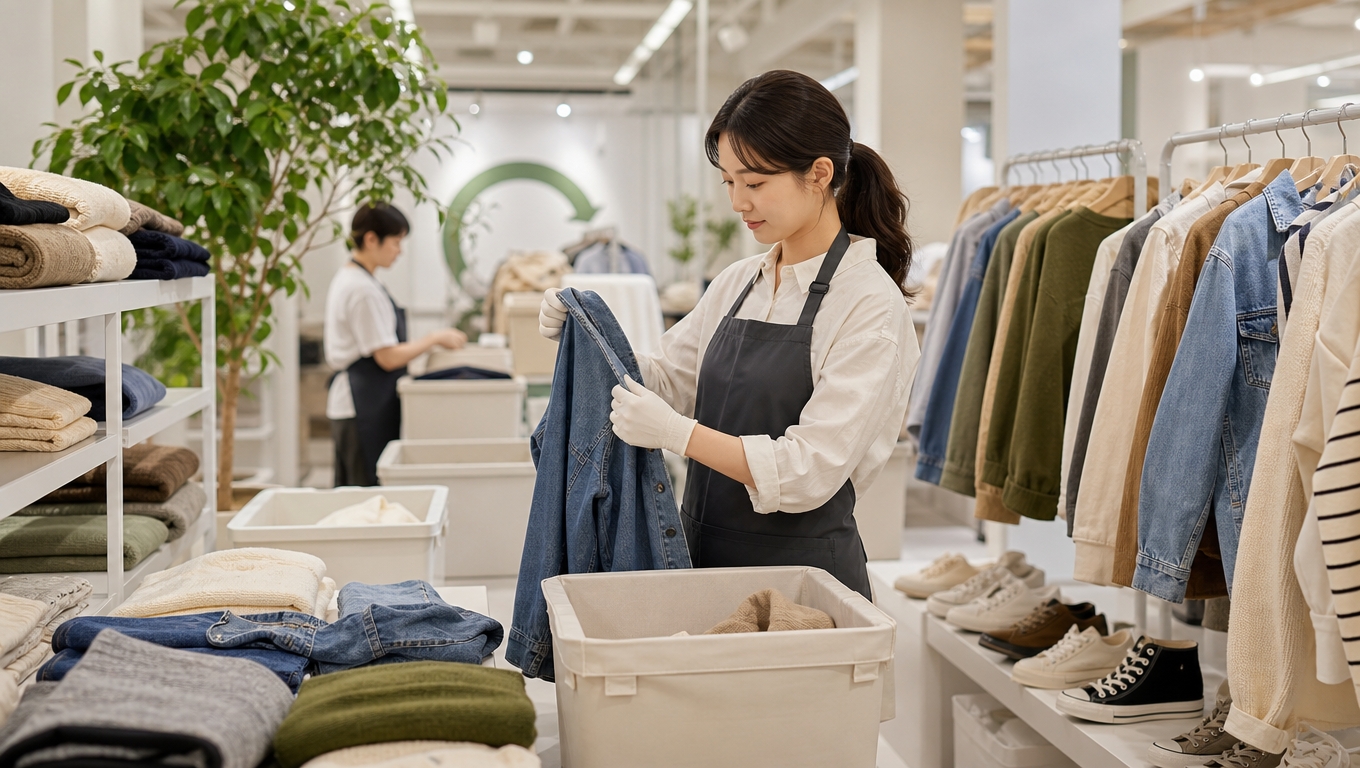
Korean fashion companies are now building this into what the industry calls recommerce. The company collects the used item, inspects it and resells it. Musinsa, LF and Kolon FnC are all expanding services of this kind. What they offer is not only cheap clothing. Buyers get some assurance about condition, and sellers get an easier way to clear out a closet.
From scarce sneakers to everyday clothes
Musinsa will shut down SoldOut, its platform for limited-edition resale, on December 31, 2026, and move its fashion recommerce functions into Musinsa Used. SoldOut was built around person-to-person trading of scarce goods such as limited-run sneakers. With that kind of trading shrinking, Musinsa says it will focus on recommerce, which it presents as a contribution to a more circular fashion system.
Resale and recommerce both deal in secondhand goods, but the center of the business is different. Limited-edition resale runs on demand for items that are hard to get. Musinsa Used covers the clothes people actually wear, sold by one customer and bought by another. The service is less about hunting for rare pieces and more about the routine of clearing out a wardrobe.
Musinsa Used launched in late August 2025. Its transaction volume in June 2026 was about 10 times its level in September 2025, right after launch. Over the same period, the number of sellers grew about 30 times and the number of listed items about 6.7 times, so the growth came from more people and more stock, not only more spending. In March 2026, Musinsa opened a Used corner inside its outlet store at Lotte Mall Eunpyeong, taking the service offline.

Buying trust along with the clothes
Two used items with the same name can be in very different condition. Shoppers cannot buy on product name and size alone, and wear that does not show in photos can change whether a purchase makes sense. In a person-to-person sale, the buyer has to read the seller’s description and ask about anything missing. Company-run recommerce moves that work to professional inspection and standard listing information, so trust in the company replaces sizing up a stranger.
In a March 2025 survey by resale solutions company Madeleine Memory, 51.8 percent of users of Kolon FnC’s OLO Relay Market said they used it because Kolon runs it and they could trust it. Another 25.1 percent said they expected the quality to be good. Who runs the service and what condition shoppers expect both mattered. The company name works as a baseline promise about the state of the clothes, not just a place to collect them.
Asked what satisfied them most, 43.7 percent of buyers said the item was clean despite being used. Lower prices than retail came second at 29.4 percent, followed by an easy buying process at 14.2 percent and the chance to buy items that had sold out at 12.7 percent. Condition mattered more to these buyers than the discount. The inspection and stock management companies pay for is what turns someone’s old clothes into a product another person will buy.
When the payout comes back as store credit
For sellers, the main change is how much less work a sale takes. On a peer-to-peer app, the seller takes the photos, describes the condition, answers questions, negotiates the price and packs the box. Company-run services take over most of that. In the same OLO Relay Market survey, sellers named an easy selling process (57.5 percent) and points credited as soon as inspection was done (38.6 percent) as what satisfied them most.
LF launched Elli Market in September 2025. A seller requests a sale, LF picks up the clothes, inspects them professionally and lists them for resale. The seller is paid in Elli Rewards, which can be spent on LF Mall. Once the clothes are gone, the payout leads back into LF’s own store, which keeps people who came to sell connected to the company’s main business.
As of February 2026, Elli Market’s sales were about 40 times their level at launch. The repurchase rate among users was 34 percent, and about 73 percent of Elli Rewards had been spent. Sellers trade clothes they no longer wear for rewards, and the company turns those rewards into new purchases. Recommerce works here as a way to keep existing customers, not only as a channel for moving used stock.
Beyond taking back their own brands
Kolon FnC’s OLO Relay Market started out with Kolon’s own brands but began buying other companies’ labels this year, growing from 19 brands to 176. Its transaction volume in the first half of 2026 was about 4.4 times its level in the second half of 2022, when the service began, and the number of sellers was five to six times its first-year level. A program for buying back the company’s own clothes has become a sales channel for many brands.
Musinsa Used has also changed which brands it accepts. The change, first planned for October 20, was pushed back to October 28. Every brand sold on Musinsa, 29CM and Empty is now eligible, and 152 more brands were added on top of those, including Dior, Louis Vuitton, Chanel and Hermes. The new rules apply from the date an item arrives at the processing center, not the date the seller applied. As platforms set clearer limits on brands and condition, sellers go through an intake check to find out whether the clothes they send will be accepted.
A wider brand list lets sellers send a mix of labels at once and gives buyers more to choose from in one place. The company’s role grows from recirculating its own products to running a broader secondhand fashion market. That depends on gathering enough stock, and just as much on being able to inspect, grade and describe clothes that all show different amounts of wear.
The services are growing faster than shoppers are joining
The services are expanding quickly, but most consumers have not joined in. In the Korea Federation of Textile Industries’ report on fashion consumption in the first half of 2026, released October 7, only 15.6 percent of respondents had bought secondhand fashion in the previous six months, and 84.4 percent had not. Among those who did, 57.8 percent bought through person-to-person apps such as Karrot, 30.3 percent at vintage shops and 22.1 percent on resale platforms.
Asked about the future, 28.7 percent said they intended to trade secondhand fashion, 31.4 percent were neutral and 39.9 percent said they did not. On a 100-point scale, respondents rated secondhand trading at 44.2 as a normal way to buy clothes. Disposal looked similar. Of the 43.5 percent who had gotten rid of clothes in the previous six months, 71.8 percent used clothing collection bins and only 20.5 percent sold them. Another 18.5 percent put them out with the regular trash, 17.3 percent donated them and 9.1 percent gave them away for free. Selling still trails far behind the convenience of a collection bin.
Company-run recommerce has its own frictions. Inspection, cleaning, repairs, photography and storage all take time, so a sale can take longer than on a peer-to-peer app. Depending on the inspection standards, an item may be rejected or earn less than the seller hoped. Some user reviews complain about fees and inspections. Because every used garment has been worn differently, companies have to balance the convenience they offer against the payout sellers expect.
What comes after the sellout
A batch of 9,900-won items gone in a minute shows how strongly a low price can pull shoppers in. The business these companies want, though, depends on trading that continues once the sale banners come down: sellers keep sending clothes, and buyers keep coming back. Clean items, an easy selling process and rewards that get spent keep that cycle going. Unclear inspection results or disappointing payouts can stall it.
According to the textile federation’s survey, each person disposed of an average of 6.8 items of their own clothing and 4.6 items of family members’ clothing. Among family clothing, children’s and baby clothes had the highest average, at 7.2 items. Clothes leaving a closet do not necessarily reach the resale market. For a would-be seller, the effort of sorting and shipping matters as much as the payout. By taking over pickup and inspection, companies are trying to catch clothes at the moment people decide to get rid of them. Buying cheaply and selling easily both have to work for the supply of used clothes to keep flowing.
The recommerce race among Korean fashion companies is not only about collecting the most used clothes. It also means describing condition in a way buyers trust, making it easy to hand clothes over and making payouts feel fair. A fast sellout captures a first purchase. The next test is whether shoppers come back when there is no special deal. Whether secondhand trading becomes an everyday way to buy clothes will show up in that repeat behavior.
Sources: Jugan Hankook (Weekly Hankook), October 7, 2026; Electronic Times, October 7, 2026; Musinsa press release, July 13, 2026; Musinsa notice, September 18, 2026.


