
Table of Contents
A track record built across Asia, starting in Tokyo
The Hyundai Global’s story begins in Tokyo in 2024. Through this platform, Hyundai Department Store has introduced Korean fashion, beauty and lifestyle brands to overseas markets. Here, “platform” doesn’t just mean an online storefront: it describes a business model that gathers multiple domestic brands and supports them in reaching customers at stores abroad. Individual brands supply the products, while the department store builds the space and operating system that connect them to customers overseas.
From there, the business expanded to Osaka and Nagoya in Japan, and to Taipei and Taichung in Taiwan. Hyundai ran pop-up stores in these major Asian cities.
That experience across Asia became the backdrop for the move into Paris. Hyundai said it is entering the European market by building on what it learned in Japan and Taiwan, a framing that positions the Paris pop-up as an extension of an existing business rather than a standalone event. Still, a track record of running stores in earlier markets and succeeding in a new one are two different things; experience in Asia doesn’t guarantee the same reception in Europe.
Signals of success from both flagship and pop-up formats
In July 2026, Hyundai Global’s first regular flagship store opened in Tokyo’s Omotesando district. A flagship store refers to a company’s main store, representing the character of a brand or business. Hyundai says the store is outperforming its sales target by 30 percent. That’s a concrete performance figure from the overseas business, but the benchmark is a target the company itself set. It shouldn’t be read as a growth rate for Japan’s fashion market as a whole, or as an increase relative to other stores; it should be understood as the company’s own account of surpassing its goal.
Pop-ups at Tokyo’s Shibuya Parco and Taiwan’s Shin Kong Mitsukoshi department store also set record pop-up sales for each location, according to the company. That result is presented as a sign of confirmed customer demand at events Hyundai Global has run. Still, the comparison is limited to that particular store’s pop-up history: it doesn’t mean the events posted the highest sales among all pop-ups in Japan or Taiwan, and should be kept separate from any independently verified assessment of the broader market.
The performance of a flagship store and a pop-up come from two different operating formats. A flagship assumes ongoing operation, while a pop-up meets customers for a set period. The two results can’t simply be combined to declare the entire overseas business a success. Even so, they matter as evidence of the experience and results Hyundai Department Store is citing as it expands into Europe. The move into Paris followed this earlier business in Asia.
In Paris, private operation meets public support
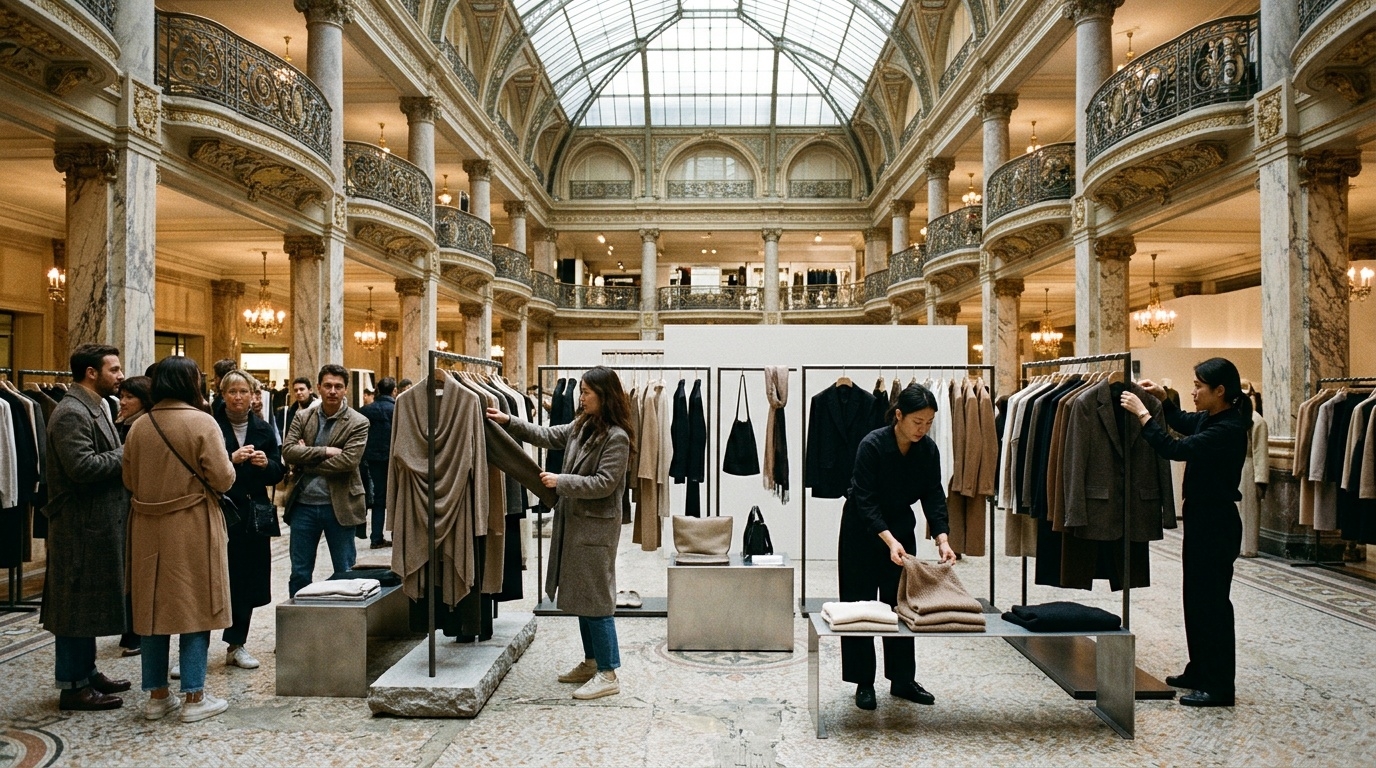
The Paris pop-up opened in October at the Haussmann flagship of Galeries Lafayette, a store that houses major global brands alongside emerging designers. Galeries Lafayette is a 130-year-old department store chain, and this marks Hyundai Global’s first pop-up in Europe, a step that moves the business Tokyo started outside Asia. The participating brands aren’t housed in a store reserved just for Korean labels; they present their products inside a department store that carries a range of fashion brands.
The event is run jointly with the Korea Creative Content Agency. Hyundai Department Store handles event planning, product shipping and running the store in Paris, while the agency supports the participating brands and handles local promotion in Europe. That division of labor shows that expanding overseas takes more than retail space: moving products to the site, running the store customers visit, and getting the brand’s name out are distinct jobs bundled into one event.
The roughly 79-square-meter space features five Korean fashion brands (KIMHĒKIM, RE RHEE, LIE, FRITUR and THE ILMA), which also explains how the business works. Rather than each brand opening its own standalone store in Paris, they’re presenting products together in a jointly arranged pop-up, a route that combines the department store’s operational work with a public agency’s support. So the significance of this move isn’t just that a store address was added in Paris; it also shows who is planning and running the overseas sales floor for multiple brands at once.
Shinsegae tests the waters in New York, by way of Bangkok
Shinsegae Department Store is pursuing its own overseas push for Korean brands through its global retail platform, Shinsegae Hyperground. In July 2026, it ran a pop-up called the K Experience Fair at CentralWorld in Bangkok, featuring seven brands from fashion, beauty and food and beverage. By bringing brands from multiple categories into one space, the event introduced not just individual products but a broader slice of Korean lifestyle. It’s a separate platform from Hyundai’s business, but the approach (bundling multiple brands to connect them with overseas customers) is similar.
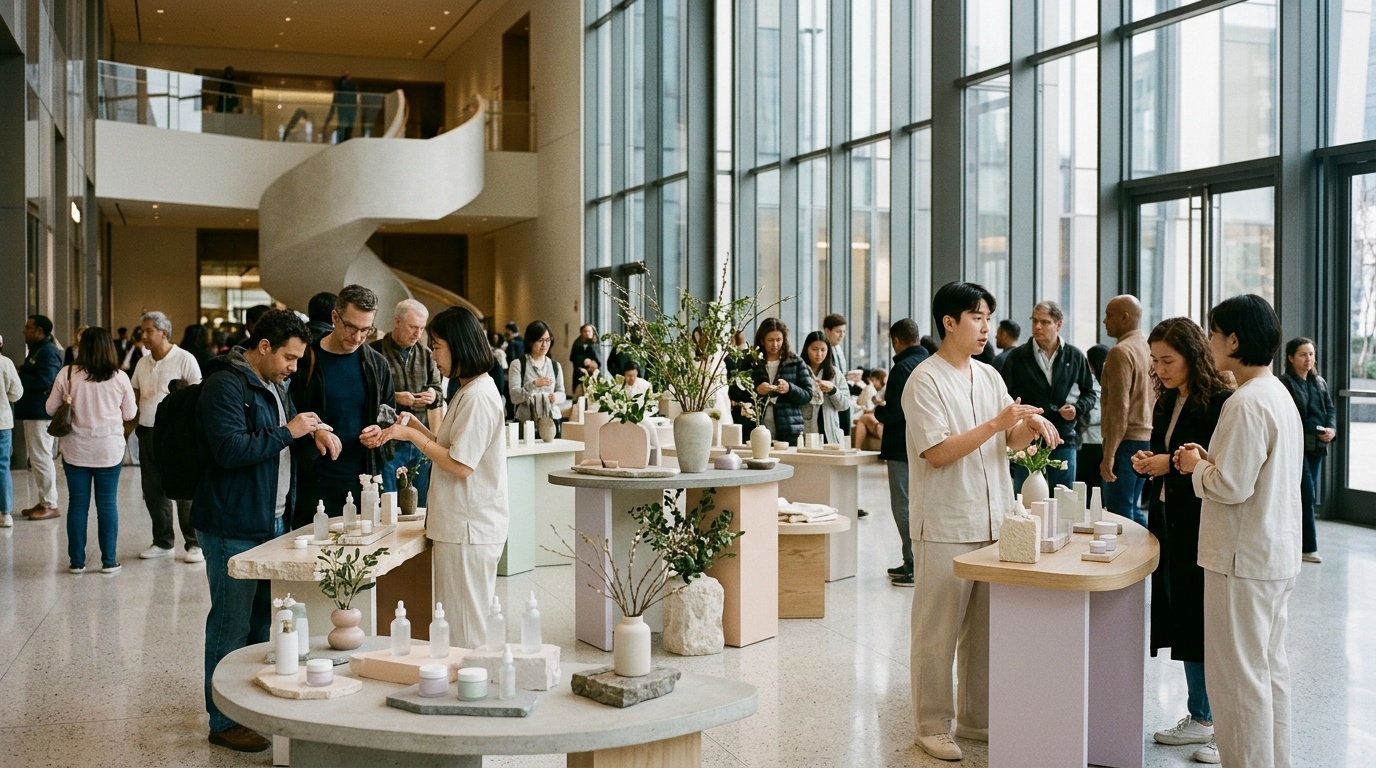
Shinsegae is now following that with its first pop-up in the United States, featuring around 30 K-beauty brands. The venue is New York’s Hudson Yards, which draws more than 14 million visitors a year, and the event, built around the concept of “Seoul lifestyle,” will introduce American customers and international tourists to the brands. That visitor figure describes the scale of the venue, though, not the number of people who will visit or buy from the pop-up, or the sales any brand will generate. It should be read as context for the kind of customer touchpoint the event offers in New York, not as a measure of the outcome.
The New York event is part of a support program for retailers expanding overseas, run jointly by the Ministry of Trade, Industry and Energy and the Korea Trade-Investment Promotion Agency (KOTRA). Shinsegae plans to use the event to gauge American customer response and gather market data to inform any future expansion. The pop-up is being presented both as a place to sell products and as a way to test a new market, but what kind of response it gets, and whether that translates into a larger business, still needs to be confirmed separately. The event shouldn’t be taken as proof that the company has already succeeded in the US market.
What comes next matters more than the store count
Hyundai Department Store is using the Paris pop-up to accelerate its push into Europe, with a goal of building more than ten Hyundai Global flagship stores across Asia, Europe and North America by 2030. That’s a target for the future, not a count of stores already secured. Shinsegae, meanwhile, is weighing the potential for a broader overseas business based on the customer response and data it gathers in New York. Both companies are expanding abroad, but what they’ve announced as their next step differs: one has set a long-term goal for physical stores, while the other is emphasizing validation in a new market.
Taken together, these moves reveal a shift in what department stores are for. Rather than serving only as retail spaces connecting brands and consumers inside Korea, they’re stepping into the role of operators who gather Korean brands and introduce them to customers abroad. Fashion is the focus in Paris and beauty in New York, but both share a pattern of folding individual brands’ activity into a department store’s planning and operations, with public-sector support layered in, expanding the unit of overseas expansion from individual brands to a shared platform.
The expansion from Tokyo to Paris, and the events running from Bangkok to New York, trace one route K-brands are taking abroad. What remains to be seen is whether the response generated by these temporary events can convert into steady sales and lasting store operations. What matters is where Hyundai’s long-term store plan and Shinsegae’s market testing lead. How well these companies close the gap between holding an event overseas and settling into a local market will be the real measure of how these export platforms perform.
Sources: Hankook Ilbo, October 7, 2026 (https://www.hankookilbo.com/news/article/A2026100615160001957); Newdaily Economy, October 6, 2026 (https://biz.newdaily.co.kr/site/data/html/2026/10/06/2026100600057.amp.html).


