
Table of Contents
Camping Chairs and Down Jackets Under One Roof in Shanghai
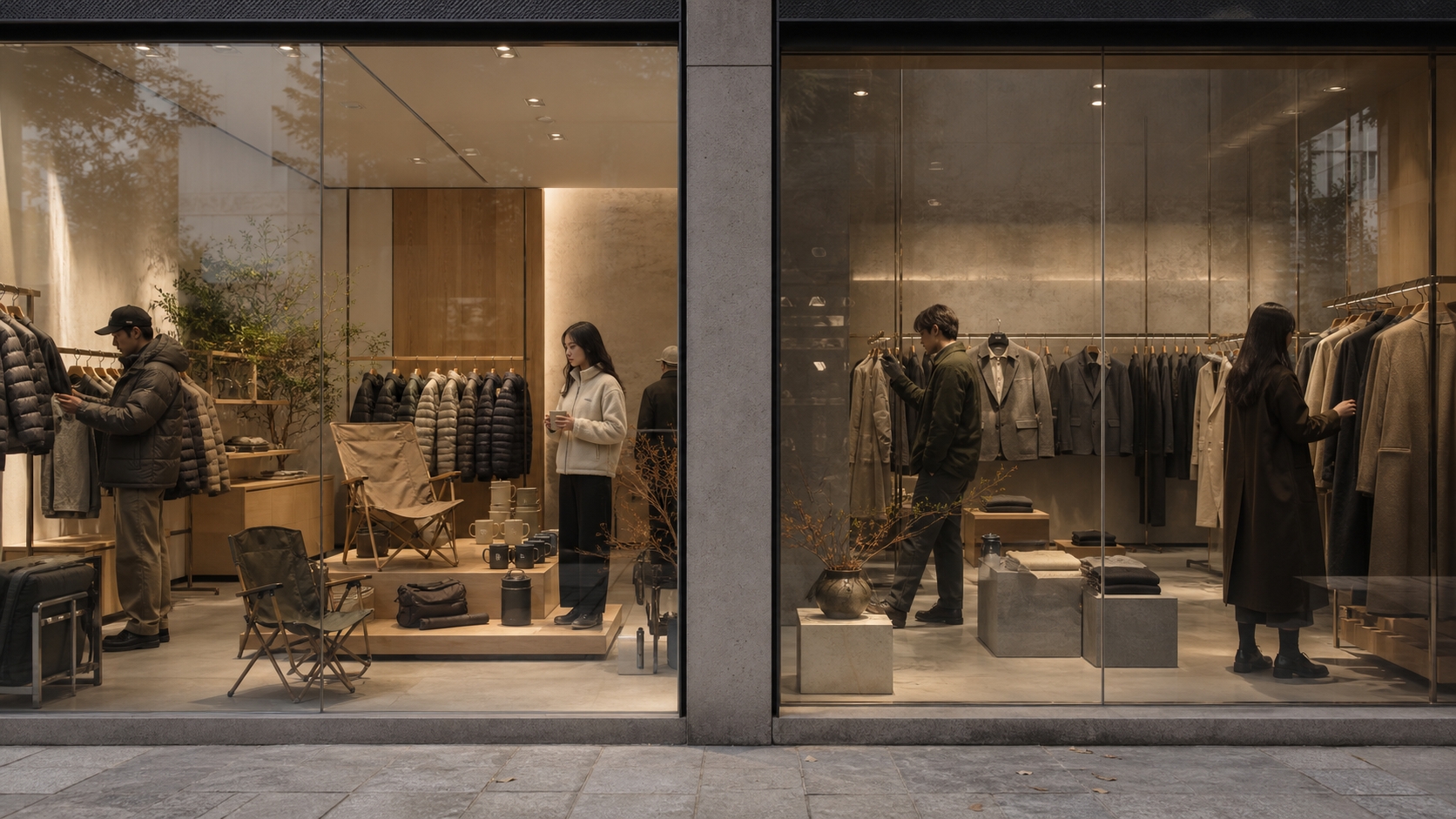
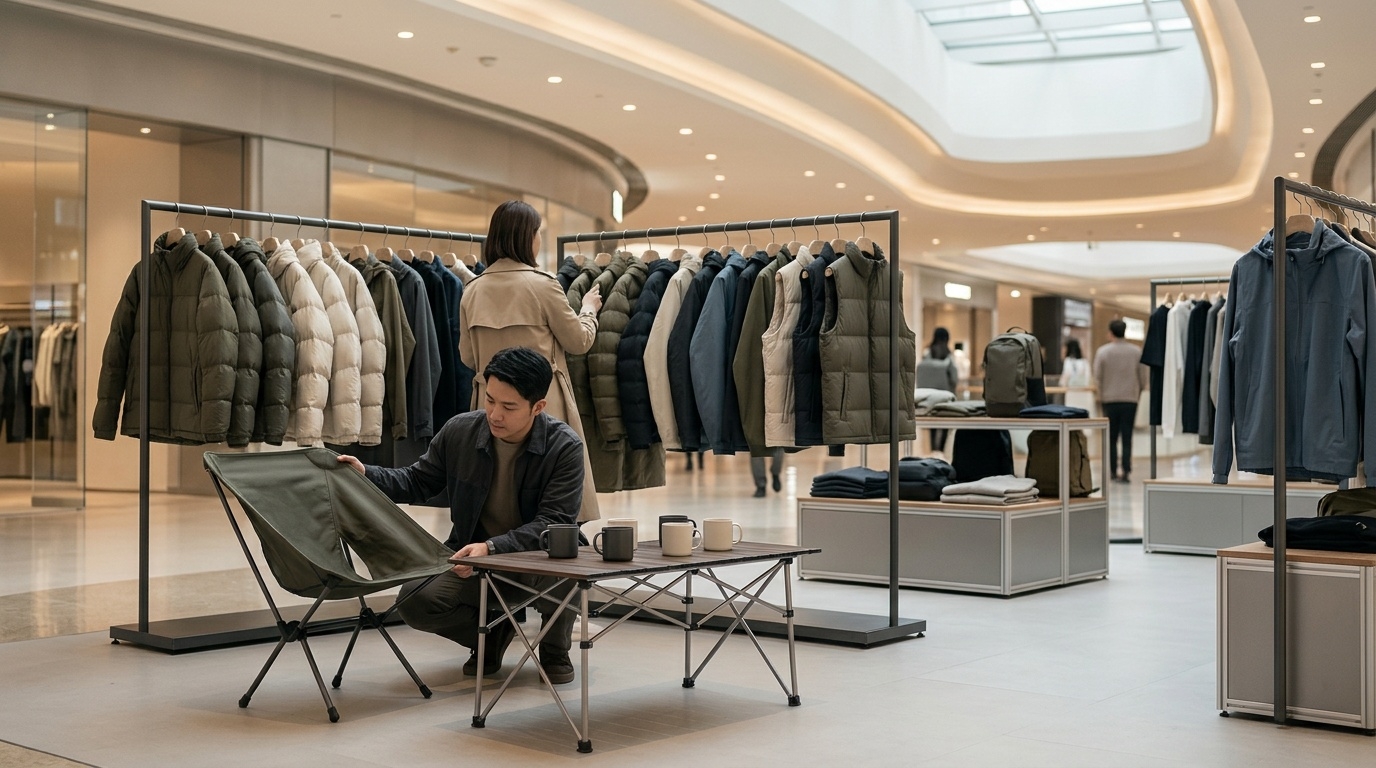
At a Helinox pop-up inside Shanghai’s Huamao iapm mall, camping gear and apparel share the same floor. Running from October 10 to 27, the space sells items including Eclipse Pack down jackets and vests alongside China-exclusive mugs and chairs. Handling chairs and clothing in a single store isn’t just an added product line. It signals a shift in how Helinox is running its brand business in China.
According to an October 12 report by The Dailybiz, Helinox’s headquarters handles gear in Korea while Kolon Industries’ FnC division handles apparel. In China, the two sides have combined both businesses through a joint venture called Helinox China. A joint venture refers to a company jointly established by separate firms. Product lines kept apart at home are placed together in a single store in China, a structure meant to connect how customers experience the brand.
At the same time, in Guangzhou, Dunst, run by LF subsidiary Citydoz, is operating a roughly five-month pop-up. If Shanghai’s Helinox shows the combination of gear and apparel, Guangzhou’s Dunst secures a long stretch of time to meet customers in one place. Together, the two sites reveal that while Korean fashion companies are expanding into China simultaneously, each has made different choices about what to sell and where and how long to operate.
Different Choices Within One Larger Trend of Re-Entry
This latest move sits within a broader trend: Korean fashion’s renewed push into China amid hopes that the “Hallyu ban” is easing. The Hallyu ban refers to measures that have restricted the distribution and activity of Korean cultural content in China. Maeil Business Newspaper reported that, alongside expectations of improved Korea-China relations, Korean fashion companies are accelerating their entry into key Chinese commercial districts. Still, this shouldn’t be read as an official lifting of all restrictions.
It’s also hard to describe the moves of all three companies uniformly as a first entry into China. Helinox had already sold gear there, and Dunst, too, drew on purchase data from its official Tmall store. What’s new is how each is expanding or changing the way it meets Chinese customers. Helinox is adding apparel to build an integrated business, while Dunst is carrying regional demand identified online into a long-term offline operation.
Musinsa’s strategy offers a useful point of comparison: a platform supporting individual brands’ entry into the local market. Where Kolon FnC is broadening its product lineup through a joint venture and LF’s Dunst is choosing where and how long to operate, Musinsa helps numerous domestic brands prepare for and carry out their own sales. Even aimed at the same Chinese market, the unit of business differs: brand integration, regional validation, and support for multiple brands, respectively.
Helinox Adds Apparel After Growth Online
Helinox opened an official Tmall store in the first half of 2025. According to The Dailybiz, Tmall sales in the first half of 2026 rose 114 percent year over year. Tmall is a Chinese online shopping platform, and this figure reflects sales through that official store specifically; it doesn’t represent revenue or profitability for the company’s entire China business. Still, it can be read as the backdrop for expanding the offline product lineup even as online sales grow.
Making its China debut is Helinox Wear, a line that applies the lightness and durability of camping gear to clothing. Kolon FnC launched it domestically in October 2025, designed to be worn both outdoors and in everyday life. In China, this apparel line is being added to existing gear offerings. The core of this rollout is treating gear purchases and clothing purchases not as separate businesses, but presenting both together under one brand.
The point of an integrated store is that customers who come in for one product category can also encounter the other. It also makes it possible to connect the functional traits of gear with the story told through apparel. Still, displaying the two together hasn’t yet been shown to actually increase cross-purchasing. What’s been announced so far is the business structure and product lineup; how much integrated operation ultimately boosts sales will have to be judged by future results.
After the Pop-Up, a Permanent Store That’s Still Just a Plan
Helinox’s Shanghai presence isn’t limited to the mall pop-up. Nearby on Nanchang Road, it’s running an urban-themed camp through October 31. Alongside the space inside the mall that showcases gear and apparel, this gives the city a separate touchpoint in the form of a camp. Running different spaces together can be seen as a way of introducing a brand identity that spans gear and apparel, though visitor response hasn’t yet been measured separately.
In December, permanent stores are set to open at Shanghai’s iapm and ITC. That lays out a timeline running from a time-limited pop-up to a permanent retail presence. A pop-up is a space for gauging customer response over a limited period, while a permanent store becomes an ongoing sales base. The event currently running and the store planned to open later should be kept distinct; a planned opening shouldn’t be described as already complete.
Longer term, the goal is to secure more than 30 stores by 2030, centered on major cities including Shanghai and Beijing. That figure isn’t a current store count but an expansion target the company has set. Going forward, it will be worth watching not just the openings themselves but whether integrated gear-and-apparel operations translate into sustained purchasing in each region. Online growth rates and store-expansion targets point to a direction, but they don’t substitute for the business’s eventual results.
Dunst Carries Guangdong’s Online Demand Into a Guangzhou Store
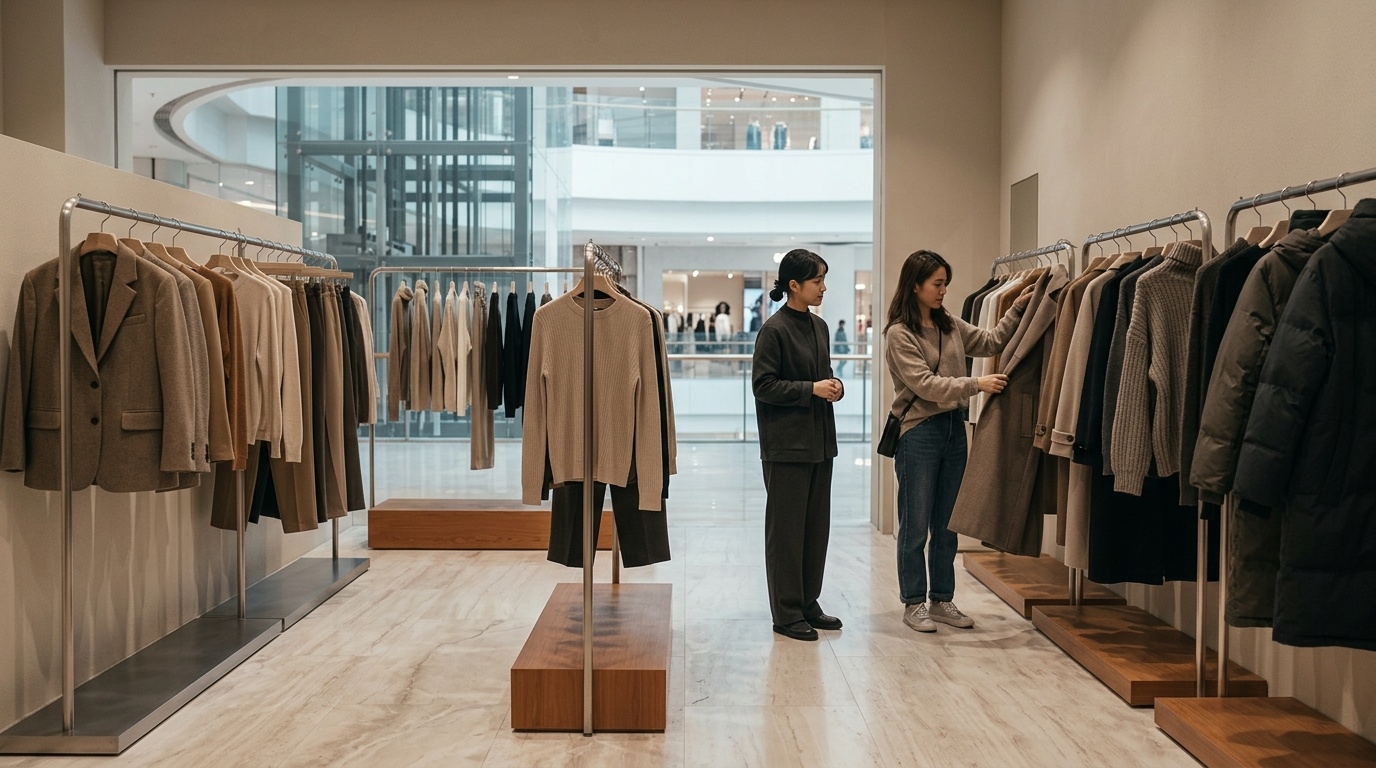
The city Dunst chose is Guangzhou, in southern China. Run by LF subsidiary Citydoz, Dunst is operating a long-term pop-up of roughly 101 square meters at Bai’etan MixC from September 30 through the end of February 2027. According to an October 2 report by Newspim, it is rolling out winter items in sequence following its autumn collection. The setup favors keeping a touchpoint with products and customers over a long stretch, rather than a single short event.
The basis for choosing Guangzhou was online sales data from its official Tmall store. According to The Dailybiz, Dunst picked Guangzhou as its location after confirming steady purchasing demand from the Guangdong region. Since Guangzhou is a city within Guangdong, the move connects demand identified online to an actual offline location. Rather than treating China as a single market, it’s an approach that moves a region where purchasing has already appeared into a concrete offline base.
In this approach, online and offline function less as substitute sales channels and more as touchpoints offering different kinds of information. Online sales serve as evidence of where purchasing is occurring by region, while the offline store becomes a space for observing demand by product and gauging customer response in person. Still, online purchasing in a region doesn’t guarantee the success of a long-term pop-up. Distinguishing the basis for an opening from the results that follow it matters for understanding the strategy.
A Long Run Spans the Seasons, With the Next Region Under Review
The roughly five-month run is another distinctive feature of Dunst’s strategy. Because autumn items are introduced first and winter items follow in sequence, the same store can track customer response across collections from different seasons. Where a short pop-up tends to be judged mainly by the attention it draws right after opening, the key thing to watch in this run is whether customer response holds up even as the product lineup changes over time.
The Dailybiz reported that Dunst plans to review further openings in southern China based on product-level demand and customer response gathered during the long-term pop-up, with a Hangzhou pop-up also in preparation. Here, further openings in the south remain under review, and Hangzhou, too, is still a plan in preparation. Operating in Guangzhou shouldn’t be read as confirmation of a nationwide store expansion already decided. For now, this is a process of testing regional possibilities and preparing the next touchpoint.
The Musinsa Shanghai pop-up, already up and running, offers a different point of comparison. At the Jing’an Kerry Centre on Nanjing West Road in Shanghai, it supports 15 domestic fashion brands entering the Chinese market, helping with everything from preparation to offline sales under a program backed by the Ministry of Trade, Industry and Energy and KOTRA. It’s a model in which several brands share the burden of market entry through platform support. Its target audience and operating purpose differ from the new developments covered here: Helinox’s integrated business and Dunst’s long-term pop-up.
What One Store’s Combination and One Region’s Time Will Leave Behind
Set the three strategies side by side and Kolon FnC is focused on bundling business lines and product categories, Dunst on designing regional choice and operating duration, and Musinsa on supporting the entry process for multiple brands. All three use offline spaces to meet Chinese customers directly, but what each is trying to confirm in that space isn’t the same. Simply comparing store counts or the number of participating brands would miss the differences in the approach each company has chosen.
Returning to the chairs and down jackets at Helinox’s Shanghai pop-up, the question going forward is whether placing two product categories in the same space is enough on its own to connect the brand experience. At Dunst’s Guangzhou location, what matters is whether regional demand identified online carries through a store run that spans the seasons. Both companies are extending an existing sales track record into new offline formats, but how effective that approach proves will have to be confirmed after the openings themselves.
Hopes that the Hallyu ban is easing form the backdrop for this renewed push into China, but they don’t explain the outcome of any individual business. What can be confirmed right now is the concrete execution: integrated rollout through a joint venture and a long-term pop-up grounded in data. Going forward, Helinox’s planned permanent store openings and the results of Dunst’s Guangzhou run will show whether this moment settles into a lasting regional business or remains a one-time entry event.
Source: The Dailybiz, October 12, 2026. https://biz.newdaily.co.kr/site/data/html/2026/10/12/2026101200052.amp.html ; Newspim, October 2, 2026. https://www.newspim.com/news/view/20261002000057 ; Maeil Business Newspaper, updated February 6, 2026. https://www.mk.co.kr/news/economy/11954496


