
Table of Contents
What a Returning Visitor Was Looking For Six Months Later
When Yonhap News spoke with a Chinese tourist in his 30s near Seoul’s Dongdaemun Design Plaza on November 6, he was on his second trip to Korea. He had first come in April to see a BTS concert, and he liked it enough to return to Seoul six months later. This time, though, he was having trouble finding something new to do. “If there were other things to see and do besides K-pop concerts and palaces, I would keep coming back to Korea. Honestly, it’s a bit disappointing,” he said.
His comment touches two sides of Korean tourism at once. A big concert gave a foreign traveler a reason for a first visit, and the memory of that trip was enough to bring him back. The harder part is the second trip. Revisiting familiar places only goes so far; returning visitors need new regions and new things to do if they are going to keep coming. Turning a good first visit into a plan for the next one is now the main job.
Korea reached 20 million annual foreign visitors with that question still open. According to a November 12 report by Asia Economy, based on figures compiled by the Ministry of Culture, Sports and Tourism and the travel industry, cumulative arrivals for the year passed 20 million that day for the first time. It is the second year in a row of record arrivals. With the headcount past that line, attention is moving to what visitors do in the country and how much they spend.
Fourteen Years From a 10 Million Milestone to 20 Million
The number took a long time to reach. When annual arrivals first topped 10 million in 2012, the government set 20 million as its mid- to long-term goal. Getting there took 14 years. So this year’s figure is less a one-year jump than the end point of a target Korea has been chasing for more than a decade, one built around growing the number of arrivals.
The path was not a straight line. Arrivals rose to 17.5 million in 2019, then fell to 970,000 in 2021 during the COVID-19 pandemic. A gradual recovery brought them to a record 18.94 million in 2025, and this year has already passed that. Seen against that history, 20 million is more than a return to pre-pandemic levels. It means Korea is drawing more travelers than it ever did, only a few years after international travel nearly stopped.
The milestone also came earlier than expected. Arrivals stood at 18.91 million through October 26, and with about 65,000 people entering each day in recent weeks, the total crossed 20 million before the third week of November, which was the original forecast. The culture ministry is still working out the timing of an official announcement with other agencies and plans a commemorative event at Incheon International Airport on November 17, so the November 12 figure is a preliminary ministry and industry count. The government’s next long-term target is 30 million visitors, and its goal for this year is 23 million.
Growth Across Many Markets Opens a Door for Regional Travel
This year’s rise is not coming from one country. According to an October 27 culture ministry press release, arrivals from January through September reached 17.11 million, up 21.5 percent from a year earlier. Visitors from Greater China rose 29.1 percent, Japan 16.9 percent, Southeast Asia 15.3 percent, and Europe and the Americas 15.1 percent. The pace differs by region, but demand grew in several markets at once, so the industry now has to serve a wider mix of travelers with different reasons for coming.
The way people enter the country is changing too. The same release showed that arrivals through airports and seaports outside the Seoul metropolitan area reached 4.82 million, up from 3.74 million a year earlier. When more visitors land at regional gateways, those cities and provinces get a better chance to be where a Korea trip starts, and visitors meet local culture earlier in their stay.
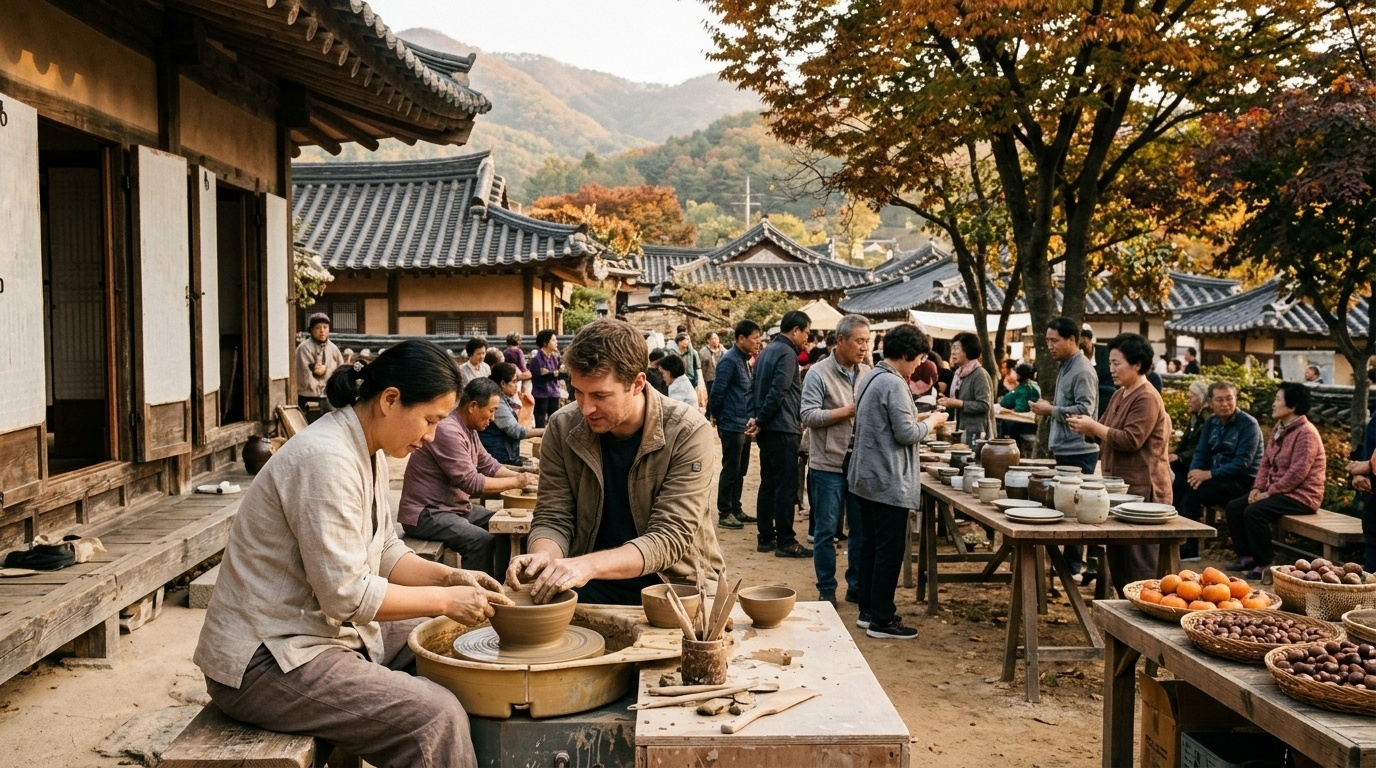
More entry points only help local economies if travelers find good reasons to stay once they leave the terminal. That is why people in the industry keep pointing to regional festivals and local content. An airport or port is just the way in; the exploring and spending happen in the days after. For repeat visitors who have already seen Seoul’s best-known sights, a regional festival or a neighborhood experience can be the reason to book another trip.
Record Arrivals, and a Tourism Deficit Again
While arrivals were heading for a record, Korea’s tourism balance went back into deficit. According to a November 8 Yonhap News report citing the Korea Tourism Organization’s Korea Tourism Data Lab, the country ran a tourism deficit of $498 million in September, wider than August’s $399.4 million and the third monthly deficit in a row since July. The tourism balance compares what foreign visitors spend in Korea with what Koreans spend traveling abroad, so it can be negative even when inbound arrivals are booming.
The deficit had only just been broken. Korea ran a tourism deficit for 72 straight months from March 2020 through February 2026, with annual deficits of $10.3826 billion in 2023, $10.2072 billion in 2024 and $10.7604 billion in 2025. This year brought four months of surplus from March through June. June’s surplus, about $600 million, was the second largest on record after $661.5 million in October 2008.
After June, the two sides moved apart. Monthly tourism receipts fell from $2.784 billion in June to $2.46 billion in September, while Koreans’ spending abroad rose from $2.187 billion to $2.958 billion over the same period. In September, foreign visitors spent an average of $1,193 each, compared with $1,304 per Korean traveler overseas. How many visitors come and how much each one spends are separate questions, and both matter when judging how the industry is doing.

Turning Concert-Driven Visits Into Everyday Cultural Experiences
Some observers link the spring and early-summer surplus to K-pop concerts. BTS held a comeback show at Gwanghwamun in March, then took its world tour to Goyang in April and Busan in June, which matches the March-to-June surplus. The Chinese fan who first came for a concert fits that pattern, though the concert calendar alone does not explain the whole surplus.
Spending tied to Korean pop culture also slowed after the summer. Global Hallyu spending, which counts foreign card purchases in sectors linked to Korean pop culture, fell 12.4 percent from 1.3927 trillion won in June to 1.22 trillion won in September. It covers less than total tourism receipts, but it shows how much this kind of spending moves up and down. Pop culture can start the first trip; the industry still has to give visitors more to spend money on once they are here.
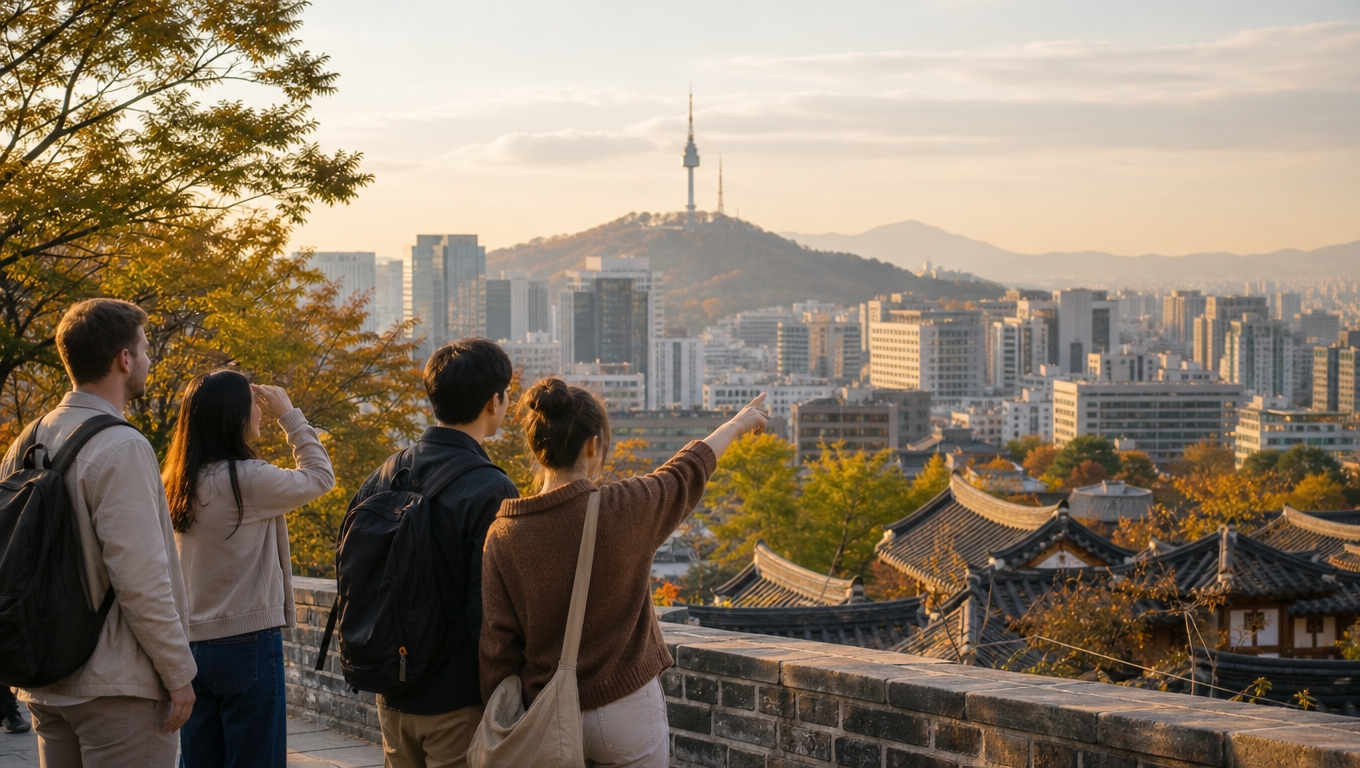
People in the travel industry put it bluntly: once visitors have worn a hanbok at Gyeongbokgung Palace and seen Namsan Seoul Tower, there is not much else on the list. Getting people to come back means more than promoting the same famous sights again. The regional festivals and local content that industry insiders propose are meant to give repeat visitors something they did not get the first time.
The Question After the 20 Millionth Visitor
Kang Ji-soo, an associate research fellow at the Korea Culture and Tourism Institute, said tourism receipts per visitor have been improving along with arrivals. She said passing 20 million should be the point where more visitors turn into real spending and growth for Korea’s tourism businesses. Her view gives credit for the arrival numbers while keeping the focus on how much of that money stays in the country.
The tourism balance is one way to track that. Because it includes Koreans’ travel abroad as well as visitors’ spending here, the headline deficit is easier to read next to total receipts and per-visitor spending. The gap between June and September shows why: in a year with record arrivals and falling monthly receipts, the picture only makes sense when visitor numbers and spending are read together.
For the Chinese visitor near Dongdaemun Design Plaza, the wish to come back was already there, thanks to his first concert in Seoul. What he lacked was something new to do. Korea has now met the target it set in 2012 and is aiming for 30 million visitors a year, and its next problem looks a lot like his: giving people who already like Korea new places and everyday experiences worth returning for.
Sources: Asia Economy, November 12, 2026; Ministry of Culture, Sports and Tourism press release, October 27, 2026; Yonhap News Agency, November 8, 2026.


