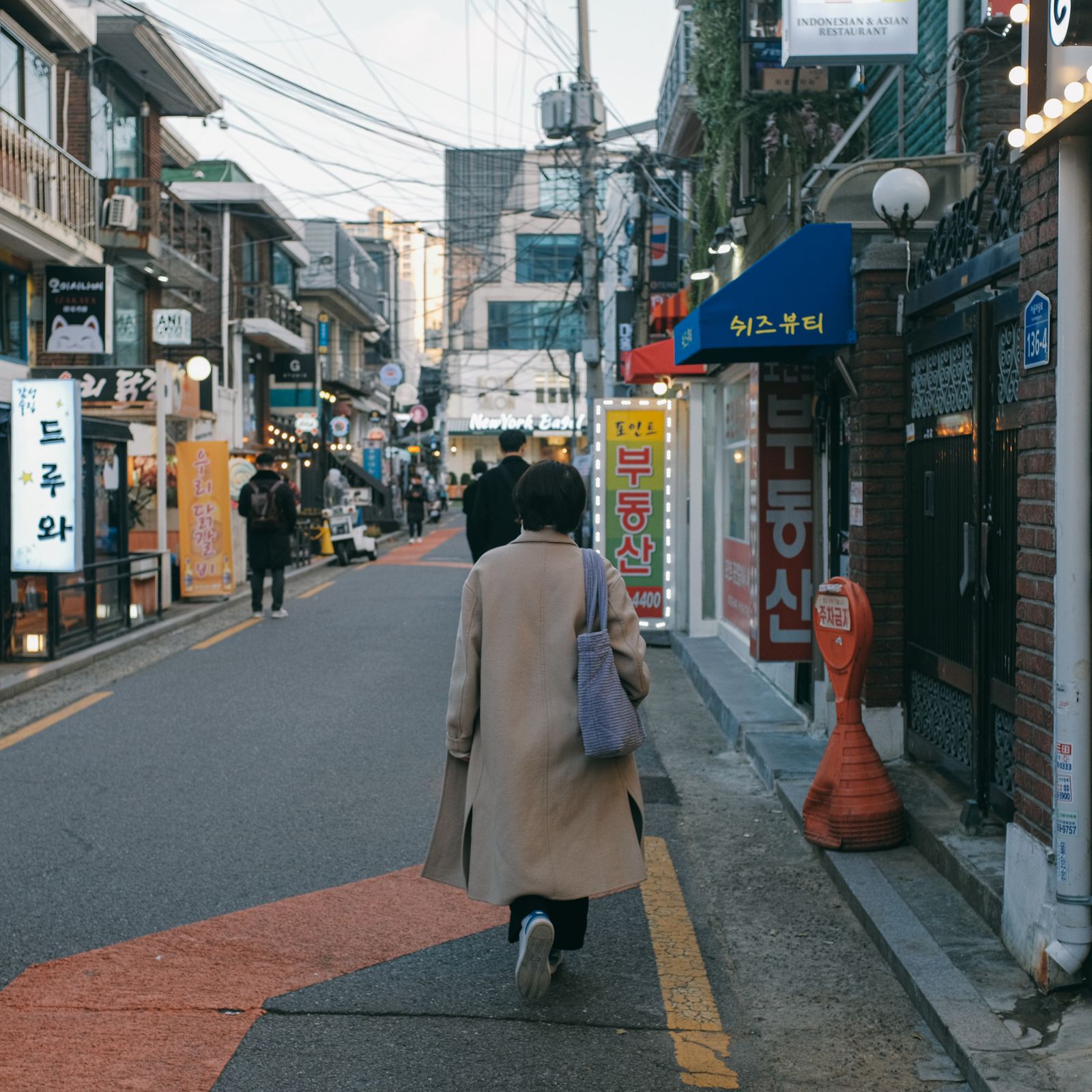
On a weekday afternoon in Sinsa-dong’s Garosugil, the street that spent two decades as one of Seoul’s defining shopping destinations is quiet enough to notice. “For lease” notices start near the entrance and keep going; walk further in and the ground-floor storefronts go dark one after another. A reporter from the Ilyo Sinmun counted roughly one vacant unit per building, with entire buildings standing empty in places. One central block holds onto life mainly through a Lacoste outlet, a duty-free cosmetics shop and a hair salon — almost everything else is gone, and what’s left leans franchise rather than the independent boutiques that made the street’s name.
The number behind that walk-through, reported June 10 by Ilyo Sinmun’s Kim Jeong-min: Garosugil’s vacancy rate hit 45.2 percent in the fourth quarter of 2025, according to Cushman & Wakefield Korea’s retail market report — against 13.8 percent across Seoul’s seven major street-commerce districts overall, 5.6 percent in Myeongdong, and just 2.5 percent in Seongsu. A shop owner who has run a business on the street for more than five years told the paper the area’s foot traffic has collapsed: “It’s true that the district has died down and sales have dropped. We’re holding on partly through social media, building repeat customers, but with fewer tourists, fewer new customers are coming in. Rent never moved — it stayed high while vacancies rose and foot traffic thinned out, and that’s basically why everyone left.”
Seongsu, a short distance away, runs on a different model entirely, which several of the people the paper interviewed pointed to as the actual difference-maker. Where Garosugil grew around a single signature street, Seongsu’s restaurants, cafes, brand stores and pop-up spaces spread across an entire district rather than concentrating on one strip — giving it a thicker, more varied customer base that isn’t as exposed if any one stretch loses momentum. Hanyang University tourism professor Lee Hoon told the paper that Seongsu’s mix of small fashion, webtoon and entertainment companies alongside cultural-content businesses, plus deliberate local-identity branding from the district government, gives it a sturdier foundation than a street built around one type of shopper. Kim Young-gap, a professor at the KYG Commercial District Analysis Institute, framed the broader shift in a single word: “맛집” — destination restaurants. As retail has migrated online, he argued, the businesses that can’t be replicated on a screen are the ones now driving offline foot traffic, and they tend to set up where fixed costs are still low enough for a small operator to take a chance.
Myeongdong took a third path back from a pandemic-era collapse: foreign tourists. On the same weekday, Myeongdong’s main streets were dense with visitors speaking Chinese, Japanese and English, some in hijab, carrying Olive Young and Lotte Duty Free shopping bags past street carts selling tteokbokki, skewers and grilled cheese. The single-brand cosmetics shops that once defined the district have largely given way to pharmacies, drugstores and multi-brand beauty retailers — nine Olive Young locations sit within the stretch between Myeongdong and Euljiro 1-ga stations alone. A local real estate agent told the paper ground-floor rent in the area now runs 1.2 million to 1.4 million won per 3.3 square meters, high enough that agencies themselves often operate out of fourth- or fifth-floor offices instead. Seoul’s overall street-commerce vacancy rate fell to 8.8 percent in the first quarter of 2026, down 1.9 percentage points year-on-year, alongside a first-quarter foreign tourist count of roughly 4.76 million — a record for the quarter.
Sinchon and Ewha, by contrast, show what happens when there’s no single force pulling demand back in. The strip that once drew clothing, cosmetics and accessory shops has weakened through a combination of online retail’s growth and the closure of a public parking lot near Sinchon station that had supported visitor traffic; landlords there have cut asking rents by more than 30 percent in places with little effect, according to local brokers, who said cosmetics and clothing retailers won’t even consider the spots and only cafes and dessert shops are filling space, and not consistently. Small-shop vacancy in Sinchon and Ewha held at 15.1 percent from the third quarter of 2025 through the first quarter of 2026, per Korea Real Estate Board data — well above Seoul’s 9.1 percent average in the fourth quarter of last year.
The four neighborhoods read less like a fixed ranking than a single rotating story. Kim Young-gap warned that Seongsu isn’t immune to its own success: the operators who build a district’s reputation tend to move on once rents catch up to their newfound popularity, the same way Itaewon cooled once its rents climbed — and well-known restaurants packing into Seongsu now could trigger the same outward migration later. Lee Hoon added a related wrinkle on the tourist side: visitors increasingly chase the same neighborhoods locals already frequent rather than purpose-built tourist zones, meaning a district’s draw now depends as much on staying genuinely local as on any deliberate appeal to outsiders. Put together, the pattern suggests Seoul’s commercial map keeps relocating rather than settling — which means whichever neighborhood looks unstoppable today is also the one due, eventually, for its own Garosugil moment.
Sources: Kim Jeong-min, “[르포] 쇼핑보다 맛집…서울 대표 상권 흥망성쇠를 가르는 변수들,” Ilyo Sinmun, June 10, 2026.