Table of Contents
A Gathering of Those Who Teach
Teaching a language is not merely about delivering grammar and vocabulary. A language carries the way its speakers have formed relationships and understood the world. The moment a teacher explains this to learners from a different linguistic background, they become a translator, an interpreter, and a cultural mediator.
To explain the multiple layers of honorifics, one must also speak about the Korean sense of social relations. When encountering expressions that cannot be precisely translated into a single foreign word—like jeong (情, affection) or nunchi (눈치, social awareness)—dictionary definitions alone are not enough.
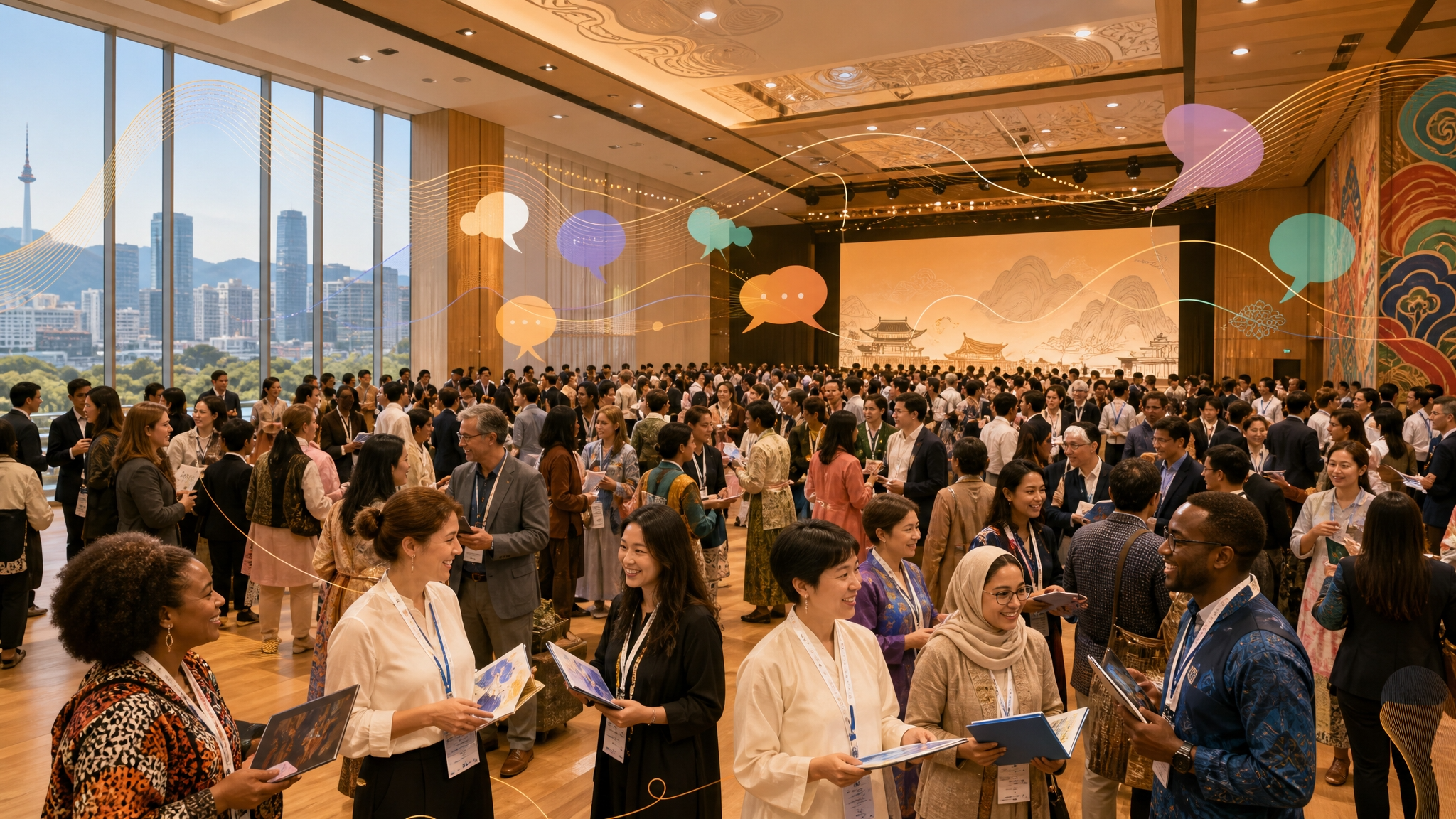
On July 13, 2026, people who have been doing this work from all over the world gathered in Seoul. Approximately 550 Korean language educators participated in the ‘2026 Integrated Training for Global Korean Language Educators’ held at the Grand Ballroom of COEX, Seoul. The government had announced an expected attendance of exactly 547 people prior to the event.
This event was a reconnection of the separate invitation training programs that had been operated independently by different ministries since the first joint ministerial training in 2017. According to the government, it has been nine years since an integrated training for Korean language educators was held.
Reconnecting Disparate Training Programs
The event was co-hosted by four agencies: the Ministry of Culture, Sports and Tourism, the Ministry of Education, the Ministry of Foreign Affairs, and the Overseas Koreans Agency. It was jointly organized by the King Sejong Institute Foundation and the Korea Foundation.
The support system for Korean language education is divided among various ministries and agencies depending on the target learners and objectives. The Ministry of Culture, Sports and Tourism and the King Sejong Institute Foundation support foreigners’ learning of Korean language and culture through overseas King Sejong Institutes. The Overseas Koreans Agency supports Korean language schools for the next generation of overseas Koreans. The Ministry of Education handles Korean language education in overseas elementary and secondary schools and operates Korean Education Centers. The Ministry of Foreign Affairs and the Korea Foundation support Korean studies and Korean language education infrastructure at overseas universities.
While separate training systems were necessary given the different targets and purposes, opportunities for educators from different fields to share experiences were limited. After the 2017 joint training, the relevant ministries reconnected their separate schedules in 2026. The format involved running the opening ceremony and common programs together, followed by 3 to 4 days of specialized in-depth training by each agency.
Thus, this event did not completely merge all training programs into one. Its significance lies in connecting the opening ceremony, common curriculum, and exchange programs while maintaining the distinct educational systems.
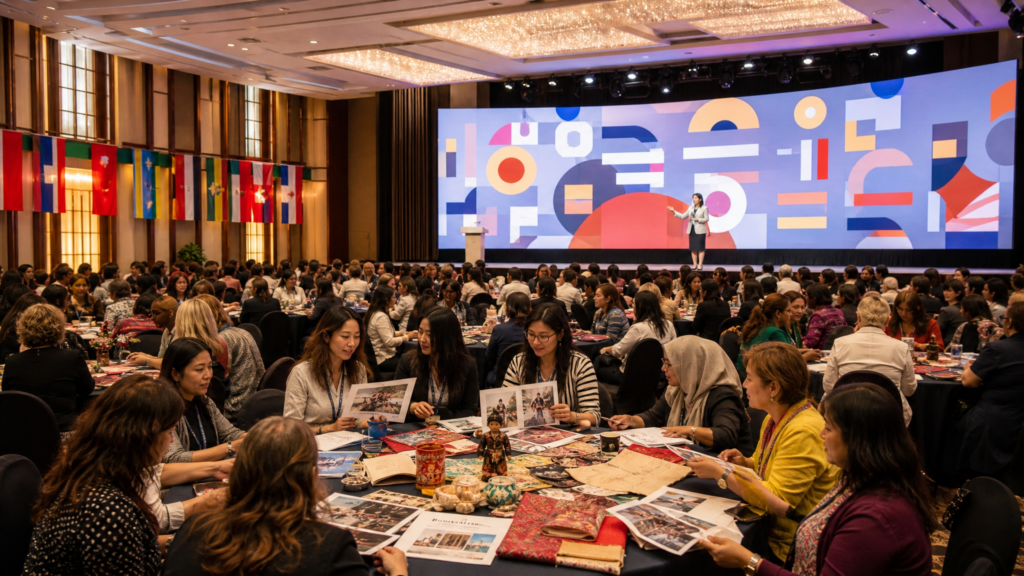
The Composition of 547 Participants
The government’s pre-announced breakdown of the 547 expected participants is as follows: 211 local instructors from King Sejong Institutes, 263 teachers and principals from Korean language schools, 43 Korean language teachers dispatched to overseas regular schools, and 30 Korean language instructors from overseas universities.
On-site reports indicated that approximately 550 people actually attended the event. Since 547 was the pre-registered number, it is accurate to distinguish it from the final attendance in reporting.
Teachers and principals from Korean language schools formed the largest group at 263. They primarily teach Korean language and culture to the next generation of overseas Koreans. The 211 local instructors from King Sejong Institutes meet foreign learners from various backgrounds who want to learn Korean.
The objectives of these two educational settings are not entirely identical. In Korean language schools, the focus is on helping the next generation of overseas Koreans maintain their linguistic and cultural roots. In King Sejong Institutes, the aim is to impart language and culture to people who are learning Korean anew, including those without familial ties to Korea. Korean language education in overseas regular schools and universities operates within each country’s formal curriculum and academic environment.
The practical significance of this integrated training is that educators who have experienced different learners and institutional conditions gathered in one space to directly share their cases with each other.
Language Education in the Age of Artificial Intelligence
Artificial intelligence was not the official title or single theme of the entire event but rather one of the key agenda items.
During the opening ceremony, a video titled ‘We, Connected by Korean, Become Each Other’s Stories’ was screened. The dance team Hook, led by choreographer Aiki, presented a reinterpretation of Bongsan Talchum (a traditional masked dance).
Professor Jang Dae-ik from Gachon University delivered a keynote speech on ‘From Speaking to Storytelling: The Future of Language Education in the Age of Artificial Intelligence.’ According to on-site reports, Professor Jang emphasized that Korean language educators should not remain in the role of conveying grammatical knowledge but should build bridges of empathy connecting different worlds.
Even in an era where the accuracy of AI translation is improving, the question of why people learn languages remains important. The government explained that motivations for learning Korean are diversifying, from interest in Korean culture like K-pop to studying abroad and employment.
The desire to understand song lyrics in the original language or to hear drama dialogues without subtitles is a different experience from merely checking translated results. However, it cannot be generalized that all Korean learners start from cultural interest. Many learn Korean out of practical needs such as academics, employment, migration, or family connections.
Participants engaged in programs including presentations of best educational practices by agency, teaching methods, cultural education, and curriculum management. Seon Hyeon-woo, CEO of TalkToMeInKorean, introduced practical teaching methods under the theme ‘Learning Korean through K-pop and Play.’
For educators who could not attend in person, the integrated training sessions were live-streamed on the YouTube channels of the King Sejong Institute Foundation, the Overseas Koreans Agency, and the Korea Foundation.
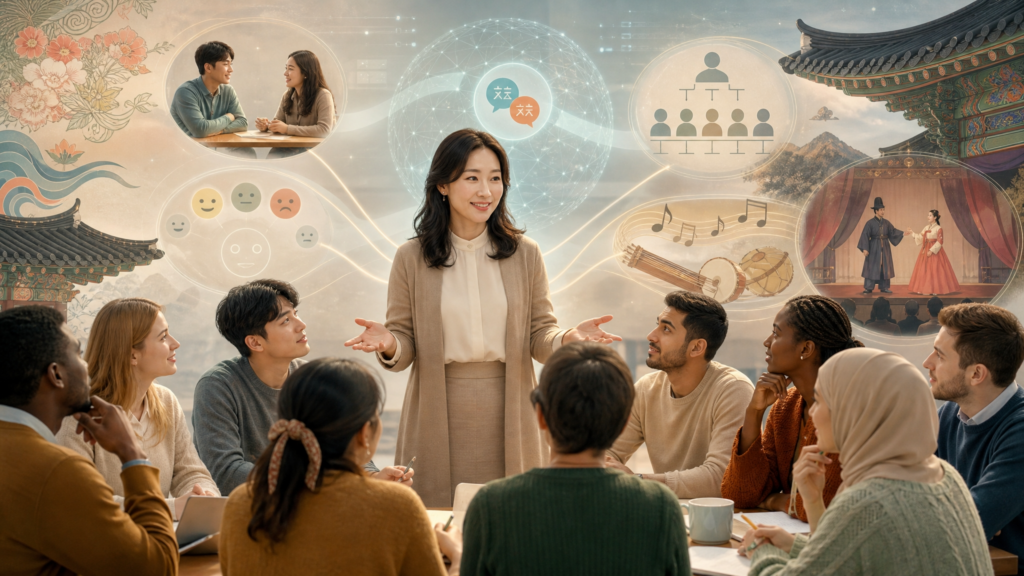
Different Fields Carrying Forward the Language
Multiple histories are layered in the effort to teach and preserve the Korean language. The compilation of dictionaries by the Korean Language Society during the Japanese colonial period cannot be seen as the same project as today’s overseas Korean language education policy. The conditions and objectives of each era are different. However, the recognition that language carries memory, culture, and identity beyond mere communication is a common thread connecting the two eras.
Today’s overseas Korean language education cannot be explained as a single stream. There is education that passes on the language of parents and grandparents to the next generation of overseas Koreans, and there is education that helps foreigners interested in Korean culture learn the Korean alphabet for the first time. There are teachers who teach Korean as a regular subject in overseas schools, and educators who run Korean studies and language programs at universities.
The government stated that as interest in K-content and demand for study abroad and employment grow together, the purposes of learning Korean are becoming increasingly diverse. However, when using the assessment that “demand for Korean has surged sharply” without concrete figures on learner numbers or institutional growth, it must be clarified that this is the government’s diagnosis.
Teaching Hangul to the next generation of overseas Koreans at a Korean language school in Los Angeles is different in purpose and environment from welcoming first-time Korean learners at a King Sejong Institute in the Philippines. Yet they meet in the common ground of connecting people and culture through the Korean language.
Participants from training programs that had been run separately since 2017 came together for the same opening ceremony and common programs after nine years. The achievement of this training is not that it unified different fields into one. It lies in reopening a channel for sharing experiences and problems while maintaining each party’s distinctiveness.
Sources: Ministry of Education ‘About 550 Korean Language Educators from Around the World Gather in Seoul’, July 2026; Ministry of Education Official Blog ‘About 550 Korean Language Educators from Around the World Gather in Seoul’; World Korean News ‘2026 Integrated Training for Global Korean Language Educators… Jointly Hosted by Four Government Ministries’, July 2026; Kyobo IT ‘About 550 Korean Language Educators from Around the World Gather in Seoul… First Joint Government Training in Nine Years’, July 2026.