Table of Contents
Why a Story of One Person Leveling Up Crossed Borders
The protagonist of Solo Leveling—Na Honjaman Level Up in Korean—starts as the weakest hunter and gains the ability to grow alone. This simple, powerful premise is often summoned when explaining the globalization of Korean web novels. The structure of getting a little stronger each day, abilities shown in numbers, and a new crisis waiting at the tap of the next chapter is quickly understood even across languages. Readers encounter Seoul’s unfamiliar dungeon system for the first time, yet they instantly recognize the rhythm of a story where the underdog becomes the strong.
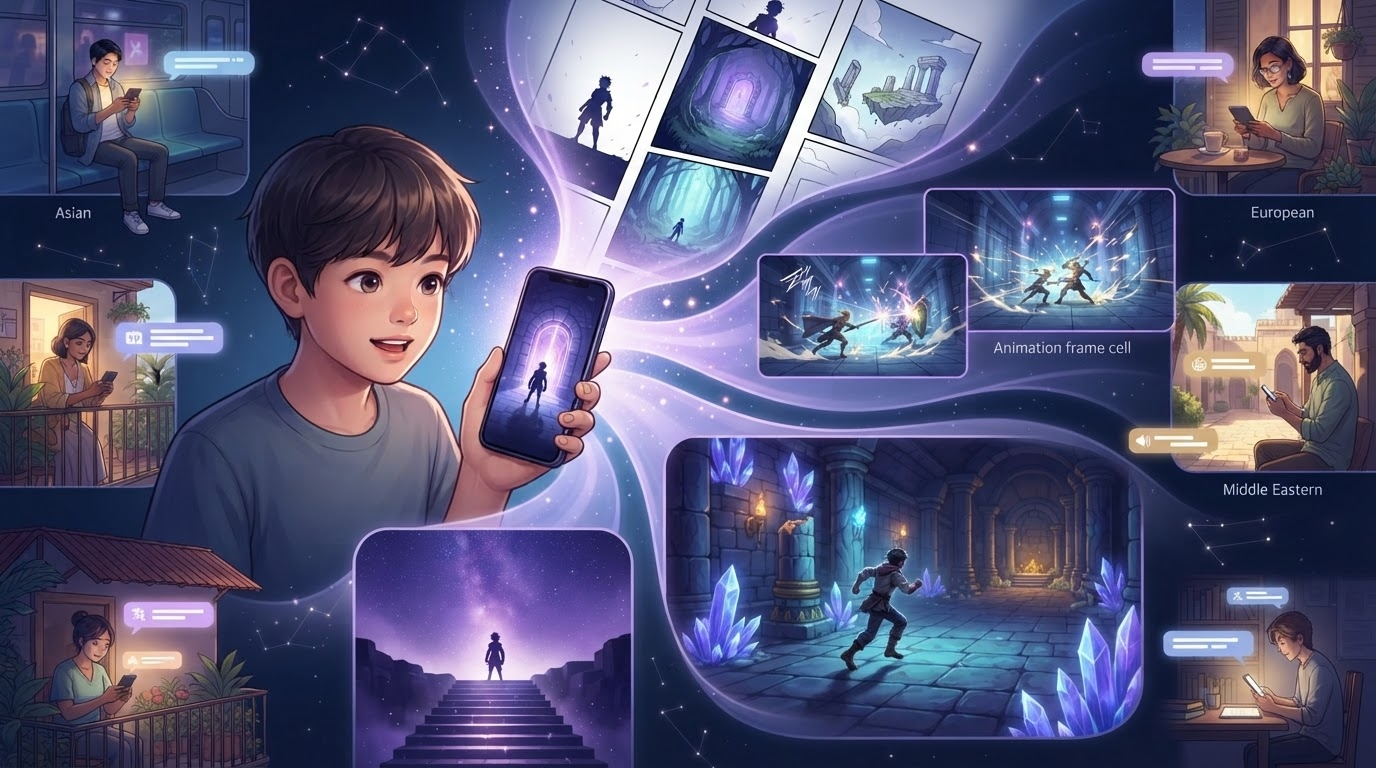
But the way Korean web novels go global is more complex than saying “they succeeded because of universal material.” A web novel doesn’t travel only as a completed book placed on a foreign bookstore shelf. The original work crosses multiple platforms: it becomes a webtoon, an animation, a game, a drama, or a film. Translation is the starting point, but not the entirety of globalization.
The Real Unit of a Web Novel Isn’t a Volume, but a Chapter
In traditional novels, a reader buys a book and reads at their own pace. Web novels operate on the rhythm of serialization. What matters is the cliffhanger—the scene at the end of a chapter that makes you want to open the next one. The reader doesn’t receive the entire long story at once; they enter the world bit by bit, daily or weekly.
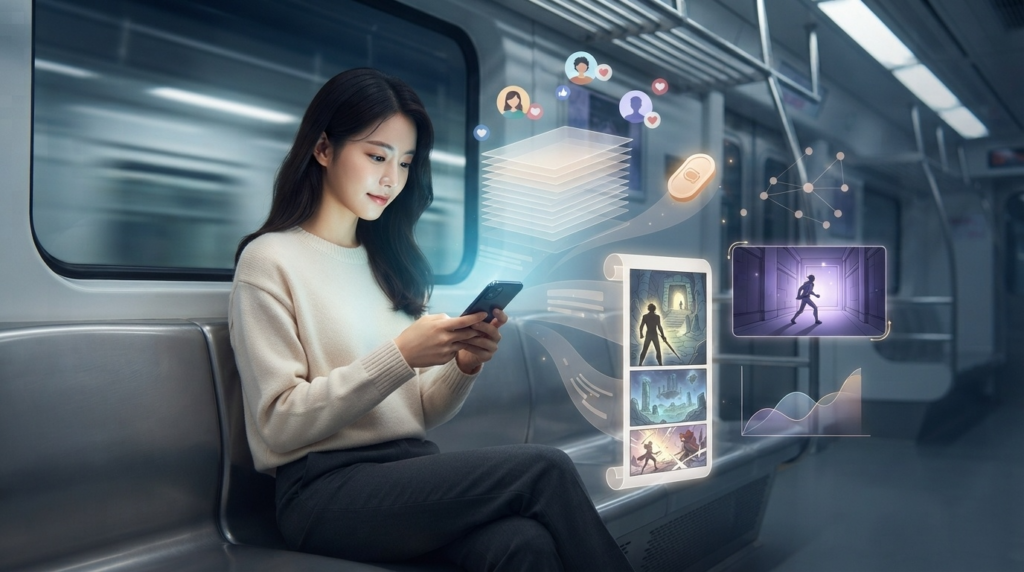
This rhythm fits the mobile environment. On the subway during a commute, you read a few chapters; at night in bed, you pay for the next installment; in the comments, you meet other readers’ interpretations. The consumption of story becomes both a personal reading experience and a social experience within the platform. When Korean web novels meet overseas readers, this structure is preserved. It’s not just translated sentences that cross over; the reading habits of waiting, paying, and sharing reactions travel along with them.
Therefore, the criteria for success differ from simple sales figures. Views, conversion to paid chapters, comments, reader influx after webtoon adaptation, and video rights—multiple indicators determine a work’s life. For authors, this is a structure of increasing opportunities, but it also brings the pressure to keep writing the next chapter.
The Different Path Shown by Omniscient Reader’s Viewpoint
Omniscient Reader’s Viewpoint—Jeonjijeok Dokja Sijeom—is a story about Kim Dokja, a web novel reader, navigating a world where the novel he was reading becomes reality. What makes this work interesting is that the reader appears not as a mere consumer but as a character who knows the rules of the narrative. Questions like “Who is the protagonist of the story?” and “At what point does the reader intervene in creation?” are embedded within the genre’s fun.
This meta-structure becomes an unfamiliar yet attractive entry point for overseas readers. However, translating it without losing the cultural context is no easy task. Korea’s internet culture, the distance in honorifics, hierarchies in school and workplace, and conventions of specific genres—these cannot be fully conveyed by simply moving words one by one. Good translation is not a technique of smoothly altering content; it is closer to a guide that helps the reader endure unfamiliarity.
Here, the role of the translator and local editor becomes crucial. Changing all proper nouns to local equivalents can erase the texture of the work; conversely, piling up Korean expressions without explanation can push the reader out of the story. How much unfamiliarity to retain and how much to unpack—that choice determines the quality of globalization.
Emerging Markets Are Not the ‘Next America’ but Different Readers
When discussing Korean content’s overseas expansion, it’s easy to think first of the U.S. and Japanese markets. Of course, both are important in scale and influence. But as web novel and webtoon platforms expand, Southeast Asia, Latin America, the Middle East, and various European language regions are also emerging as core readers. Calling them all simply “emerging markets” as a single lump misses the actual differences among readers.
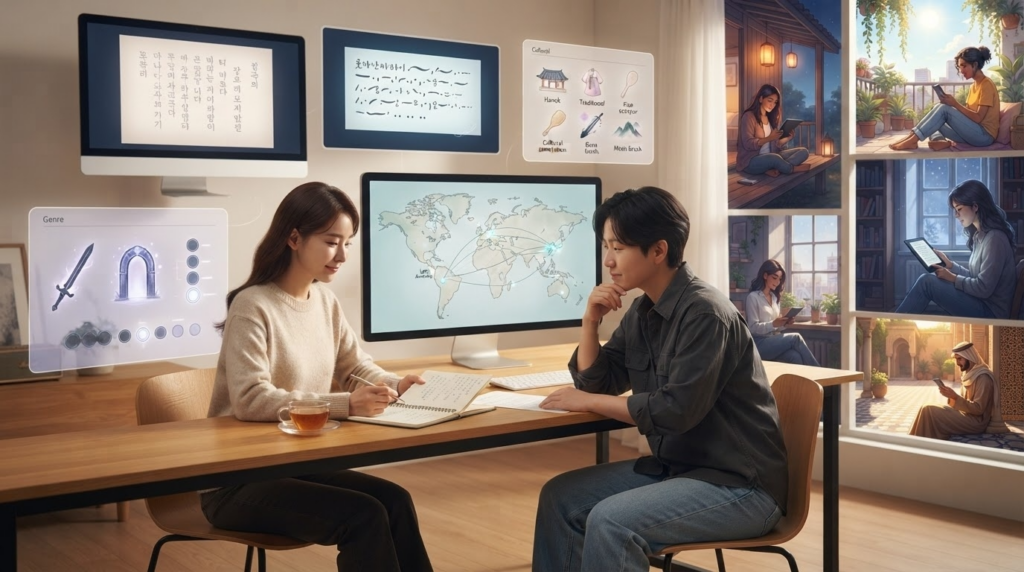
In some regions, mobile payment methods determine accessibility; in others, the speed and quality of local language translation matter more. Some areas see strong responses to fantasy and action, while others see romance fantasy or contemporary romance grow first. The globalization of Korean web novels is not about exporting a single right answer, but about meeting different reading cultures.
In this process, the power of platform companies grows. They recommend works, set prices, decide translation priorities, and judge the potential for video adaptation. The author’s creative rights, revenue distribution, and how reader data is handled remain important issues going forward.
For Stories That Endure Longer Than World Conquest
The phrase “Korean web novels conquer the world” sounds exhilarating, but it makes the movement of literature and content too much like warfare. A more accurate expression is that Korean stories are being read by readers around the world in different ways. Some works become known first through animation, some gather readers through webtoons, and some quietly gain long life through serialized translations.
Solo Leveling and Omniscient Reader’s Viewpoint are symbolic works in this flow, but they cannot be clones of success. It doesn’t mean the next work must follow the same level-up structure or the same path to video adaptation. Rather, what matters more is an ecosystem where diverse genres and voices are translated, authors can create stably, and readers can discover works in their own languages.
Web novels come into your hand lighter than a paper book, but the path a single story takes to cross borders is never light. It requires the translator’s sentences, the platform’s choices, the fans’ comments, and the variations of animation and game adaptations to overlap. The true face of globalization is not that one work is loved equally everywhere. It is that different readers come to wait for the next chapter in their own language and time.
Sources: Korea Economic Daily Global Edition, “Netmarble’s new RPG ‘Solo Leveling’ logs $70 mn sales in 1st month”, June 2024; Korea Creative Content Agency, data on webtoon and web novel industry, 2026.