
Table of Contents
The winter of Korean cinema hidden in the word ‘agreement’
The word hyeop-yak (協約, agreement) carries not the hard command of law but the weary breath of compromise—a pact struck between parties with diverging interests, seated across a table, finally finding common ground. So it is with the ‘Win-Win Agreement for Revitalizing Korean Film Production’ signed on July 16 by the Ministry of Culture, Sports and Tourism, the Korean Film Council (KOFIC), film production companies, and major management agencies. This is not a state-imposed cap on actors’ fees, but a voluntary promise from the industry itself to restart a shrunken filmmaking scene.
The core of the agreement is simple: for films receiving KOFIC’s mid- and low-budget production support, production companies and management agencies will cooperate to keep the total fees for lead and supporting actors under 10% of the net production cost. Signatories include major agencies like BH Entertainment, Management SOOP, and J-Wide Company, along with the Korean Film Producers Association and the Korean Film Producers’ Guild.
The emergence of this agreement cannot be explained by the individual value of actors alone. According to KOFIC data, the average production cost of a Korean film in 2024 was about 9.5 billion won, with actor fees accounting for 18–19% of that—nearly half of total labor costs. The more that limited budgets concentrate on star casting, the less remains for cinematography, post-production, art, sound, and the working conditions on set.
10% is not a cap but a standard for voluntary cooperation
First, a misunderstanding must be corrected. This agreement is not a system that binds all Korean films to keep actor fees under 10% of net production cost. It applies only to mid- and low-budget films receiving government support, and it is closer to a moral and industrial consensus without legal force. Contracts regarding fees will still be determined through negotiations between producers, actors, and agencies.
That does not mean the agreement is insignificant. In the Korean film industry, the rising cost of actor fees has long been cited as a key factor in escalating production expenses. Especially at a time when theater attendance has not recovered to pre-COVID levels and streaming platforms have reshaped the order of production and distribution, the burden of production costs makes investment decisions even more difficult.

The government has also announced plans not to let this agreement end as a one-time declaration. A private-sector consultative body involving management agencies, production companies, investors, and distributors will be formed to continue discussing ways to improve the production environment. Because although fees appear as numbers, they are actually tied to casting practices, investment structures, distribution conditions, and box office revenue—the entire industrial ecosystem.
Why mid-budget films need special protection
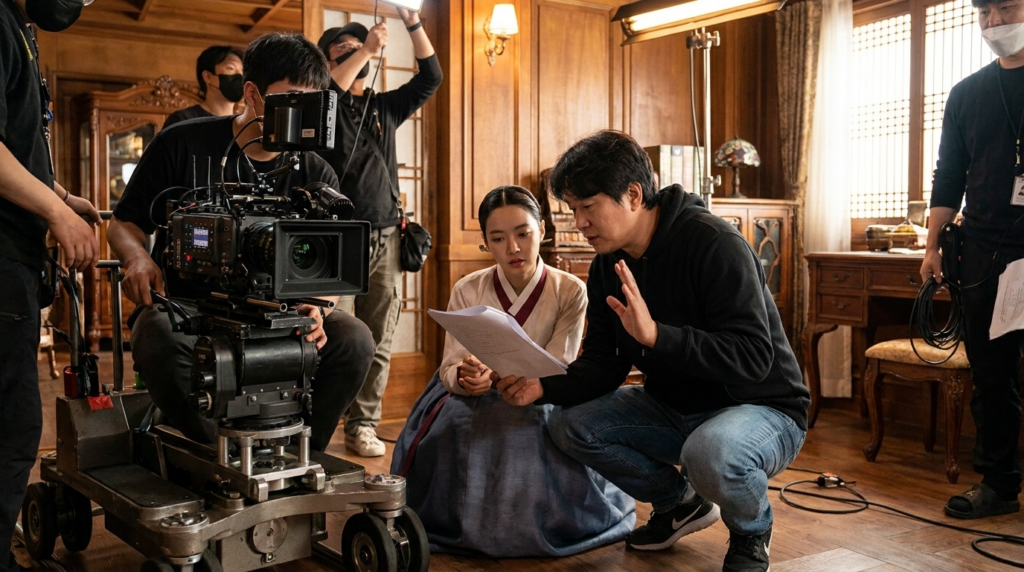
Mid-budget films occupy the space between blockbusters and low-budget independent films. They have enough production funds to secure actors, crew, and genre polish, but they cannot afford the massive marketing costs and star dependency of large franchise films. When that middle ground shrinks, Korean cinema loses the diverse stories that lie between giant commercial films and small independent ones.
KOFIC launched a new mid-budget Korean film production support program in 2025, expanding the initial budget of 10 billion won to 20 billion won by 2026. After supplementary budgets and other measures, the total policy support grew even larger. In 2026, 334 films applied for support, and after review, 16 were selected. This is not just about increasing the amount of subsidies; it proves that many films still find it difficult to enter production through private investment alone.
Director Chung Ji-young’s My Name, starring Yum Hye-ran, is one of the 2025 supported works. After being invited to the Forum section of the Berlin International Film Festival, it prepared for domestic release. Government support does not guarantee box office success, but it can buy time for mid-sized films to go from production and completion to international festival exposure.
An actor’s name still moves investors and audiences
The most practical question surrounding this agreement is this: Will lowering fees automatically produce good films? The answer is no. Mid-budget films have smaller promotional budgets than blockbusters and may secure limited screens during theatrical release. So production companies still rely on familiar actor names as a key basis for attracting investment and marketing.
This is also why some in the industry view the agreement with caution. Some argue that the problem of excessive fees is more pronounced in big-budget commercial films over 10 billion won or in large-scale streaming series. Since this agreement applies only to mid- and low-budget films receiving government support, it cannot immediately change the entire market where cost increases are most severe.
Moreover, it remains unclear how many proven box-office actors will participate in projects offering lower fees than usual. There are concerns that reduced star casting could put films at a disadvantage in investment and promotion. Conversely, there is hope that the reduced fee burden will open space for new actors, new directors, more meticulous scripts, and better production environments. The agreement marks the first experiment between these two possibilities.
The larger question that remains after fee adjustments
Explaining the crisis of Korean cinema solely through actor fees is overly simplistic. Audience viewing habits have changed; the gap between theatrical release and online availability has narrowed; investors tend to prefer safe blockbusters or platform series over uncertain mid-sized films. Fee adjustment may be a necessary starting point, but without addressing investment, distribution, screening opportunities, and production labor conditions, it will not last.
As one distributor insider put it, the discussion must not stop merely at lowering actors’ fees. Conditions must be created where talented actors naturally want to participate in mid-budget films, where producers do not have to bear excessive risk, and where audiences can encounter films of various scales in theaters.
Because the agreement lacks enforcement, it may seem weak. But changing market practices that cannot be enforced often begins with a promise. What matters going forward is not the number 10%, but what films are actually made under that number. Whether new actors and directors meet, whether production funds flow back into film quality and on-set safety, and whether audiences once again choose mid-sized Korean films—that will be the real report card of this agreement.
Sources: Ministry of Culture, Sports and Tourism and KOFIC Win-Win Agreement announcement, 2026-07-16; Yonhap News, 2026-07-16; Hankook Ilbo/The Korea Times, 2026-07-27; KOFIC, ‘2026 Mid-Budget Korean Film Production Support’ announcement.