
Table of Contents
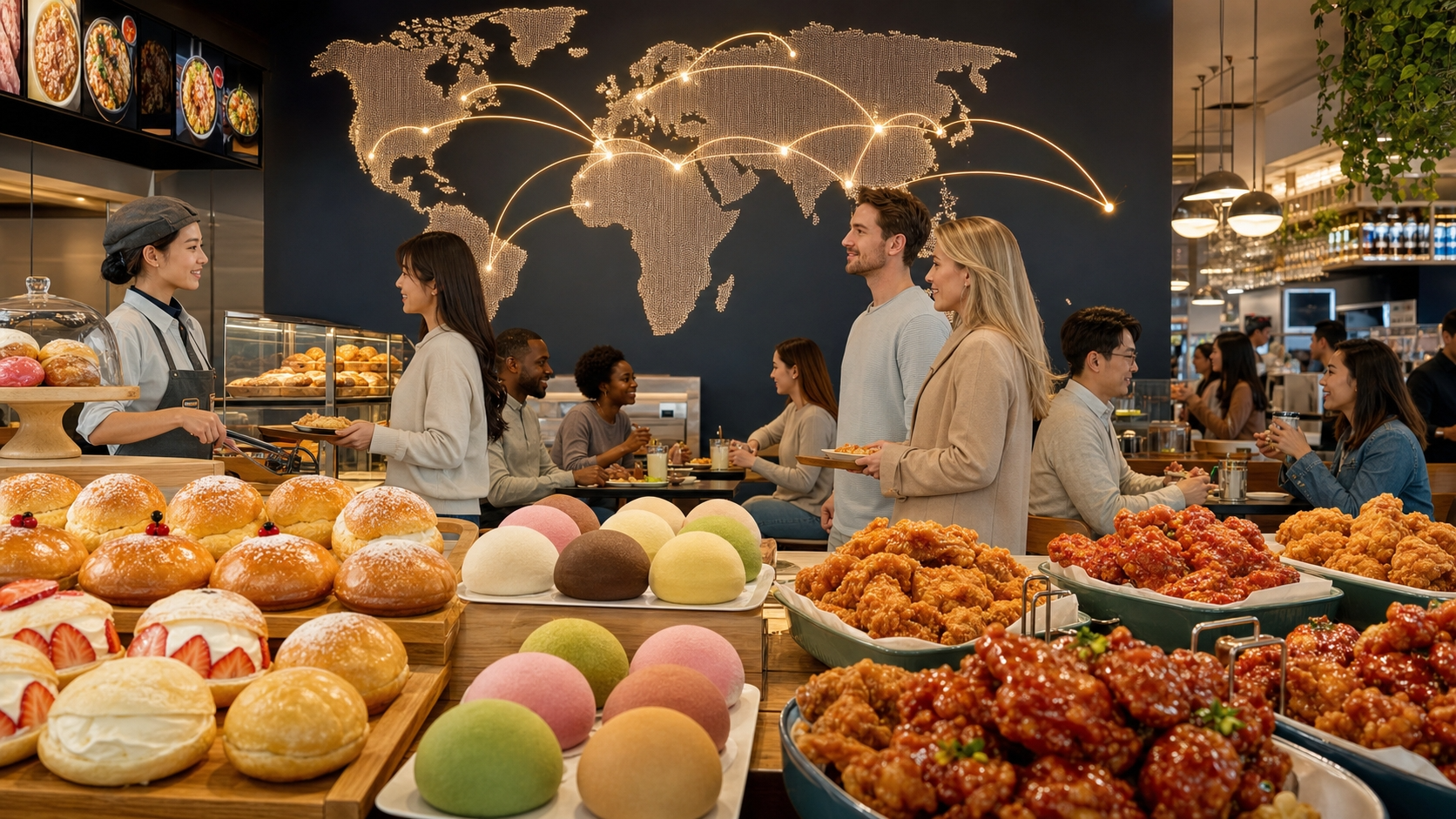
The number of Korean restaurant companies with stores overseas just hit 203. Bakeries and fried chicken are leading K-food’s overseas push past a handful of big-company success stories and into what looks like the industry’s second wave of expansion.
203 Companies, 228 Brands, 77 Countries
As of the second quarter of 2026, 203 Korean restaurant companies had stores overseas. That’s up 81 from 122 in 2025, a 66.4% jump, and the first time the count has topped 200. Between them, these companies run 228 brands and 5,188 stores abroad. Of the 203 companies, 194 are franchises and 9 are non-franchise operations.
That doesn’t mean all 81 newly went overseas this year — read it as the total number of companies with an overseas presence growing year over year. In fact, only 28 brands made their first overseas move through the second quarter of this year. The real story in this number isn’t individual openings, it’s that the base of companies going global has gotten wider.
The countries expanded too, to 77. By company count, the U.S. leads with 65, followed by Vietnam with 55 and Japan with 39. By store count, the U.S. tops every single country with 1,228 locations. Compared to earlier waves of expansion, when China was the center of gravity, the U.S. and Japan now carry more weight — that’s a different picture than before.
From 299 to 300: U.S. Stores Are Piling Up Fast
Bakeries show America’s expansion most clearly. Paris Baguette was running 299 U.S. stores as of May, and crossed the 300-store mark on June 1 with a location at Philadelphia International Airport. Tous Les Jours passed 200 U.S. stores sometime in May. Put the two brands together, and that’s already more than 500 stores in the U.S. alone.
Revenue at CJ Foodville’s U.S. subsidiary, which runs Tous Les Jours, climbed from 51 billion won in 2021 to 76.3 billion won in 2022, 105.4 billion won in 2023, 137.3 billion won in 2024, and 194.6 billion won in 2025 — roughly 3.8 times the 2021 figure. Net profit over the same stretch grew from 4.6 billion won to 34.9 billion won.
Tous Les Jours also built a roughly 90,000-square-meter production plant in Gainesville, Georgia, giving it the capacity to make more than 100 million units a year of frozen dough, cakes, and other products. It’s not just adding franchise locations anymore — it’s started building out its own local supply chain.
K-Bakeries Are Changing How Americans Pick Their Bread
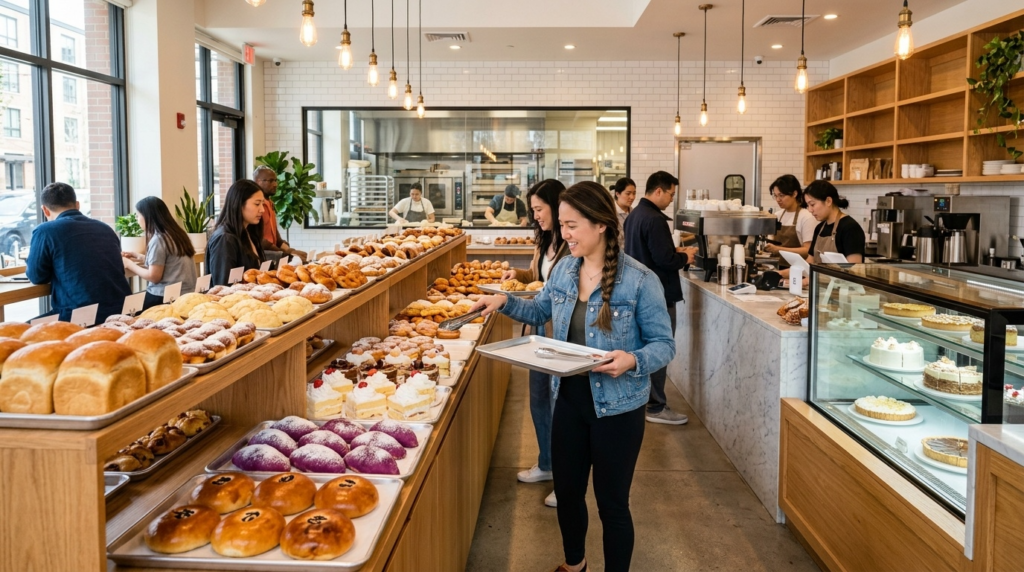
What makes Korean-style bakeries stand out isn’t one or two signature items — it’s the sheer range of options. Unlike the smaller-menu bakeries typical in the U.S., Tous Les Jours leans on baking roughly 400 kinds of products in-store, from red bean and cream buns to cakes and donuts.
For customers, that turns into the experience of a café, a dessert shop, and a grab-and-go spot all in one place. Operationally, it lets headquarters standardize dough, recipes, equipment, and display, which makes franchise expansion easier. And within the familiar format of “bread,” they can build in distinctive flavors like red bean, sweet potato, matcha, and milk cream.
Fried chicken works the same way. A familiar ingredient — chicken — becomes distinctly Korean through seasoning and a crispy batter, and it travels well for takeout and delivery. Standardizing sauces and cooking processes also makes it easier to expand through master franchise partners across many locations. Among currently overseas-bound brands, Korean food leads with 87 brands, followed by fried chicken with 32.
A Saturated Home Market Turned Going Overseas From a Choice Into a Growth Requirement
Competition in Korea’s domestic restaurant market is fierce, and labor, rent, and ingredient costs have all climbed. Even opening a new store at home risks overlapping with an existing franchisee’s trade area. Overseas, on the other hand, companies can tap the goodwill Korean food already has thanks to K-pop and K-dramas, and pick up new franchise demand from there.
In this survey, the most common reason companies gave for going overseas was “to capture new growth opportunities through the global market.” The dominant expansion model was master franchising — a local operator handles store development and day-to-day operations, while the Korean headquarters supplies the brand and operating system. It’s a structure that lowers the upfront investment burden while allowing fast expansion across multiple cities.
But relying on local partners also carries the risk of quality control slipping. Royalty rates and contract terms vary a lot depending on the country and how well-known the brand already is, and without a solid logistics network behind it, a menu can shrink or costs can rise.

After “Breaking 200,” the Next Numbers to Watch Are Revenue and Survival
The number 203 marks a turning point — K-food’s overseas expansion has entered another growth phase. It matters even more given that the count of companies with an overseas presence climbed as high as 193 in 2017, fell to 121 by 2024, and has now rebounded.
Still, company and store counts alone can’t confirm success. What’s worth tracking next is local subsidiaries’ revenue and profit, franchisee survival rates, sales per store, and how much of their ingredients are sourced locally. Whether more brands build out production plants and supply chains the way Tous Les Jours has is another thing worth watching.
This story isn’t meant to spotlight one brand’s overseas success — it’s a follow-up look at what breaking 200 restaurant companies actually means for the structure of the industry. K-food’s next test isn’t going out further, it’s surviving longer across 77 different markets.
Source: Asia Business Daily, August 5, 2026; Money Today, May 24, 2026.