

Table of Contents
Korean kimchi just made itself a little more at home on dinner tables around the world. Kimchi exports came in at about $164.4 million for 2025, a record for the second year in a row after 2024. The number of countries buying it grew too, hitting 102 for the first time ever. That matters more than the dollar figure alone — exports used to lean hard on a handful of countries and Korean communities abroad, and that’s slowly starting to spread out.
This year’s numbers look decent too. Kimchi exports for the first half of 2026 came in around $86 million, up 3.2% from the same stretch last year. It’s too early to call the full-year result, but if that pace holds, 2026 could make it three record years running. Just keep in mind last year’s full-year record and this year’s half-year number are measuring different windows, so they’re not directly comparable.
102 Countries Wide: How Far Kimchi’s Export Map Has Spread
The number of countries buying kimchi went from 85 in 2020 to 95 in 2024, and hit 102 in 2025. What stands out isn’t just the export total — it’s how much wider the map got. For kimchi’s growth to actually hold up long-term, it has to become something local shoppers pick out for themselves, not just a familiar side dish for Korean expats.
Part of what’s driving that is straightforward: interest in Korean culture, plus a broader appetite for fermented, gut-healthy food. Kimchi shows up constantly in K-dramas, music, and variety shows now, so people already know the name and roughly how to eat it before they ever taste it. Add in a wave of shoppers who are actively looking for fermented foods for gut health, and kimchi stops looking like “that spicy Korean thing” and starts looking like just another healthy staple.
Where you can actually buy it is changing too. It used to be Korean grocery stores and Asian markets doing most of the heavy lifting. Now it’s showing up on shelves at big-box discount stores and regular supermarkets abroad. That means a shopper doesn’t have to go out of their way to a specialty store anymore — they can just grab it while doing their regular grocery run. That kind of everyday-shelf placement is what actually turns “more countries importing kimchi” into “more people eating kimchi.”
What North America’s Roughly 40% Share Actually Means
North America accounted for roughly $30.6 million of kimchi exports in the first half of 2026, up 15.3% from the same period last year. Stack that against total first-half exports, and North America made up close to 40% of the whole pie. That’s not “emerging market” territory anymore — it’s the region actually driving kimchi’s export growth. The U.S. specifically is doing most of the pulling.
U.S.-bound exports for the first half came in around $24.6 million, up 12.9% year over year. Japan, meanwhile, still took the top spot at roughly $28.82 million, but that was down 1.8% from the same period last year. With the gap between Japan and the U.S. narrowing, people are already floating the idea that the U.S. could overtake Japan as the top kimchi market. I’d hold off on calling that, though — one half-year of numbers isn’t enough to bet on a ranking flip. Better to watch how the full year plays out.

There’s another quiet tailwind here: the U.S. government’s 2025–2030 dietary guidelines actually name-check kimchi as an example of a fermented food. The guidelines push people toward minimally processed vegetables, fruit, protein, and fermented foods. Having kimchi show up in an official U.S. government document is the kind of thing that makes it a lot easier to explain to a new shopper why it’s worth trying.
From Spicy Side Dish to Everyday Ingredient
For kimchi to keep growing in North America, the product lineup needs to actually fit how people eat there. Beyond traditional napa cabbage kimchi and cubed radish kkakdugi, small single-serve packs that are easy to toss on a sandwich, a burger, grilled meat, or fried rice could open things up to more shoppers. Clearly labeling spice level, how fermented it is, and whether it’s vegan also lowers the barrier for someone trying kimchi for the first time.
Kimchi-based seasonings, sauces, and powdered products could catch on too. For someone who isn’t ready to commit to a whole container of kimchi, being able to sprinkle a little into a dish they already cook is a much easier entry point. That said, if “kimchi-flavored” processed food multiplies without much actual kimchi in it, that risks blurring what real Korean kimchi even is. Being upfront about origin, ingredients, and how it’s actually made needs to go hand in hand with that kind of product expansion.
Cold Chains and Local Regulations Have to Keep Up Too
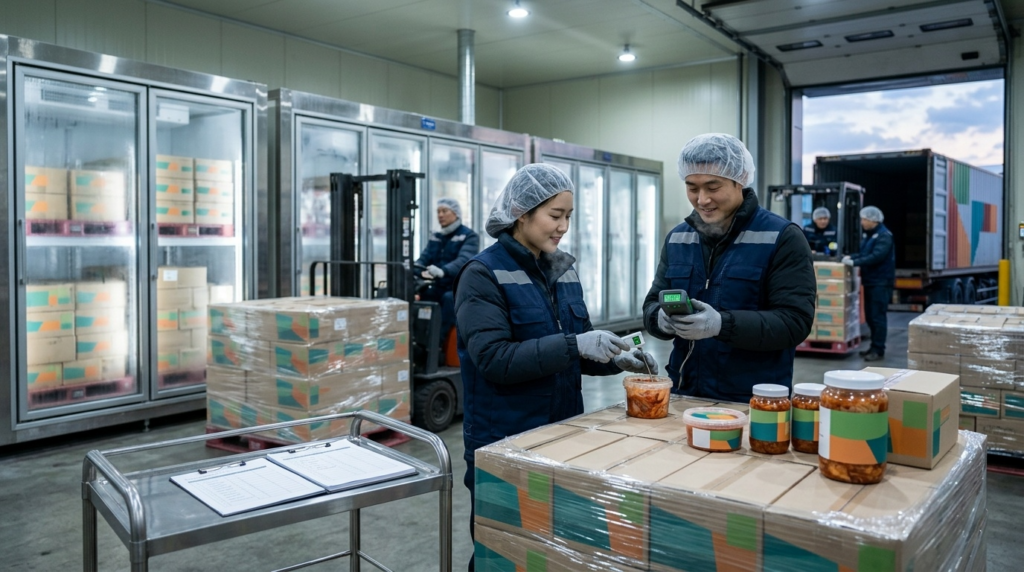
Growing exports also depends on something less glamorous: reliable cold-chain shipping and staying on top of local food regulations. Kimchi keeps fermenting the whole time it’s in transit, so how long shipping takes and what temperature it’s kept at can change both the taste and how the packaging holds up. Every country has its own rules on food labeling and additives too, and those need careful attention. Selling more kimchi matters, but making sure a shopper gets roughly the same quality every single time they buy it is what actually builds long-term trust.
What Comes After the Record Is One Steady Meal at a Time
Central Asia had a strong first half too — exports there grew 32.2% year over year. It’s a smaller number than North America’s, but it’s worth noting because it came from actually getting onto local retail shelves and building out cold-chain shipping, not just riding an existing wave. If kimchi exports don’t want to lean too hard on a handful of major markets, the strategy needs to actually reflect each region’s food culture and distribution setup. One flavor and one style of packaging isn’t going to work everywhere.
It’s genuinely good news that kimchi just posted a second straight record export year. But the real win happens later — when someone who tried it once buys it again, and starts treating kimchi as just another everyday ingredient instead of a novelty. North America’s roughly 40% share shows real potential, but it’s also a number worth watching so exports don’t end up too concentrated in one region. Whether kimchi sets the next record will come down to the unglamorous, ongoing work — quality, localization, and distribution, all improved together.
Source: Ministry of Agriculture, Food and Rural Affairs, “2026 First-Half Korean Food Export Results” press release; Korea Customs Service trade statistics; Hankyung; Good Morning Economy; Nongmin Shinmun (Farmers Newspaper).