
Table of Contents
Works That Had to Wait Their Turn to Be Translated
For Korean webtoons to reach readers abroad, a title had to go through selection, translation, lettering, and local review, in that order. Because it was hard to invest the same cost and time in every title, opportunities to go overseas tended to concentrate on works that had already proven popular at home. Titles aimed at niche tastes or a smaller readership, even highly polished ones, often struggled to find any path into other languages.
Translating a webtoon involves more than swapping the dialogue inside speech bubbles into another language. Translators must convey characters’ speech patterns, relationships, honorifics, humor, and cultural context while fitting the translated text into a limited space. Even platforms with a global distribution network faced limits on how many titles could be translated and how quickly, which reduced the very chances niche titles had to be judged by readers abroad. A work often had to be translated first to gauge overseas demand, yet it was difficult to justify translation costs for a work whose demand had not yet been confirmed.
How the 2026 Canvas Integration Became a Turning Point
The shift became a concrete service plan in March 2026. Webtoon Entertainment, the U.S.-based parent of Naver Webtoon, announced it would integrate Canvas — its amateur creator platform, previously run separately by country and language — into a single global platform. The plan is to connect creators and readers who had been scattered across different regions in one shared space, increasing the chances that a work can be discovered across borders.
Before the integration, Canvas was split into separate language-specific services, so creators who wanted to reach readers in other regions had to re-post and manage their work separately for each language market. On the integrated platform, the performance and reader response of a work published in multiple languages can be checked in one place. Creators are spared the burden of running each regional service separately, while readers can more easily discover titles from other regions that match their language and taste.
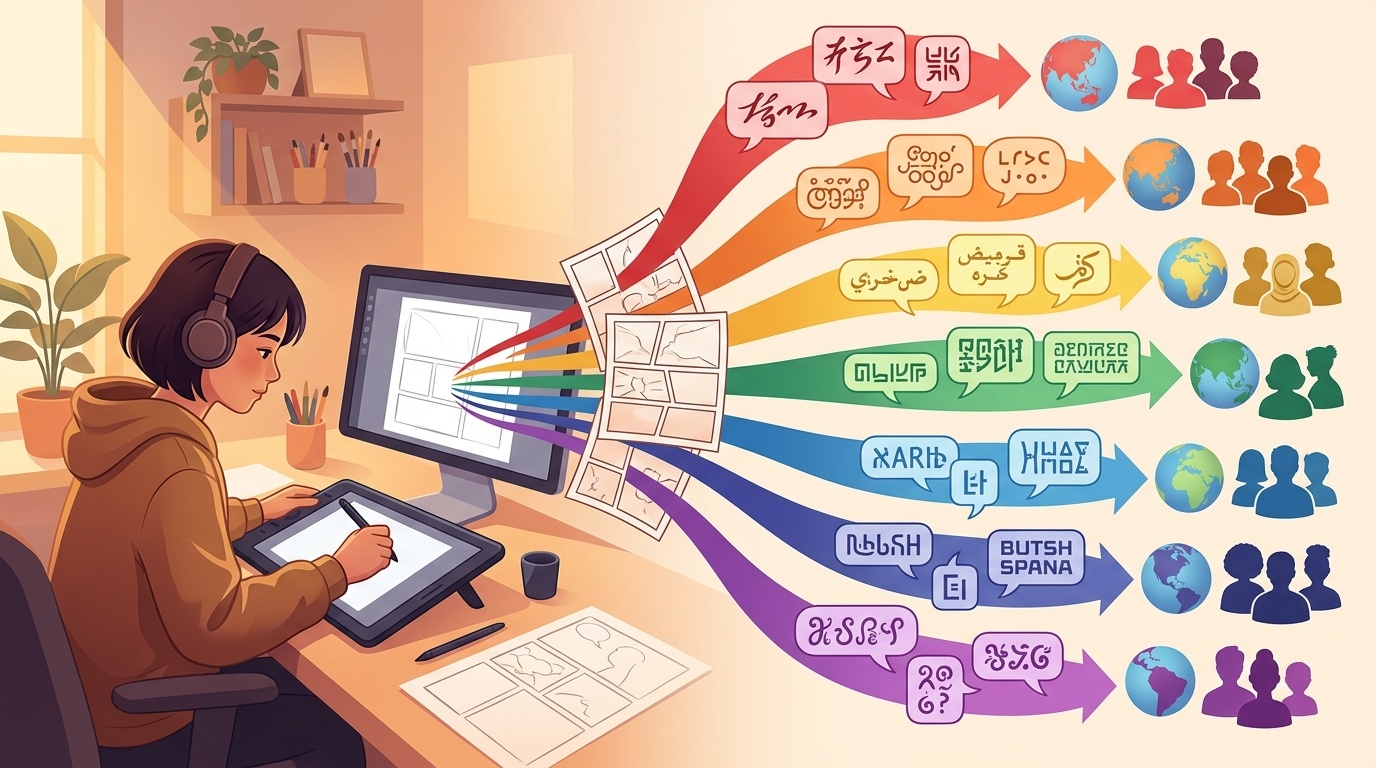
The core feature of the integrated platform is an opt-in AI translation program that lets creators decide whether to participate. It supports seven languages: English, Spanish, French, Indonesian, Thai, Traditional Chinese, and German. A pilot covering a portion of the English Canvas titles began in the first half of 2026, with plans to gradually expand the program to the other language services.
From Curated Hits to Creator Choice
Under the old model of overseas distribution, it was standard for a platform or publisher to review a title’s commercial potential before selecting it for translation. Under the new program, Canvas creators who meet certain requirements can decide for themselves whether to take part and which languages to offer. That opens a channel for testing how readers in other languages respond to a work even before it grows into a major hit.
According to Canvas’s guidelines, a title must have at least 10 episodes published and have logged more than 2,000 cumulative global views over the past 365 days to join the translation program. Creators who meet those conditions can choose one or several languages for translation on a title-by-title basis. New episodes are translated and released alongside the original, narrowing the time gap between the source text and the translated version.
Creators compile a glossary of key character names, titles, and plot details to help keep translations consistent, and can add further notes on the work’s setting and key terminology. Those who prefer not to participate can simply not apply, or can withdraw later, and creators running multiple series can set different translation choices for each one. The structure is designed so that AI lowers the cost and time barrier to translation while leaving the basic authority over whether and where a work is published with the creator.
Niche Titles Meeting a Reader Base in the Hundreds of Millions
Webtoon Entertainment has disclosed an average of about 157 million monthly active users in 2025. The significance of the integrated Canvas lies in connecting that existing reader base with creative work in multiple languages. A title classified as a small niche genre at home or in a particular region can build a new fan base once it connects with overseas readers who share similar tastes.
The potential of niche titles does not lie only in becoming broadly popular in every region at once. Even where the overall readership in a given market is small, a work can find readers in a specific country or language group who respond strongly to its subject matter, art style, or characters. For titles that previously could not even be released abroad because of translation costs, the ability to test small, region-specific reactions is itself a meaningful change.
The integrated platform also introduces a creator dashboard that shows performance metrics such as view counts and subscriber growth, personalized recommendations that connect readers with titles matching their tastes, and tools for viewing and managing comments in multiple languages. Rather than simply publishing a translated work and stopping there, the system is designed to track daily, weekly, and monthly response, adjust serialization and promotion accordingly, and manage a fan community that spans borders.
More Titles Get a Starting Line in the Global Market
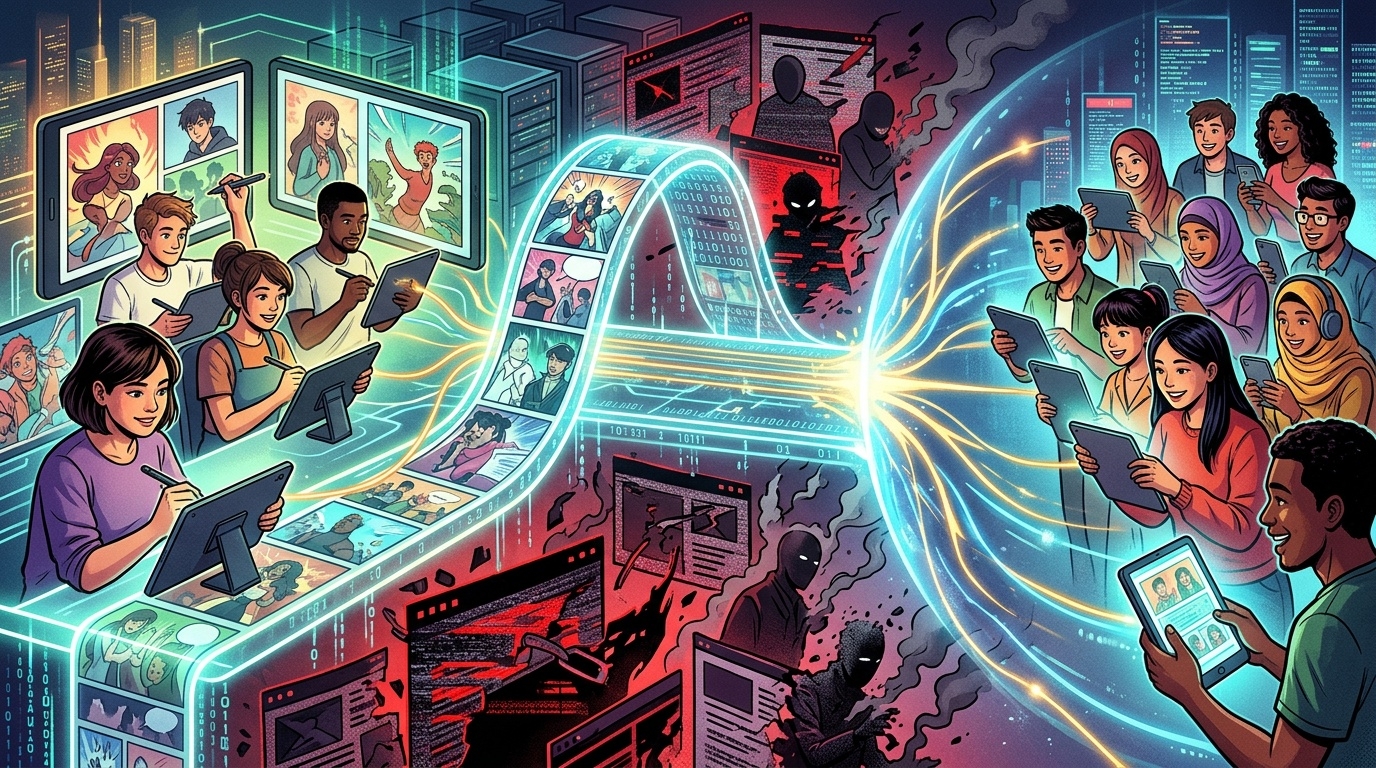
AI translation does not guarantee every title will succeed overseas. But it can widen the opportunity for works that never made the translation shortlist to be exposed to readers abroad and prove their growth potential based on actual response. It reverses the order of distribution — from translating and exporting titles that are already hits, to using translation as a way to discover new hits.
That shift is also tied to the expansion of webtoon intellectual property. View counts, subscriber changes, and comments and reader response gathered across multiple language markets can become data for judging whether a work is ready to expand into official serialization, print publication, or other media such as film and games. For niche titles that cannot expect large-scale marketing in particular, a platform that combines translation, recommendation, and performance analysis becomes the first proving ground on the way to the global market.
Canvas is a space where amateur creators publish their work directly and build up reader response in search of a chance at official serialization. Adding multilingual distribution on top of that can reduce the extent to which the region where a work originates limits its growth potential. Rather than simply exporting Korean titles into foreign languages, the structure is expanding into one where creators from many countries seek readers worldwide on the same platform.
Expanding Official Distribution While Tackling Piracy
Alongside improving access to translation, illegal translation and unauthorized copying remain a challenge that must be addressed. The Korea Creative Content Agency’s “2024 Webtoon Industry Survey,” applying the Korea Copyright Protection Agency’s piracy usage rate, estimated the webtoon industry’s damage from piracy in 2023 at roughly 446.5 billion won. If demand waiting for an official translation abroad shifts instead to illegal distribution channels, it weakens the revenue base for both creators and platforms.
Naver Webtoon said on August 13, 2026 that it had worked with South Korea’s Ministry of Culture, Sports and Tourism, Interpol, and local law enforcement in North Africa to shut down three global illegal webtoon and manga sites and arrest their operators. The sites had scanned and translated roughly 300 popular Naver Webtoon titles into English without authorization and distributed them, drawing a combined total of more than 130 million visits a year.
The sites that were shut down were not merely relay networks linking copies hosted elsewhere — they served as primary sources, distributing scans and translations they had produced themselves. Naver Webtoon gathered information on the sites’ operating structure and evidence of copyright infringement and handed it over to the relevant authorities, and local investigators arrested the operators and are pursuing legal proceedings. Rather than simply blocking individual addresses, the action targeted both the upstream distribution networks through which pirated copies spread and the operators behind them.
The Canvas integration and the opt-in AI translation program represent an attempt to expand K-webtoons’ growth model from exporting proven hits to discovering many titles worldwide at once. What happens next depends on whether translated titles actually build overseas readerships and paying users, and whether niche titles go on to secure official serialization and expanded intellectual property. The next step after lowering the language barrier is building a distribution structure that channels fair compensation back to the creators and works that get discovered.
Source: Webtoon Entertainment press release, March 26, 2026; Canvas creator guidelines, 2026; Korea Creative Content Agency, “2024 Webtoon Industry Survey,” December 2024; Naver Webtoon press release, August 13, 2026.