Table of Contents
The economic pressure behind rising satisfaction
Satisfaction with current life among single-person households in South Korea has reached 73.5%, marking a 2.3 percentage point increase from 2024. Yet, the same survey reveals that the proportion of those living in monthly rent setups is pushing 48.8%, and 59.6% are “N-jobbers” taking on side hustles in addition to their main work. Among those with loans, 34.0% reported using borrowed money to invest in financial products. People are increasingly happy living alone, but the financial burden required to sustain that lifestyle is growing just as fast.
The KB Financial Group Research Institute published its “2026 Korean Single-Person Household Report” on July 19. The survey polled 2,000 single men and women aged 25 to 59 in major cities nationwide from February 25 to March 23. Designed as a representative study of Korea’s single-person households, now nearing 8 million statistically, the report offers a comprehensive look at their life satisfaction, housing, consumption, asset management, and employment trends.
Living alone has become more comfortable
Life satisfaction for solo dwellers jumped from 57.0% in 2020 to 73.5% in 2026. A solid 58.3% also expressed a strong intention to continue living alone. When asked why, the most popular answer among this group was simply “because it’s comfortable being alone” (61.4%). More and more people are embracing solo living not as a temporary waiting room before marriage or cohabitation, but as an independent and autonomous lifestyle in its own right.
That said, not everyone started this journey entirely by choice. About half of the respondents noted they began living alone regardless of their own will, often driven by job relocations, studies, shifts in family dynamics, divorce, or bereavement. However, as they adapt to the lifestyle, their satisfaction naturally grows. This blend of an involuntary start and current contentment is the first major duality of the Korean single-person household.
Jeonse shrinks while monthly rent nears half
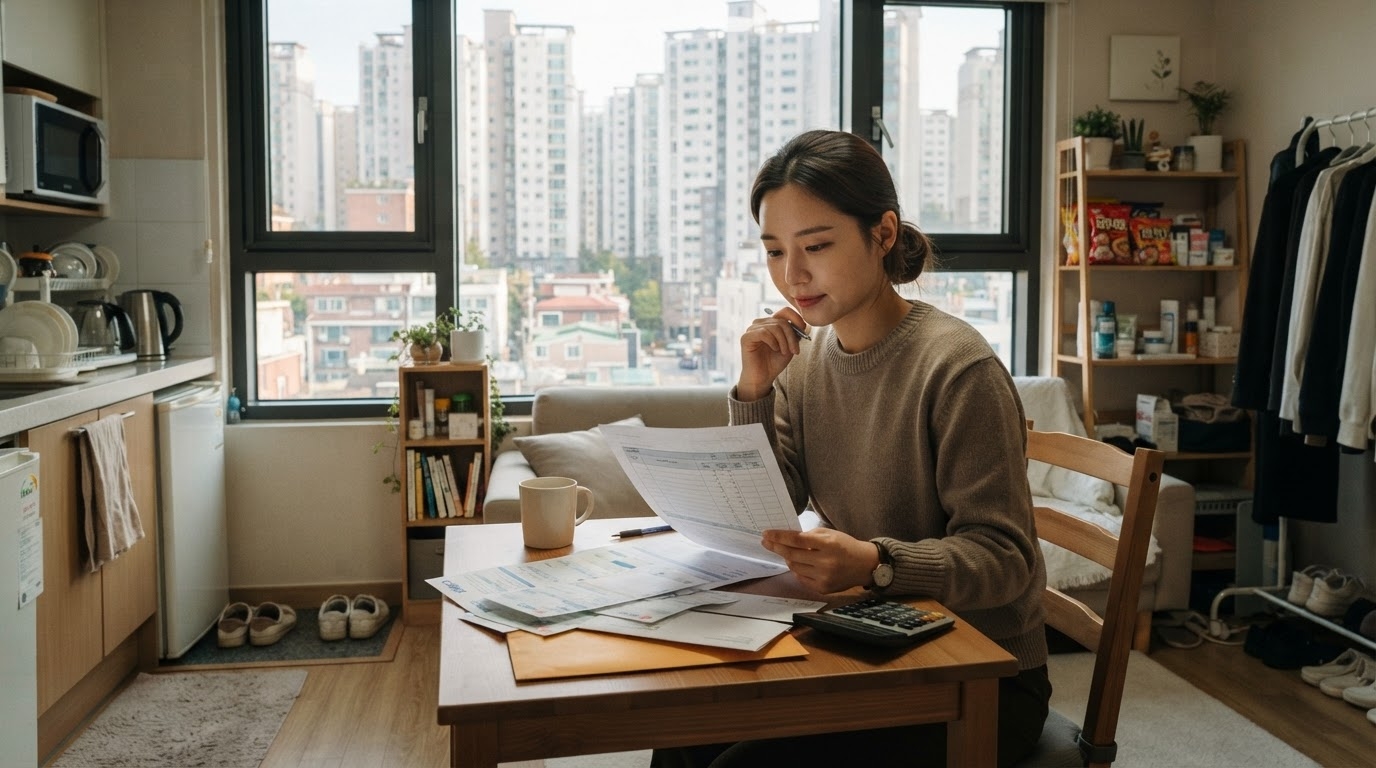
Nowhere is this shift more visible than in housing. The proportion of people paying monthly rent hit 48.8%, up 3.7 percentage points from 2024. Over the same period, those utilizing jeonse (Korea’s unique leasing system where a tenant gives the landlord a lump-sum deposit, returned at the end of the contract, instead of paying monthly rent) dropped by 6.6 percentage points to 23.4%. Meanwhile, homeownership rose slightly by 2.0 percentage points to 23.8%. While jeonse eliminates monthly out-of-pocket rent, it forces tenants to shoulder the burden of securing a high deposit and the risk of not getting it back.
The decline in jeonse suggests single-person households are diverging into two paths: staying in monthly rentals or outright buying smaller properties like officetels and villas. The survey found that 10.7% had experienced falling behind on rent, up 2.8 percentage points from two years ago. Conversely, 61.0% of non-homeowning singles expressed a strong desire to buy property. As the pressure of monthly rent mounts, the craving for homeownership naturally intensifies.
Solo dwellers don’t have the luxury of splitting rent and maintenance fees with roommates or family members. Even in a tiny space, one person bears the full weight of the deposit, utility bills, and basic living expenses. The rise in monthly rent residency is more than a shift in housing types; it directly squeezes the livelihoods of singles who now face steeper fixed monthly costs.
When one job just isn’t enough
One of the most striking changes in the report is the boom in side hustles. The ratio of “N-jobbers,” people working additional jobs on top of their main career, stood at 59.6%. That is a 17.6 percentage point leap from 42.0% in 2022. By age group, those in their 20s led the pack at 69.1%, followed closely by people in their 40s (59.1%) and 50s (47.8%). Side hustling now cuts across generations as a strategy for supplementing income, not just an experiment among the young.
Taking on multiple jobs is a response to the crushing cost of living, but it also serves as a tool for asset management. Among those juggling two or more side gigs, 21.1% felt their retirement preparations were excellent, noticeably higher than the 14.8% among those with no side jobs. Similarly, 33.0% of heavy N-jobbers believed they managed their assets well, compared to 21.3% of single-job workers. Extra labor seems to act as a buffer for immediate living expenses while unlocking the capacity to save and invest.
We shouldn’t frame this high rate of side hustling purely as economic desperation. Some actively choose to juggle gigs to gain new skills, explore different careers, or simply boost their disposable income. Yet, when paired with the rising burden of monthly rent and broadly low satisfaction regarding personal finances, it’s safe to say the N-job trend is fueled by a mix of proactive choice and defensive survival.

Fewer savings, more debt-leveraged investing
The makeup of financial assets is also shifting. Traditional savings and deposit accounts made up 28.3% of portfolios, tumbling 7.8 percentage points from two years ago. On the flip side, stocks and ETFs grew by 6.1 percentage points to 21.1%, while cryptocurrency holdings nudged up by 1.3 percentage points to 3.5%. When asked what financial products they plan to invest in over the next year, domestic stocks and ETFs topped the list at 42.1%.
Among those with existing debt, 34.0% said they had used borrowed funds to invest in financial markets, a 5.2 percentage point increase from 2024. This doesn’t mean 34% of all single-person households are making highly leveraged trades; the figure only applies to those who already hold loans. Even so, it clearly points to a growing pressure to migrate away from safe, low-yield savings toward more volatile assets.
It’s worth reading these numbers through the lens of the survey’s timing. Conducted between February 25 and March 23, the data captures investment sentiment before the recent plunge in the KOSPI index. Therefore, the strong appetite for stocks and ETFs shouldn’t be read as a post-crash reflection. When market realities shift dramatically, risk tolerance and investment desires often follow suit.
A lifestyle where freedom and anxiety grow together
When asked what area of their lives most desperately needs improvement, 67.3% of single-person households pointed to economics and personal finance. The leading reason for this financial dissatisfaction, cited by 60.7%, was an “insufficient economic foundation.” People love the solo lifestyle, but the solitary burden of covering rent, living expenses, and retirement savings remains a heavy shadow.
The numbers in this report show that people living alone cannot be stereotyped as either hopelessly lonely individuals or carefree, indulgent consumers. Satisfaction with a lifestyle and economic security are entirely different battles. The fact that people feel “more comfortable alone” while simultaneously dealing with rising monthly rent, taking on side hustles, and making aggressive investments shows that choosing personal freedom now demands intense financial and risk management.
Moving forward, societal discussions need to evolve past merely encouraging people to get married. If housing contracts, financial products, employment policies, and retirement plans continue to be designed exclusively around multi-person families, the high life satisfaction of solo dwellers will remain vulnerable to economic shocks. With nearly 8 million single-person households in Korea, it’s time for policies and services to stop treating them as an anomaly and start building for them as a standard part of modern living.
Sources: KB Financial Group Research Institute ‘2026 Korean Single-Person Household Report’, July 19, 2026; Maeil Business Newspaper, July 20, 2026.