
Table of Contents
The Moment the Single Syllable ‘Ping’ Became a Language of the Theater
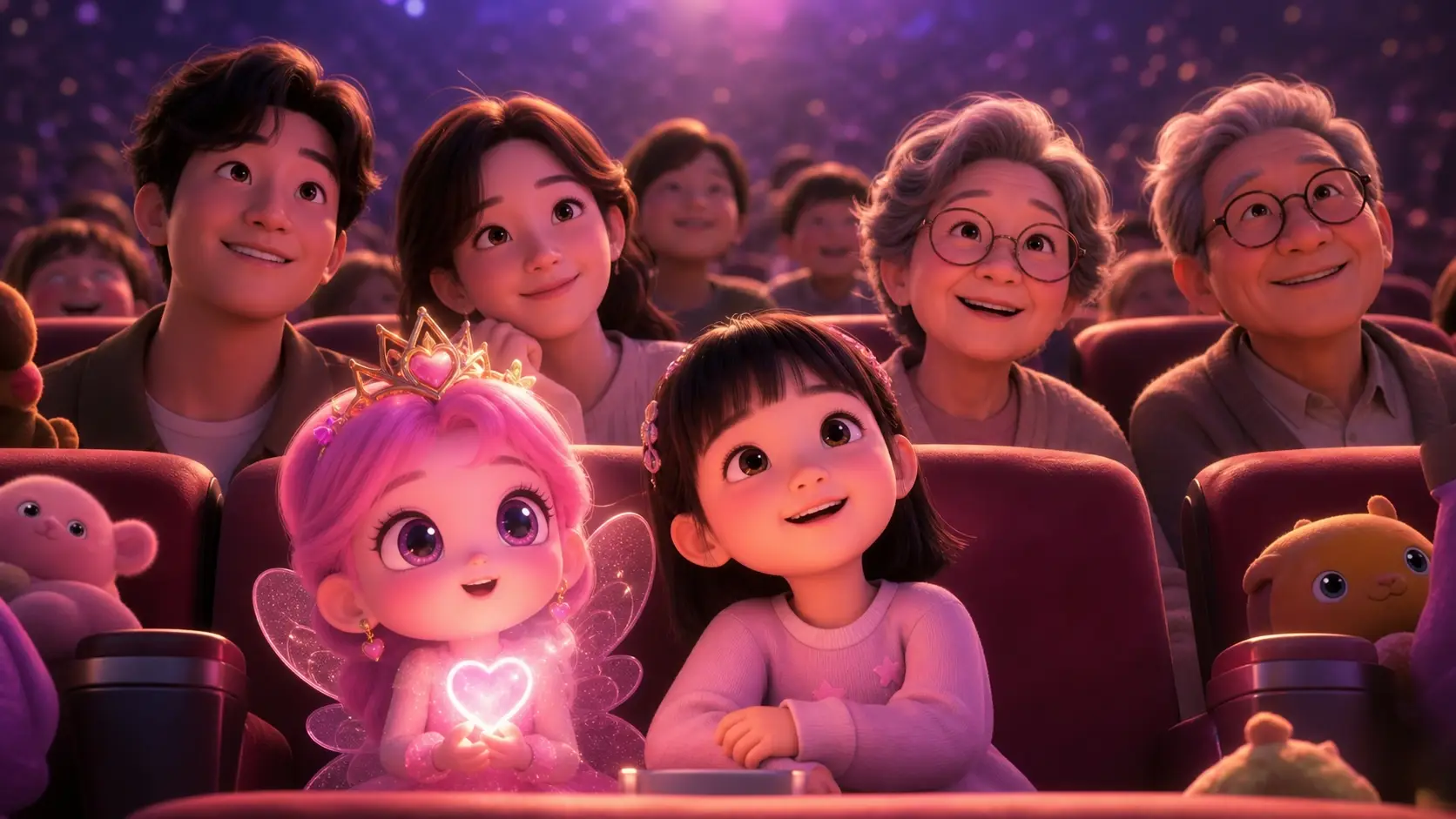
The name ‘Hachu-ping’ carries no dictionary meaning in Korean. It is not a word for love, nor a being out of some old legend — it is a proper noun invented by the children’s animation world of ‘Catch! Teenieping.’ And yet when ‘Hachu-ping: The Movie of Love’ appeared in Korean theaters in the summer of 2024, these three unfamiliar syllables became not just children’s vocabulary but the everyday language of parents and grandparents. Audiences said they went to see Hachu-ping, bought their children Hachu-ping dolls, and began calling that funny, faintly ruinous spending experience by a new coinage: ‘paksan-ping’ — roughly, ‘bankrupt-ping.’ How quickly that single coinage spread suggests just how far one film reshaped everyday language well beyond the theater itself.
The film crossed one million cumulative admissions on September 16, 2024, forty-one days after release. It was the first time in twelve years — since 2012’s ‘Padak: The Dinosaur of the Korean Peninsula 3D’ — that a Korean animated film reached one million admissions. Its final tally came to roughly 1.24 million. That places it near the top of Korean animation’s box-office record, alongside ‘Leafie, a Hen into the Wild’ and ‘Padak: The Dinosaur of the Korean Peninsula 3D’ — and above all, it demonstrated that a Korean-made character born on television could draw its own independent audience as a theatrical feature.
Set against Hollywood animation’s large-scale hits, the number alone may be hard to compare. But given the production and distribution environment Korean animation actually works within, one million is not merely a box-office unit. It stands as long-scarce proof that content made for children can expand, inside a theater, into a story an entire family shares.
The Children Already Knew Hachu-ping Before They Walked Into the Theater
To understand ‘Hachu-ping: The Movie of Love’’s box-office run, one must look first at the hours accumulated in front of a television screen, before the film’s opening frame. SAMG Entertainment’s ‘Catch! Teenieping’ series divides a range of emotions into individual characters, building a world already familiar to toddlers and young children. Among them, Hachu-ping was known specifically as the character embodying love. Rather than introducing an entirely unfamiliar protagonist, the film chose to show the origin of a character children already loved.
That strategy makes good use of the prequel format’s inherent advantage. For young viewers, it offers the pleasure of seeing how a favorite character first came to be; for parents, a chance to understand, together, a world their child already loves. The relatively simple plot of Romi and Hachu-ping’s first meeting lets even audiences unfamiliar with the complex lore follow the emotional throughline. If a character-franchise film adaptation is to avoid looking like an extended toy commercial, lowering exactly this barrier to entry is what’s required.
This phenomenon won’t feel unfamiliar to audiences abroad, either. As with Japan’s ‘Doraemon’ or America’s ‘Pokémon’ films, when a character raised on television arrives in theaters, audiences aren’t simply buying a new movie — they’re meeting a memory they already carry. What makes Hachu-ping’s case different, though, is that the industry that built that memory was itself a comparatively young Korean animation franchise. Where Doraemon and Pokémon spent decades accumulating trust across generations, Hachu-ping had to compress that same accumulation into a far shorter span — which makes the achievement all the more conspicuous.

‘Bankrupt-ping’ Is a Joke, but It Also Describes an Industry’s Structure
The phrase ‘paksan-ping’ is a self-deprecating joke parents use for what they spend on their child’s Teenieping merchandise, toys, clothing, and experience events. It grew out of the idea of opening one’s wallet for a child’s love — but the fact that the phrase spread so widely reveals just how large the character industry operates outside the movie theater’s box office. A film’s admissions count is only one indicator of its success; how often a character turns up in everyday life is what determines a franchise’s lifespan.
Still, it isn’t enough to explain this phenomenon as mere consumer frenzy. Children learn the names of emotions through characters, and parents learn how to take part in the world their child loves. Hachu-ping’s ‘love’ is as broad and abstract an emotion as the English word love itself, but the film translates it into concrete action — waiting for a friend, taking on risk, working to mend a relationship. A children’s film doesn’t need to become a textbook for emotional education, but it can become a space where feelings are safely experienced through story.
Of course, one can also criticize the character industry for endlessly stoking children’s desires. Parents don’t need to buy every piece of merchandise, and a film’s emotional impact shouldn’t be measured by the volume of spending it generates. If anything, for the ‘paksan-ping’ joke to endure, brands need to keep proving themselves not just through price and product variety, but through stories and quality that children will keep loving for a long time.
What One Million Admissions Left Behind for Korean Animation
Korean animation has long possessed outstanding production talent, yet often lost out to overseas blockbusters at the theatrical feature box office — a market that demands production budget, distribution screens, character recognition, and family-audience trust all at once. It’s still too early to say ‘Hachu-ping: The Movie of Love’ tore that wall down completely. One film’s success does not, by itself, mean the stability of an entire industry.
Even so, the change this film left behind is unmistakable. A precedent now exists: a character made in Korea, speaking Korean, growing up inside the everyday sensibility of a domestic audience, can meet more than a million people in movie theaters. What matters especially is that the parent generation didn’t just accompany their children to the theater — they responded themselves to the film’s emotion, its songs, and the relationships between its characters. Counting a children’s film’s audience as children alone is no longer sufficient.
The Korean Film Council’s web magazine cited ‘Hachu-ping: The Movie of Love’’s more than 1.2 million admissions as a distinctive case within Korean animation. The next task isn’t to replicate this success, but to build a production environment where Korean animated films carrying different stories and different visual languages can keep being made, one after another. Hachu-ping’s success should become, for other works, not a pressure to ‘make the same kind of character’ but encouragement to ‘meet your own audience for a long time.’
Hachu-ping Will Be Tested on a Second Voyage to the Sea
SAMG Entertainment announced that its sequel, ‘Hachu-ping: The Movie of Love — Legend of the Whale Gem,’ will open on August 5, 2026. The second installment of the theatrical trilogy has been introduced as a story in which Romi and Hachu-ping search the sea for the secret of the whale gem. The first film’s 1.24 million admissions give the sequel a solid starting point — and, at the same time, its highest expectation to meet. If the first film was the joy of discovery, the second must find a new way to explain why audiences need to meet this world in a theater again. The trilogy format itself signals that the production company is designing this character’s vitality not as a one-time hit, but as a narrative built across several years.
Hachu-ping’s box-office run will stand as the record of Korean animation reaching one million admissions for the first time in twelve years. But what may last even longer is the fact that, inside a theater a child entered following a beloved character, adults too had the experience — much as they did in their own childhoods — of handing their heart over to some being. Love is a large word, but Hachu-ping shaped it into something small hands could hold. Now it remains to be seen, in the next story headed out to sea, just how far those small hands will carry the audience.
Source: Yonhap News, September 16, 2024; Korean Film Council web magazine, 2025; SAMG Entertainment official announcement, June 4, 2026; Korean Box Office Information System (KOBIS).