
Table of Contents
Rejuran Exports Reveal a New Growth Engine
PharmaResearch reported consolidated Q1 2026 revenue of 146.1 billion won and an operating profit of 57.3 billion won, its best quarterly performance yet. Revenue and operating profit rose 25% and 28% year-over-year, with an operating margin of 39.2%. A key driver was the injectable aesthetic medical device Rejuran, which held steady domestic demand while expanding exports, particularly across European markets.
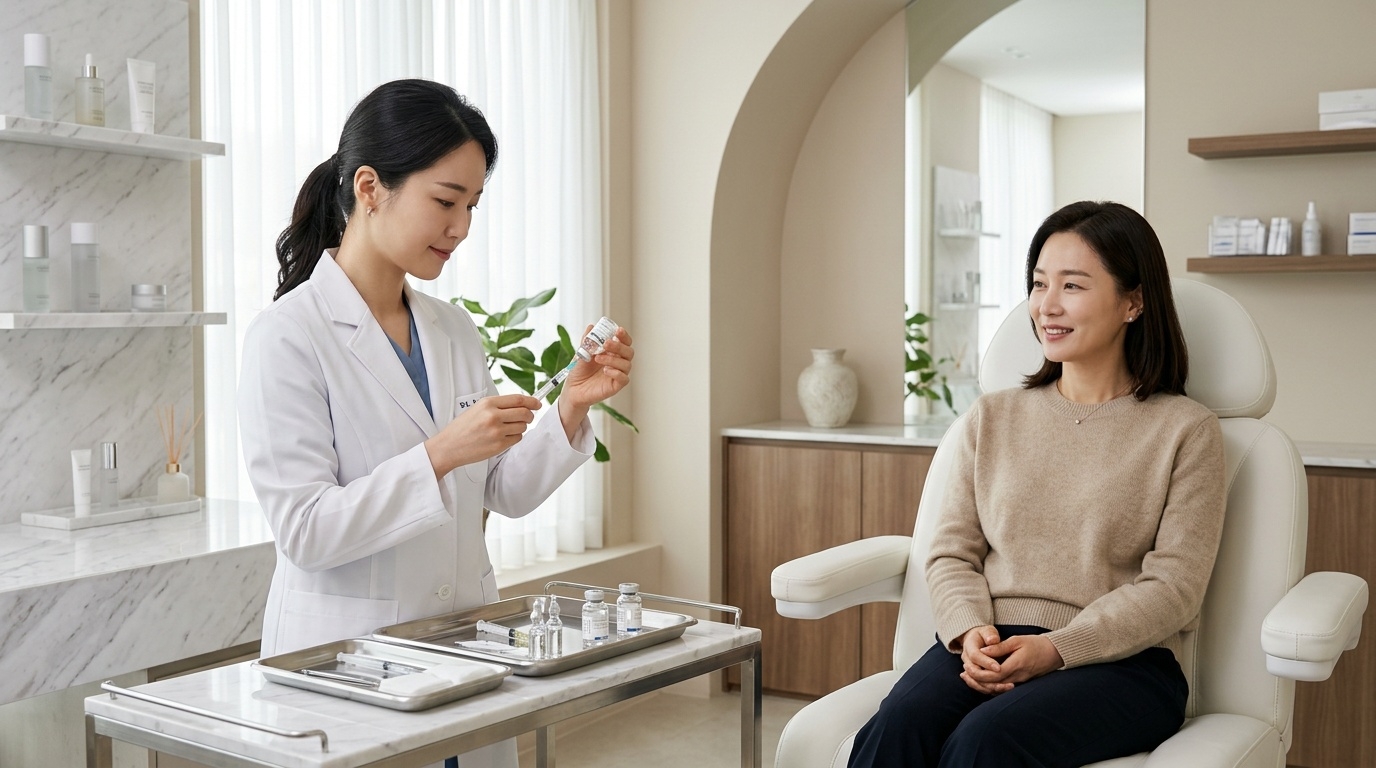
Skin boosters aren’t typical creams or serums applied to the skin’s surface; they’re specialized products used for injectable treatments at medical clinics. Because they involve delivering specific ingredients directly into the skin for textural and structural improvement, they operate under different usage protocols, regulatory frameworks, and distribution channels than regular cosmetics. Rejuran’s global expansion shows how K-beauty is moving beyond consumer skincare into professional medical aesthetics.
A Medical Device Business Fueled by Both Domestic and Global Demand
PharmaResearch’s medical device division brought in 79.5 billion won in Q1, up 14.5% year-over-year. Domestic sales accounted for 58.4 billion won of that, growing 20.9%, which reflects Rejuran’s steady hold on Korea’s clinic-driven skin booster market. A rising number of international visitors traveling to Korea for aesthetic treatments has also helped widen the domestic procedure market.
In the same quarter, the company’s total export revenue reached 58.8 billion won, up 30% from the previous year, and overseas sales now make up 40% of total revenue. Of that 58.8 billion won in exports, medical devices accounted for 21.1 billion won. The company points to its expanding footprint in European markets as the driver, a sign that the clinical experience and brand recognition built in Korea are translating into overseas medical networks and distribution channels.
Why the Cosmetics Division Grew Even Faster
The highest growth rate at PharmaResearch actually belonged to its cosmetics division. Q1 cosmetics revenue hit 42.2 billion won, up 51% year-over-year, while cosmetic exports rose 55.8% to 26.9 billion won. That came from a combination of expanding distribution across the US and Asia, rising demand from tourists visiting Korea, and new product launches.
There’s also a link between the clinic and the vanity table. The medical device Rejuran builds trust and recognition in medical settings, which opens the door for Rejuran Cosmetics to reach everyday consumers. Patients introduced to the brand at a clinic can go on to buy its daily skincare products, while cosmetics buyers become more aware of the clinical offerings. Professional treatments and daily skincare are feeding into each other under a single brand across separate distribution networks.
APR’s Two Distinct Products and Their Timelines
APR, a company built on cosmetics and at-home beauty devices, is also moving into medical aesthetics. Its skin booster product earned Class II medical device certification and export clearance from Korea’s Ministry of Food and Drug Safety before shipping its first exports in Q2 2026. The company plans to expand overseas sales in the third quarter, targeting Japan and the Middle East.
A separate clinical lifting device now in development is on a different track than the skin booster. It has regulatory approval but hasn’t launched yet, with release planned for late 2026 to early 2027. The two products are at different stages: the skin booster is already selling internationally after certification, while the lifting device is still preparing for its market debut.
In August 2026, APR raised its annual revenue target from 2.1 trillion won to 3 trillion won. That jump is driven mainly by surging cosmetic sales in North America and Europe, but skin boosters and lifting devices are the company’s next area of focus. Whether APR can turn its existing customer base and global distribution experience into a foothold in medical aesthetics will decide how that bet plays out.
The Next Step for the World’s Second-Largest Cosmetics Exporter
Korea’s cosmetics exports hit $11.4 billion in 2025, up 11.8% from the previous year. That pushed Korea past the United States to become the world’s second-largest cosmetics exporter, trailing only France. The cosmetics trade surplus crossed $10 billion for the first time, landing at $10.1 billion. By country, the US led at $2.2 billion, followed by China at $2.0 billion and Japan at $1.1 billion.
These numbers point to a structural shift. Korean beauty exports are no longer overly reliant on the Chinese market or a handful of viral items. The market is diversifying across the US, Europe, Japan, and the Middle East, and the product lineup is expanding beyond traditional serums and sheet masks to include at-home beauty gadgets and clinical medical devices. Because skin boosters have to navigate strict medical regulations and specialized distribution, they’re one of the clearest signs of how far K-beauty’s boundaries have moved.
Looking Beyond the Export Numbers
Competition is intensifying as new skin boosters, including ones using extracellular matrix (ECM) components, enter the market. (ECM refers to the material surrounding cells that gives tissue its structure and environment.) Even with new products arriving, domestic demand for established skin boosters remains steady, and exports keep climbing thanks to deeper European market penetration and stronger distribution networks.
Still, the global success of skin boosters can’t be measured by short-term sales volume alone. Building recurring demand for clinical procedures takes time: local medical approvals, specialized distribution, physician training, safety data, and brand trust all have to build up together. PharmaResearch’s 21.1 billion won in medical device exports and 40% overseas revenue share, along with APR’s push into Japan and the Middle East, show that market entry is underway. What comes next is whether the brand recognition built in Korea turns into lasting adoption in clinics worldwide.
Source: PharmaResearch Q1 2026 Earnings Release, May 8, 2026; Ministry of Food and Drug Safety, May 22, 2026; ChosunBiz, August 29, 2026.