
Table of Contents
Two Countries, One Cooking Station, Many Kinds of Spicy
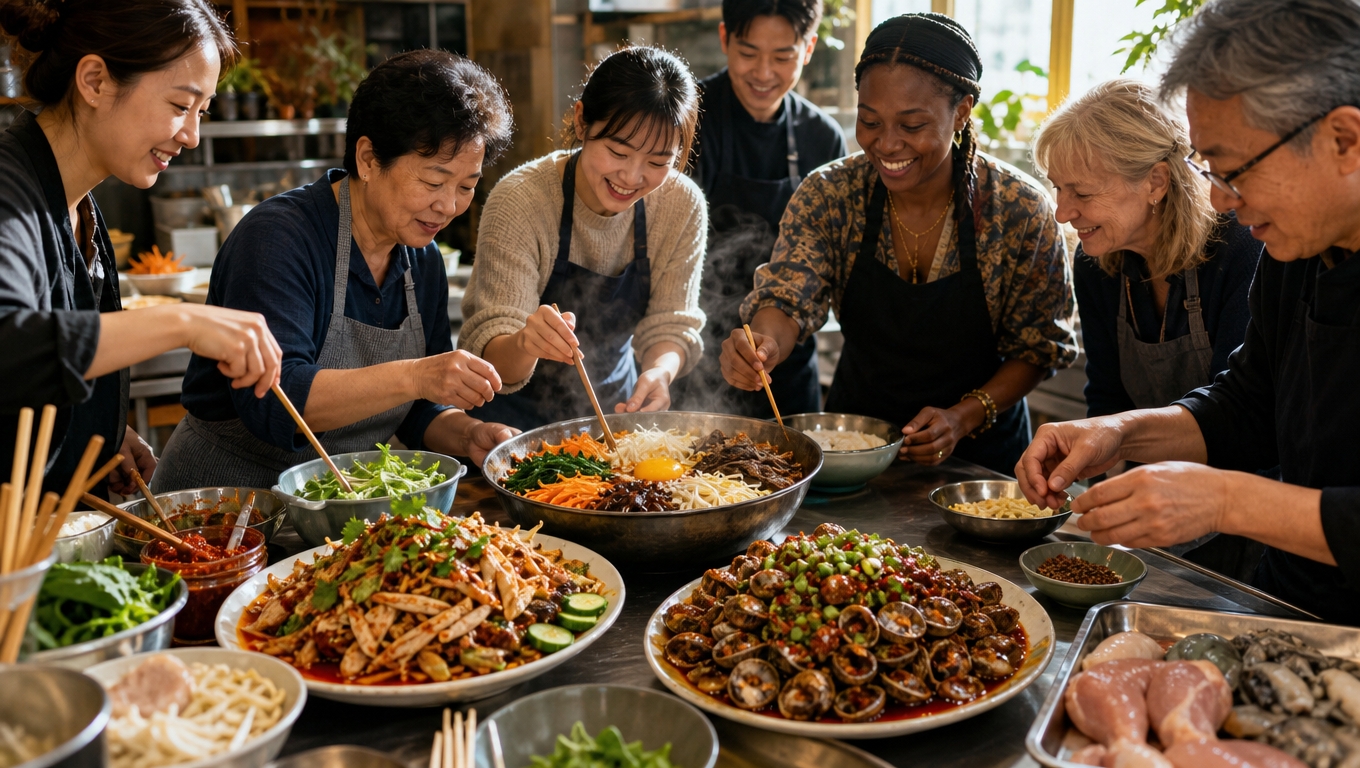
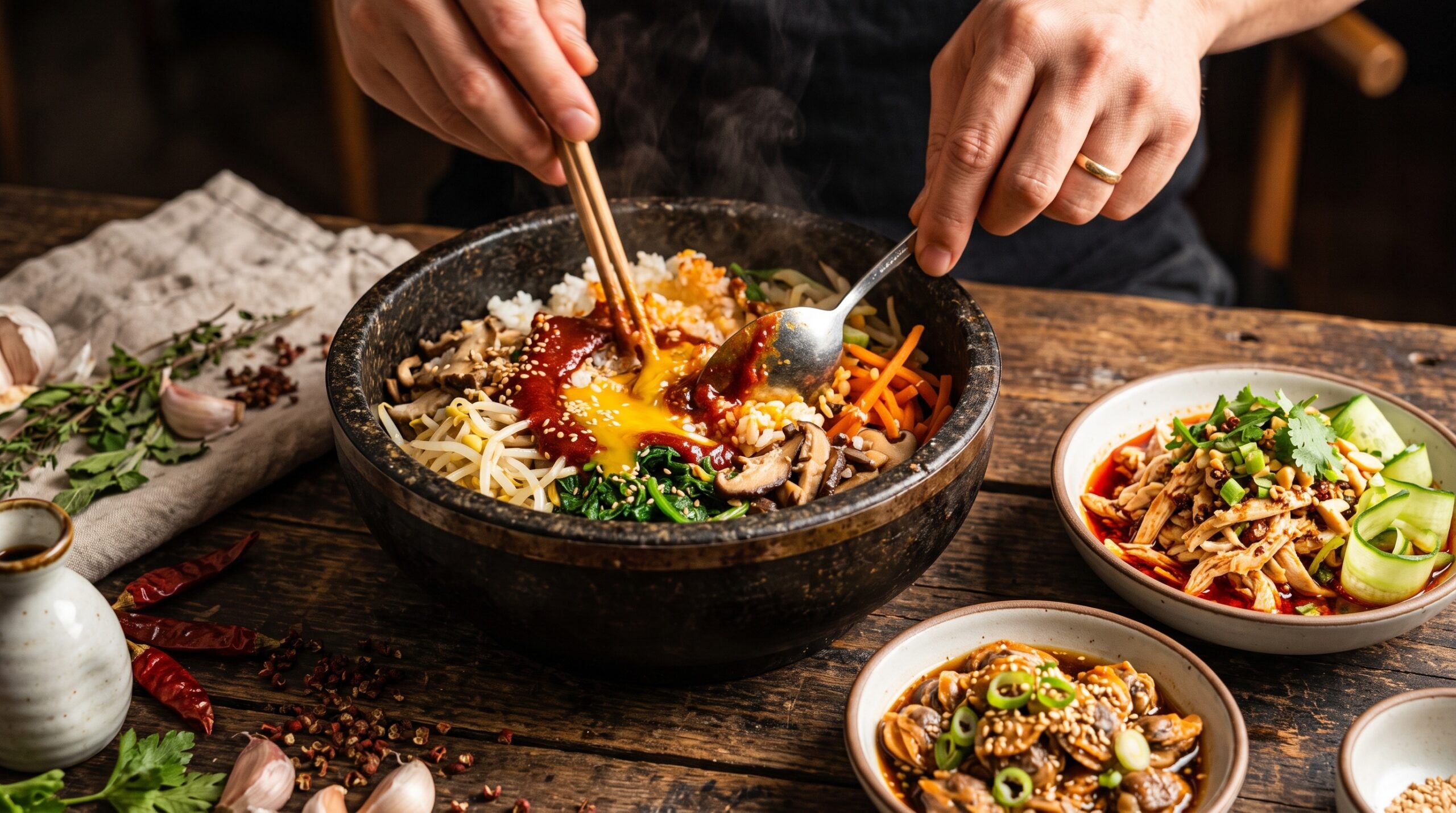
Participants cooked Korean kkomak-muchim (seasoned blood cockles) and bibimbap alongside Chinese mala chicken salad. Rather than simply tasting finished dishes, they handled the ingredients themselves and mixed the seasonings from scratch. All three dishes carry a kind of heat, but the ingredients, seasoning blends, and cooking methods behind that heat differ sharply. Participants compared more than how the finished plates looked; they traced how each cooking process produced its own version of spicy.
The Korean Food Promotion Institute and the Chinese Cultural Center in Korea held the Korea-China food culture exchange event “Spice Without Borders: Korea × China, A Journey Through Spicy Flavors” on September 29. The Institute is led by Chairman Lee Gyu-min, and the Cultural Center by Director Shim Hyo-kang. The event wasn’t built around deciding whose food is spicier. Starting from a sensation both countries share, it aimed to help people understand how two different food cultures arrive at flavor through different paths. Korea and China sit close together geographically, so the event used that familiarity as an entry point before letting participants experience the distinct cooking traditions underneath.
The Same Heat, Shaped Differently by Ingredients and Technique
Spicy flavor shows up easily in both Korean and Chinese cooking, but it resists being reduced to a single sensation. Making kkomak-muchim, bibimbap, and mala chicken salad with their own hands, participants saw that even within the shared category of “spicy food,” the impression of the heat and the process behind it can vary widely. What ingredient takes center stage, how the seasonings get combined, how the finished dish gets eaten together all shape the outcome. The same intensity of spice can play a completely different role in a dish depending on the main ingredient and the seasoning blend surrounding it.
Kkomak-muchim highlights the pairing of a seafood ingredient with seasoning, while bibimbap shows the Korean habit of mixing several ingredients together in one bowl. China’s mala chicken salad combines chicken with mala seasoning. Cooking all three dishes, participants experienced that spicy flavor doesn’t exist on its own, but comes together with the main ingredient, the seasoning, and the way everything is prepared. The program’s distinguishing feature was shifting the comparison away from simple heat levels and toward the entire process that builds the flavor.
The experience also suggests that introducing a dish to foreign audiences by name or spice level alone isn’t enough. Spicy flavor is only the entry point into a food culture; behind it sit the way ingredients are handled, the order in which seasonings come together, and the way multiple dishes share a single table. By cooking together and sharing the results, participants came away with more than the finished taste. They understood how that taste took shape. Hearing an explanation about a dish and physically handling the ingredients while following the cooking steps lead to very different depths of cultural understanding.
Cooking as a Way to Explain Culture
Korea and China are close neighbors geographically and historically, but each has built its own distinct food culture. Rather than emphasizing only similarities or framing the differences as opposition, this event placed both side by side within a single shared cooking experience. Having participants handle ingredients and mix seasonings by hand was designed to move them beyond passively receiving food, toward understanding the cultural background embedded in each recipe. Unlike an event where finished dishes are simply served, letting participants take part in the cooking process turns differences in flavor into something concrete rather than abstract.
Cooking together also opened up conversation about each country’s food culture. Participants prepared ingredients and combined seasonings while observing how each dish came together, then continued talking about similarities and differences as they shared the finished meal. It was an example showing that cultural exchange isn’t limited to watching a finished performance or exhibit, but can also take the form of jointly carrying out an everyday act of cooking.
Kim Ki-hoon, Secretary-General of the Korean Food Promotion Institute, explained that while Korea and China share many elements in food culture, each country has developed distinct traditions shaped by its own ingredients and cooking methods. He said he hoped the event became a meaningful moment for understanding and exchange between the two cultures through food, and pledged to continue creating opportunities to introduce Korean food and food culture through cooperation with institutions at home and abroad. Shim Hyo-kang, Director of the Chinese Cultural Center in Korea, also described food as one of the most approachable mediums for understanding different cultures and connecting people. The two institutions’ remarks make clear that the event’s purpose centered on mutual understanding rather than promoting any particular menu.
From a One-Time Experience to an Overseas Restaurant Network
This event connects to a larger pattern, since the Korean Food Promotion Institute’s international exchange work doesn’t stop at cooking experiences. The Institute and the Ministry of Agriculture, Food and Rural Affairs selected four new overseas hansik restaurant councils in 2026. With these additions, the network expanded from 27 councils across 20 countries to 31 councils across 22 countries. The newly added locations are Beijing in China, Taipei in Taiwan, Madrid in Spain, and St. Petersburg in Russia. Adding major cities in Asia and Europe broadened the regional foundation that lets local Korean restaurants connect with one another.
Overseas hansik restaurant councils are private cooperative organizations built around local Korean restaurants in each region. They share opinions and industry trends among restaurants in a given area and work to strengthen the network and competitiveness among them. If a cultural event is the stage where people first experience Korean food, an overseas restaurant network is closer to the foundation that lets that initial interest turn into a lasting dining habit in that location. Making Korean food a global presence requires more than promotional events; it also needs cooperation among the people actually running restaurants on the ground.
Among this round’s selections, the general-type councils are based in Beijing and Taipei, while the smaller-scale councils are in Madrid and St. Petersburg. The Institute recruited general and smaller-scale councils based on the number of participating Korean restaurants in each region. This reflects an attempt to build cooperative organizations that account for different market sizes and restaurant densities across regions, while still lowering the threshold for participation. Connecting the cultural interest sparked by an exchange event to the realities of running restaurants abroad requires this kind of region-specific operating foundation.
A Training Foundation Rooted in a European Culinary School
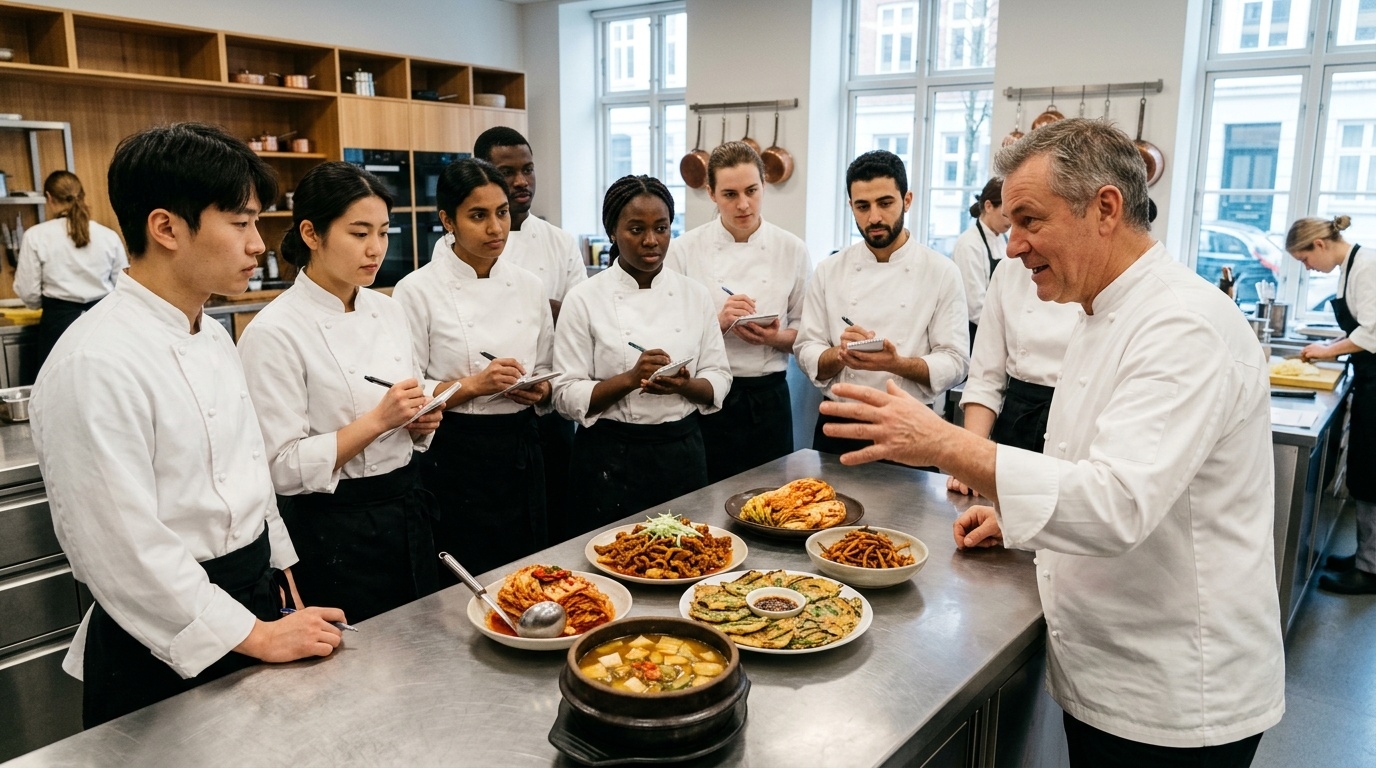
Professional culinary education is another pillar of this strategy. The Ministry of Agriculture, Food and Rural Affairs, the Korean Food Promotion Institute, the Ministry of Culture, Sports and Tourism, and the Korean Cultural Center in Italy held a hansik lecture for students at ALMA, Italy’s international culinary school, on June 17 and 18. The lecture focused on Korean table settings built around traditional fermented sauces. Over the two days, 49 advanced-course students and faculty members took part, covering an introduction to Korean food, the theory behind traditional sauces, and live cooking demonstrations.
The lecture introduced a full table setting made up of doenjang soup, stir-fried pork, zucchini and shrimp pancakes, seasoned squid, and cabbage kimchi. Rather than teaching a single signature dish, the program arranged soup, stir-fry, pancake, seasoned dish, and kimchi together to show how a Korean table brings multiple dishes into harmony. Presenting traditional sauce not as a simple seasoning product but as the foundation applied across different dishes was also meant to give students a systematic understanding of Korean flavor.
The participating institutions also signed a memorandum of understanding to run regular hansik lectures at ALMA going forward. If a short-term experience broadens cultural understanding for general participants, training at a culinary school is an approach that lets future culinary professionals learn the cooking principles and table culture behind Korean food. The decision reflects a view that if Korean food is going to settle into culinary education and professional kitchens abroad, rather than being consumed as a passing trend, it needs a systematic channel for reaching the people who actually cook. As trained culinary professionals move into different workplaces, the channels through which people encounter Korean food can naturally widen as well.
Building Toward the October Hansik Festa
The Korean Food Promotion Institute plans to hold the “2026 Hansik Festa” from October 23 to 25 in the plaza in front of the Mirror Pond at the National Museum of Korea. Organized around Hansik Day on October 24, the event will feature product showcases from food and food-industry companies, tasting and hands-on programs, and activities for visitors to take part in. If the Korea-China exchange event focused closely on the similarities and differences between two food cultures, the Hansik Festa becomes a space for introducing the many facets of Korean food to a much broader public.
The festa will run for three days, combining booths that introduce hansik-related foods, ingredients, and beverages with hands-on content that visitors can take part in. Its symbolic link to Hansik Day, paired with an actual food experience, carries forward the thread from September’s exchange event. Offering explanations about products, ingredients, cooking, and food culture alongside the tasting, rather than ending with a single bite, can be one way to present the fuller scope of Korean food.
The kkomak-muchim and mala chicken salad that participants cooked together on September 29 show that the globalization of Korean food doesn’t move in just one direction. Exchange that places Korean dishes side by side with another country’s food to experience shared ground and difference, a local network connecting overseas Korean restaurants, training at professional culinary schools, and a public festival all create distinct points of contact. The thread running through the Institute’s approach is widening the opportunity to understand the culture and the cooking behind that flavor, carrying things further than just spreading word of the heat itself.
Returning to the cooking experience at the heart of the event, the starting point of this strategy isn’t complicated. People approach unfamiliar food through a familiar sensation of heat, discover differences as they handle ingredients and seasonings, and talk about those differences as they eat together. Whether Korean food becomes a lasting channel for international cultural exchange depends on how steadily these kinds of experiences connect to restaurants abroad, culinary education, and public events.
Sources: Korean Food Promotion Institute press release, October 1, 2026; Korean Food Promotion Institute press release, September 2, 2026; Korean Food Promotion Institute press release, June 26, 2026; 2026 Hansik Festa booth recruitment notice.