
Table of Contents
When the son who returns after nine years feels like a stranger
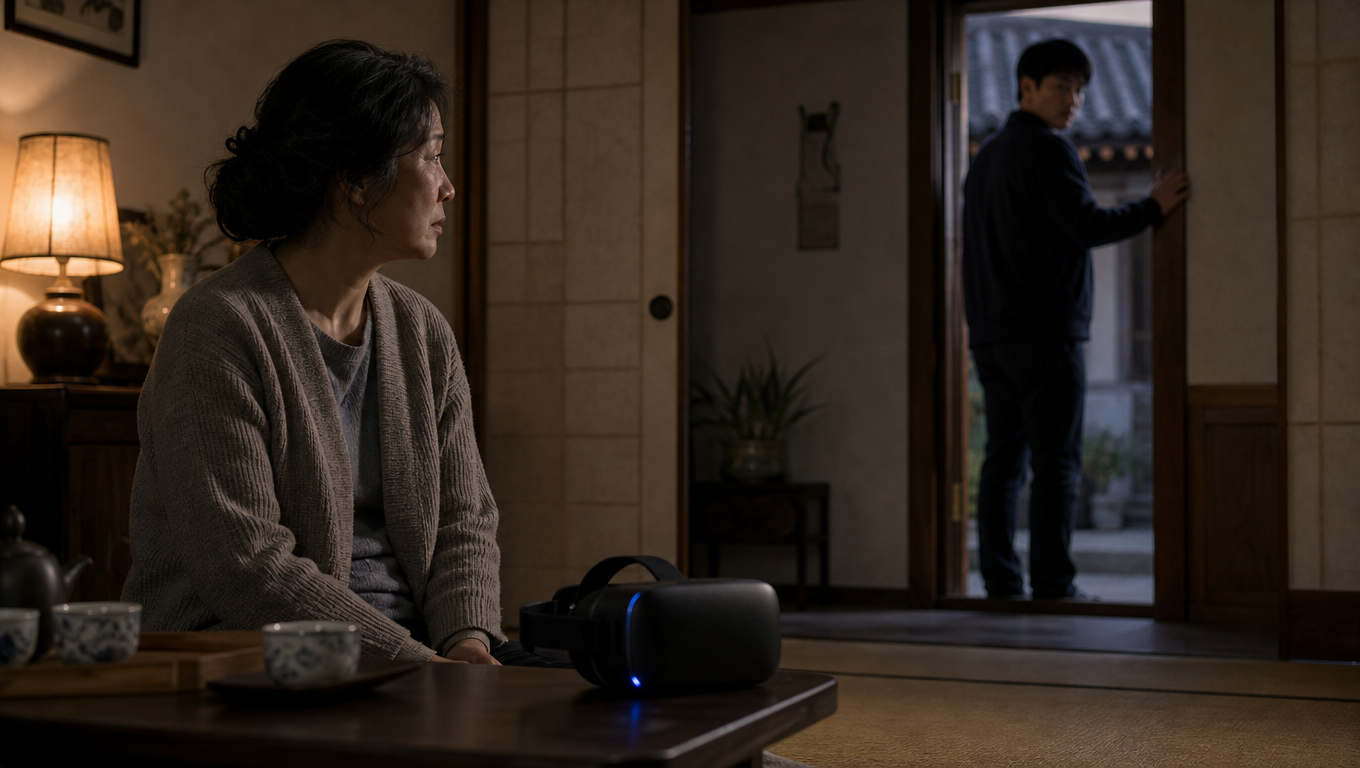
A mother who has spent nine years visiting her missing son through artificial intelligence suddenly finds the real son at her door. Yeon Sang-ho’s “Paradise Lost,” which opened in Korean theaters on October 21, uses that reunion as the starting point for a psychological thriller. Kim Hyun-joo plays the mother, So-young, and Bae Hyun-sung plays her son, Sun-woo. The film runs 100 minutes and is rated 15+. That is the basic setup described in Yonhap News Agency’s pre-release review.
The film’s conflict is about more than how accurately AI can copy a person. So-young is torn between the young son in her memory and the son who has changed in real life. Does she accept the virtual child who never changes, or the person who lived through years she knows nothing about? A question about technology becomes a question about family and about what it means to understand another person.
How the film was made matters too. “Paradise Lost” was completed on a net production budget of around 500 million won in 14 shooting days. In an interview with Yonhap, Yeon said he wanted to explore the parts of being human that AI cannot replace, and he called low-budget filmmaking something he wants to keep doing for the rest of his life. The film brings his questions about technology together with an experiment in working small.
It began with three pages his mother wrote
The story did not start from some grand vision of technology. It started with three pages Yeon’s mother wrote in a notebook. According to Yonhap, the director developed the idea several times from that text. Another version became the novel “Black Inferno,” written by Oh Seong-eun from an original concept by Yeon and Ryu Yong-jae, so the film and the novel should be treated as related but separate works.
That origin shows the film cares more about relationships than about machines. Who the son is and how his mother receives him are two different questions. Being family does not mean you can understand or accept everything about the other person. The AI device makes that gap easier to see.
The idea also took several forms over time, and a novel and a film convey a character’s inner life and strangeness in different ways. Rather than importing the ending or reading of another version, it is worth watching how So-young sees the virtual child and the real young man. That relationship is what gives the film’s question its shape.
A child frozen in time and a son who kept growing
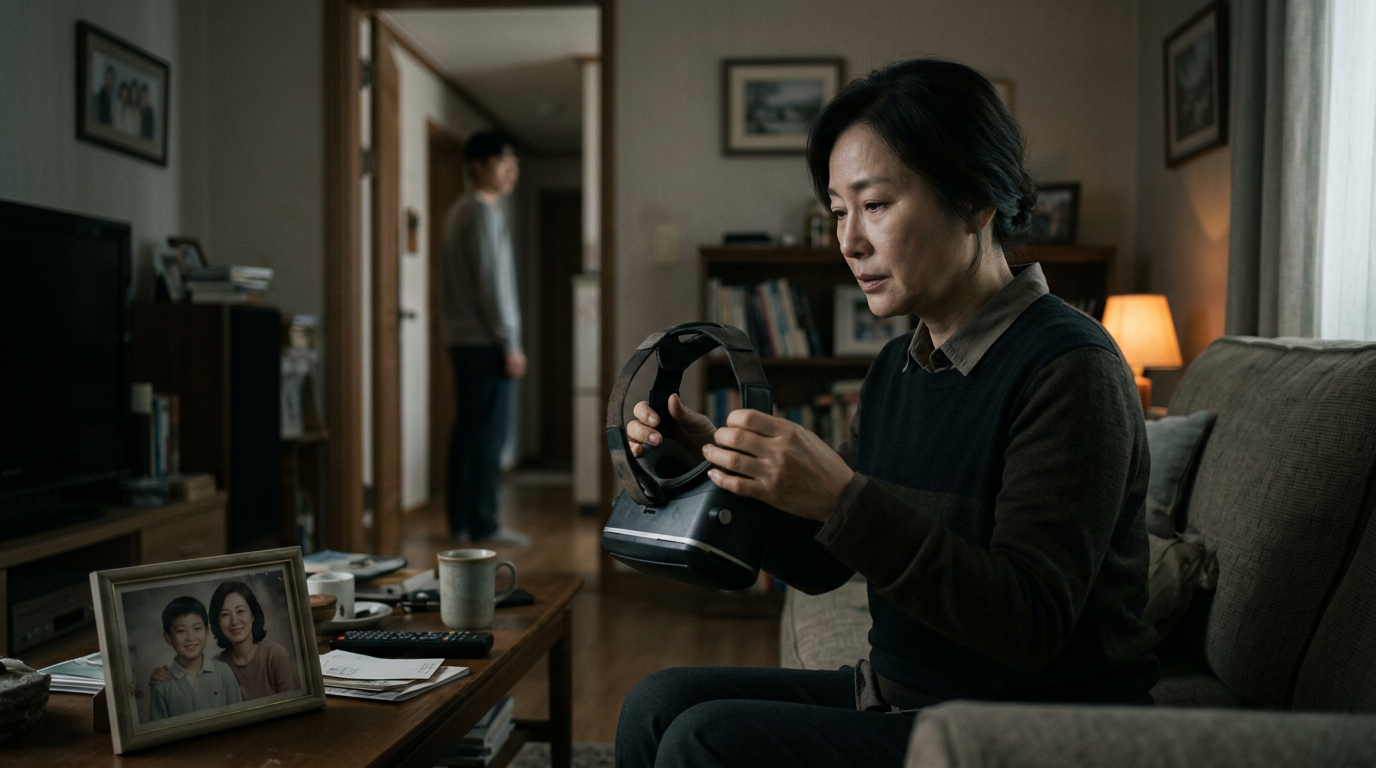
The story begins with the disappearance of a camping school bus. After losing Sun-woo in that incident, So-young comes to rely on “Children of Paradise,” an AI program that recreates the missing children in virtual reality. Inside the program, Sun-woo is still 10 years old. For So-young, it works like a doorway back to the relationship she had before her son vanished.
The real Sun-woo who returns nine years later is no longer a child. Yonhap’s review describes the scars covering his body and his cold gaze, which set him apart from the boy So-young remembers. The return she waited for does not repair the relationship right away. The fact that her son is back and the feeling that she recognizes him come apart, and that split is where the psychological tension comes from.
The two versions of Sun-woo give So-young two different kinds of time. The child in the AI program holds on to a familiar past, while the real son carries years his mother never shared with him. Preserving how someone used to be is not the same as understanding who they are now. The film places a difficulty that a happy reunion cannot solve right in that difference.
500 million won and 14 shooting days, with the focus on a character’s cracks
The production chose to stay small. Yonhap reported that “Paradise Lost” follows Yeon’s previous film “The Ugly,” made for about 200 million won, as another low-budget project. This film’s net budget was in the 500 million won range, and all filming wrapped in 14 sessions. Those figures describe the scale of production, not box office numbers or returns to investors.
Yeon did not frame working on a low budget as simple cost-cutting. In an October 14 interview, he said it lets him bring back the spontaneity and raw energy that have faded as the film industry grew more sophisticated. “I want to make a low-budget film every year, and it’s work I want to keep doing until I die,” he said. He treats working small as a creative choice he plans to return to.
Both leads are reuniting with the director. Kim worked with Yeon on “Jung_E,” and Bae on season two of the Netflix series “Hellbound.” Bae also steps away from the kind-hearted young men he played in “Our Blues” and “Family by Choice.” Yonhap’s review pointed out the change, noting how he conveys the cold air of an unfamiliar son.
A feature about AI and short films made with AI are not the same thing
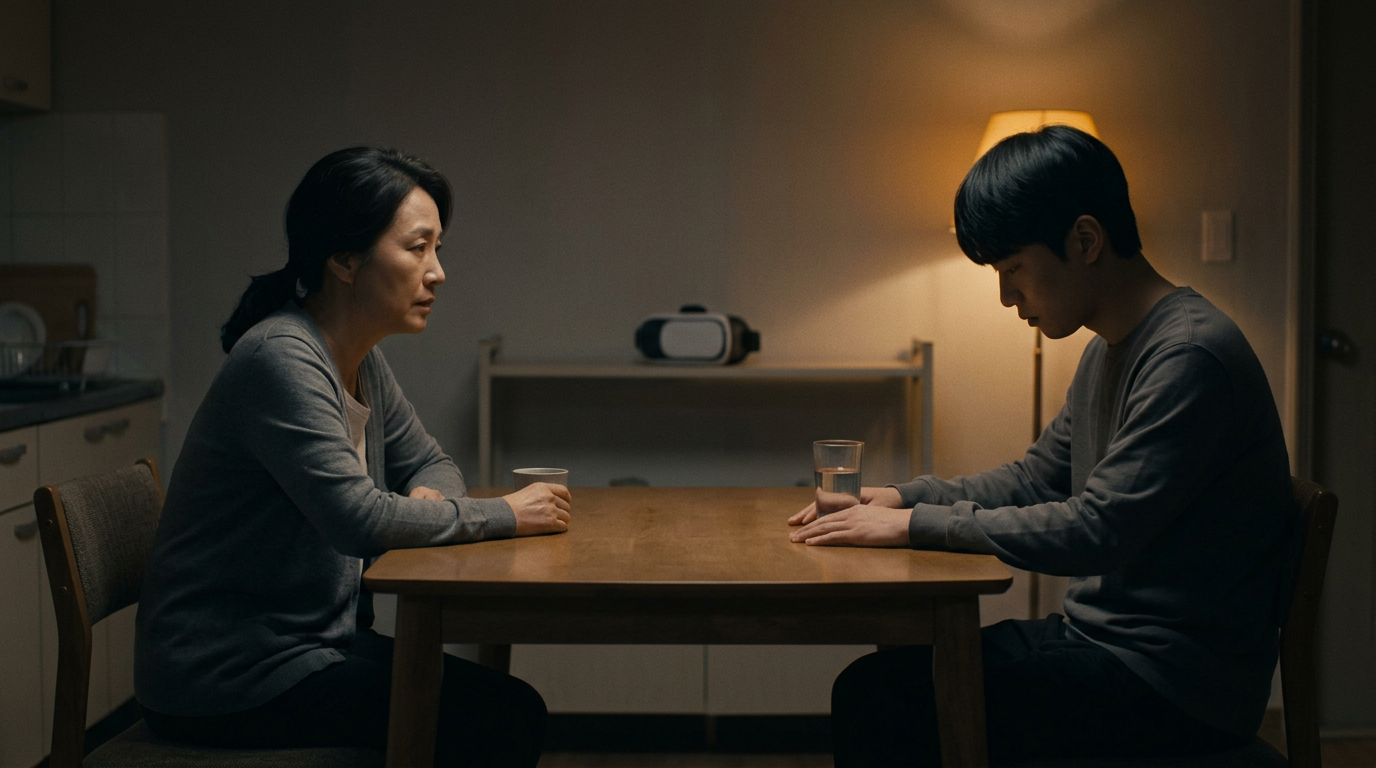
The film had its first screening at the 51st Toronto International Film Festival before its theatrical release, followed by screenings at the Busan International Film Festival. Ahead of the release, Yeon also put out a separate short series, “Paradise Lost – Universe.” It draws on the technology of “Trans Human,” the company that built the program in the film, and follows people who reunite with family members who have died, inside virtual reality.
Yeon wrote the four-part short series himself and made it with generative AI in about two weeks. He said, however, that he did not use generative AI to make “Paradise Lost” itself. Using AI as subject matter and using it as a production tool are two separate things here.
That distinction keeps the director’s stance from being flattened. Making a film that questions the difference between humans and AI does not mean he wants AI kept out of creative work. Using AI for the shorts does not turn the feature’s view of people into optimism about technology, either. What the tool can do and the limits of the humans it reproduces are questions that can be asked side by side.
What “paradise” lacks is reflection
“AI is a collection of the universal, but humans are beings that can’t be explained by the universal alone,” Yeon said in the interview. He described the film’s paradise as “a world where reflection does not exist.” In his view, people experience not only happiness but also pain and cruelty because they think. Whether a calm-looking simulation can hold all of that human complexity is a separate matter.
The idea links to “Colony,” which Yeon released in May. He said that “Colony” set zombies, standing in for the collective nature of AI, against individual humans, while “Paradise Lost” looks at the gap between AI built on collective knowledge and a human being. What ties the two films together goes beyond genre or budget. Both ask how to understand an individual who cannot be reduced to a group.
The film’s question does not end once we confirm that the child in the AI program is fake. Real people do not stay the same to match our memories and expectations. So-young’s struggle lies in the gap between recovering a lost past and accepting a changed present. When we talk about technology that recreates family members, we also have to ask what we want to preserve and whose change we are trying to erase.
Sources: Yonhap News Agency, “AI-revived son vs. son who returned after nine years: Yeon Sang-ho’s Paradise Lost,” October 13, 2026. Yonhap News Agency, “Yeon Sang-ho: ‘The age of AI makes questions of human existence more important, and I put them in Paradise Lost,'” October 14, 2026.