
Table of Contents
The Movement of Hands Inside a Single Sheet
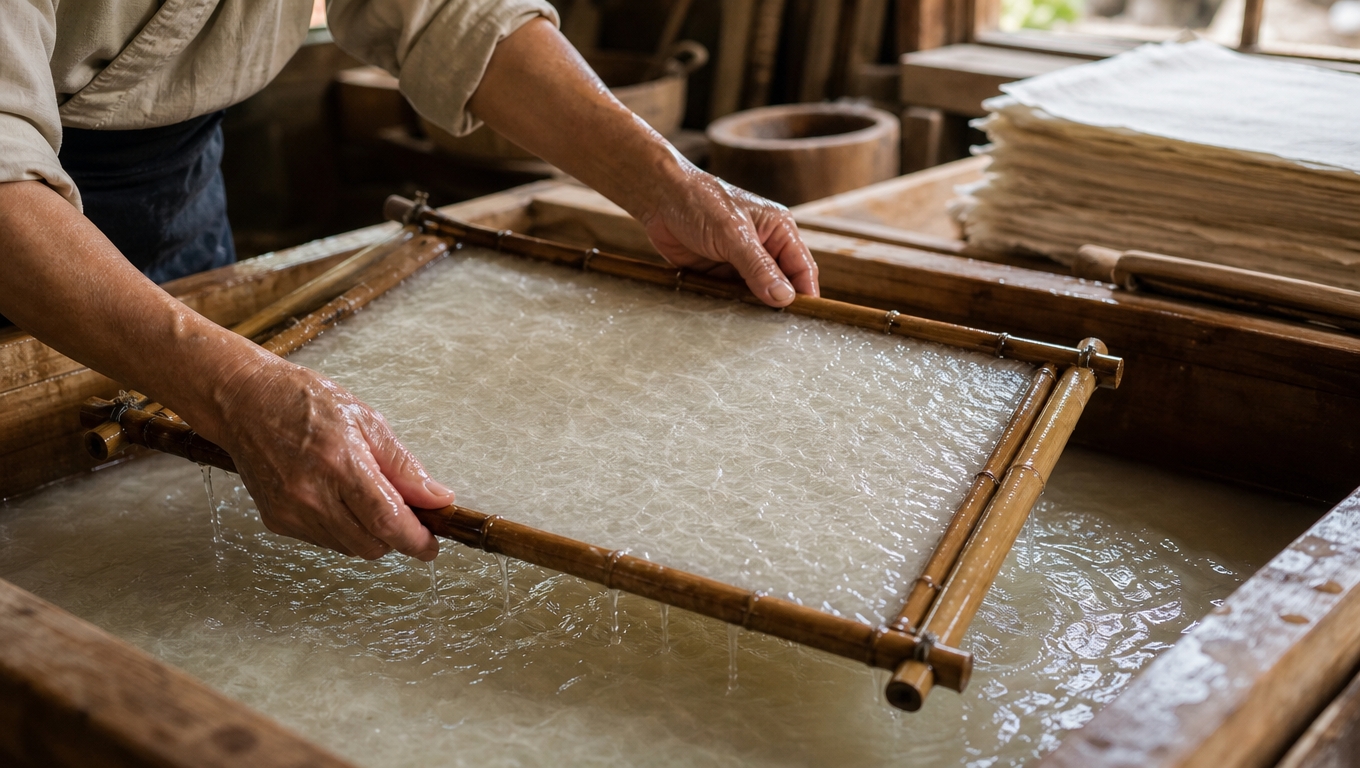
A bamboo screen rocks front to back, then side to side, and the mulberry fibers in the water settle into an even web. This is oebal-tteugi, the core technique behind hanji, Korea’s traditional paper. Before one thin sheet exists, the raw material has to be harvested, boiled, stripped and beaten. Much of the knowledge and handwork that goes into it is invisible once the paper is finished.
Hanji is made from fibers taken from the bark of the paper mulberry tree. It is best known as a material for keeping records, but today it also goes into eco-friendly building materials, household goods and artwork. The culture around hanji is more than the preservation of old paper. It lives on in the people who still make and use it, and that is the point that matters here.
The heritage Korea submitted to UNESCO is also not called simply “hanji.” Its formal name is “Traditional knowledge and skills associated with the production of hanji and related cultural practices in the Republic of Korea.” The title covers the paper as an object, the way it is made, and the relationships between the people who make it. To see why hanji ended up before an international intangible heritage review, it helps to look first at how the paper has been produced.
From Mulberry Bark to Goryeo Paper: A Long History of Use
According to the Korea Heritage Service, hanji has been handed down through the skilled hands of craftspeople for close to a thousand years. Alongside the main ingredient, mulberry bark, makers use natural materials such as dakpul, a plant-based mucilage, and lye made from ash. The Korea Economic Daily explained that working with these natural materials does less damage to the fibers, which is why the paper can be thin and still tough and long-lasting. The materials and the method decide the character of the paper together.
During the Goryeo period, Korean paper was highly prized in China under the name “Goryeo paper.” That reputation shows Korean paper was known well beyond the peninsula. The UNESCO nomination, though, is not about past fame. Its title is about who still holds this long-standing knowledge today and the practices through which it continues.
Hanji began as paper for writing and records, and its uses now extend into architecture, daily life and art. The tradition has not stayed tied to its original purpose. An old method of making paper continues, and new uses keep appearing, and both are part of what hanji looks like today.
The People Behind the “Paper Touched a Hundred Times”
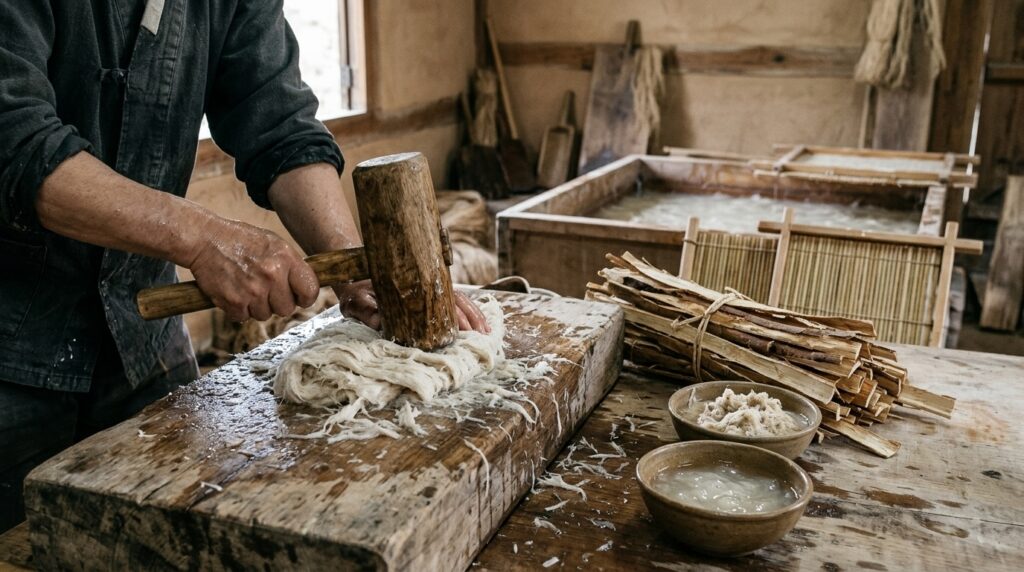
The Permanent Delegation of the Republic of Korea to UNESCO lists harvesting, boiling, stripping, beating, sheet forming and drying among the stages of production. The work runs from preparing raw material that is not yet paper to drying the finished sheets. Hanji’s nickname, “the paper touched a hundred times,” comes from how many steps pass through someone’s hands.
Oebal-tteugi is the step where a bamboo screen scoops up water mixed with mulberry fiber and dakpul and is then shaken front to back and side to side. That motion is what knits the fibers evenly. Gathering the materials and actually forming the sheet are separate jobs, which is why descriptions of hanji name the craftsperson’s skill alongside the raw materials.
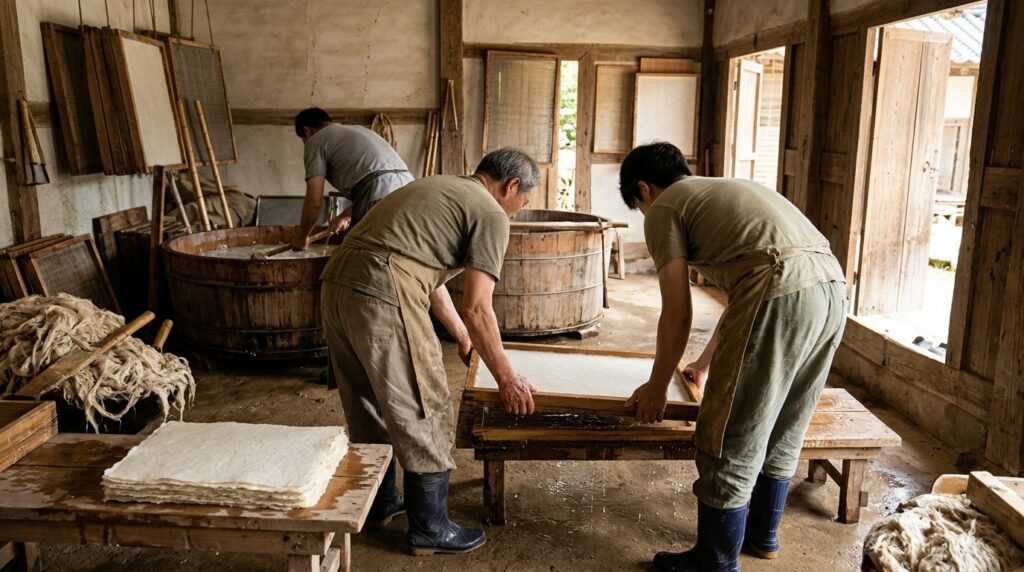
Production also draws on pumasi, a custom in which villagers trade labor and help with one another’s work. The Korea Heritage Service says this cooperation joins the skills and knowledge that run from harvesting mulberry to making the paper. Because one sheet depends on relationships between people, making hanji is both an individual craft and a shared cultural practice.
From the Workshop to a UNESCO Nomination
Korea’s officially recognized hanji masters, holders of the National Intangible Cultural Heritage title for hanji-making, are Hong Chun-su in Imsil, North Jeolla Province; Kim Sam-sik in Mungyeong, North Gyeongsang Province; Shin Hyeon-se in Uiryeong, South Gyeongsang Province; and An Chi-yong in Goesan, North Chungcheong Province. The title goes to craftspeople who carry on the traditional skill of making hanji. With masters working in different regions, hanji makes more sense when described together with the people who keep its knowledge alive than as a finished product alone.
On March 31, 2024, the Cultural Heritage Administration, the agency now known as the Korea Heritage Service, submitted the hanji nomination to UNESCO headquarters. The nomination’s title includes the related cultural practices as well as the traditional knowledge and skills of production. Material preparation, oebal-tteugi and village labor sharing all sit inside one application, which presents the paper’s long history and today’s production side by side.
In May 2026, the Permanent Delegation of the Republic of Korea to UNESCO published an introduction to the stages of hanji production, and the Korea Craft and Design Foundation produced a promotional video. Material that shows the craftspeople at work and how one stage leads to the next explains what a finished sheet cannot. For readers abroad, it frames hanji as an activity built on many layers of knowledge, rather than a traditional craft object.
A Recommendation for Inscription, With the Decision Still Ahead
On November 5, 2026, the Korea Heritage Service announced that the Evaluation Body of UNESCO’s intangible heritage committee had recommended hanji for inscription. The body reviewed 59 nominations for the Representative List, recommending 56 for inscription and referring 3 back for more information. Hanji was among those recommended. The process that began with the 2024 submission has now reached the stage just before a final decision.
The Evaluation Body’s recommendations fall into three categories: inscribe, refer, and not to inscribe. In hanji’s case, the body judged inscription appropriate. A recommendation is still not an inscription. It goes to the Intergovernmental Committee, which reviews it and makes the final decision, and hanji’s status will be settled through that process.
The final decision is scheduled for the 21st session of the Intergovernmental Committee for the Safeguarding of the Intangible Cultural Heritage, held in Xiamen, China, from November 30 to December 5. Korea currently has 23 elements on UNESCO’s Representative List, and hanji would become the 24th if inscribed. The most recent precedent, Korea’s culture of making jang (fermented soybean sauces and pastes), received a recommendation in November 2024 and was confirmed the following month.
Traditional Paper Abroad and the Decision Still to Come
Two of Korea’s neighbors already have traditional paper on the UNESCO list: China’s Xuan paper since 2009 and Japan’s washi since 2014. The hanji nomination joins a wider international practice of treating traditional papermaking as intangible heritage. Ranking the papers against each other is beside the point. The more useful question is what knowledge and practices keep each papermaking culture going.
In the same review, North Korea’s nomination of Taekwon-Do as a traditional martial art was also recommended for inscription. Korea Heritage Service Administrator Huh Min expressed regret that a joint inscription by the two Koreas had become practically impossible, citing the state of inter-Korean relations and other circumstances. He noted that the UNESCO system grants no exclusive rights to whichever country inscribes or applies first, and the agency said it will keep pursuing options such as an extended inscription.
What remains for hanji is the committee’s final review in Xiamen. While that decision is pending, what is being judged is clear: the handwork that turns mulberry fiber into paper, the knowledge built up across many stages of production, and the community habit of sharing labor. Whether hanji becomes Korea’s 24th element of intangible cultural heritage will be decided by the committee, and the decision covers the paper together with the culture of the people who have made it.
Sources: Cultural Heritage Administration press release, April 1, 2024; Korea Heritage Service press release, November 5, 2026; Permanent Delegation of the Republic of Korea to UNESCO, May 20, 2026; The Korea Economic Daily, November 5, 2026.


