Table of Contents
Where the Smell of Coffee Shares an Alley With the Sound of Metal
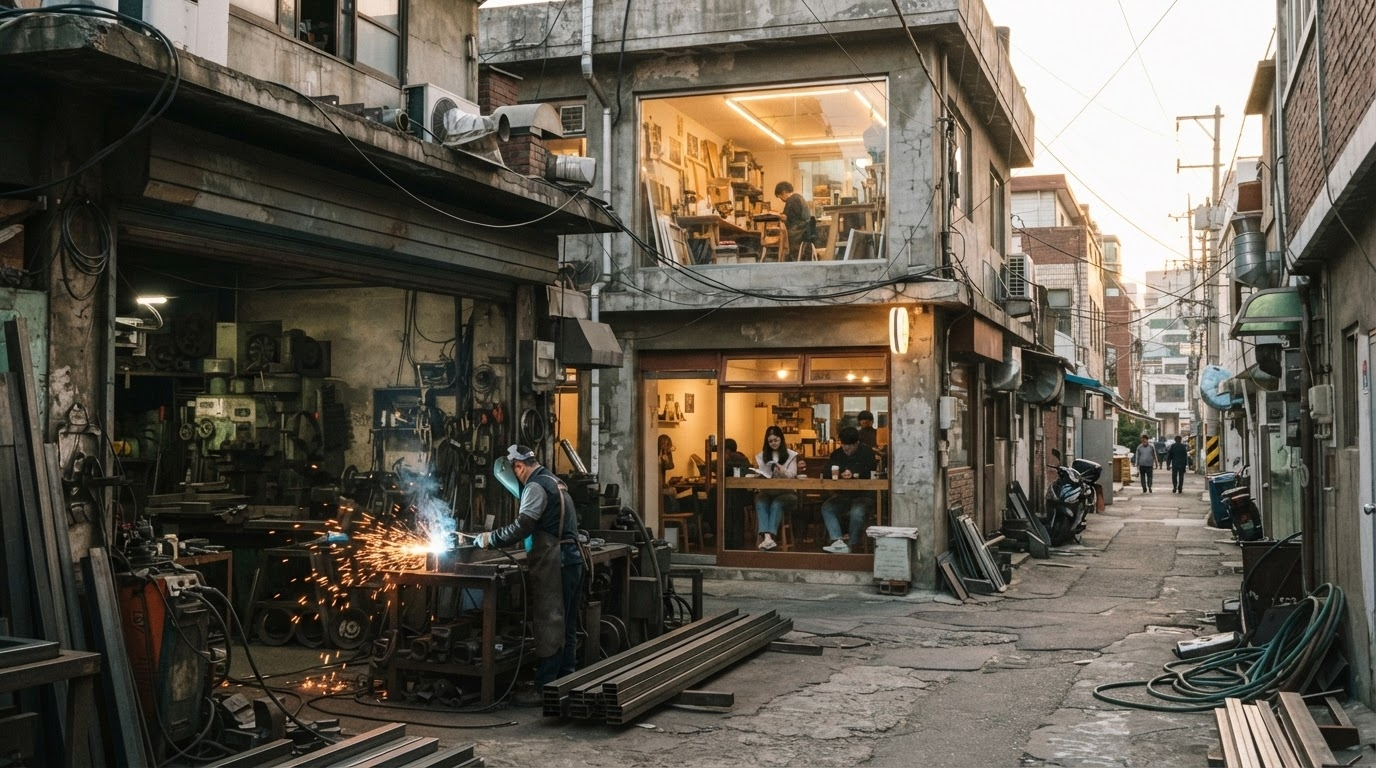
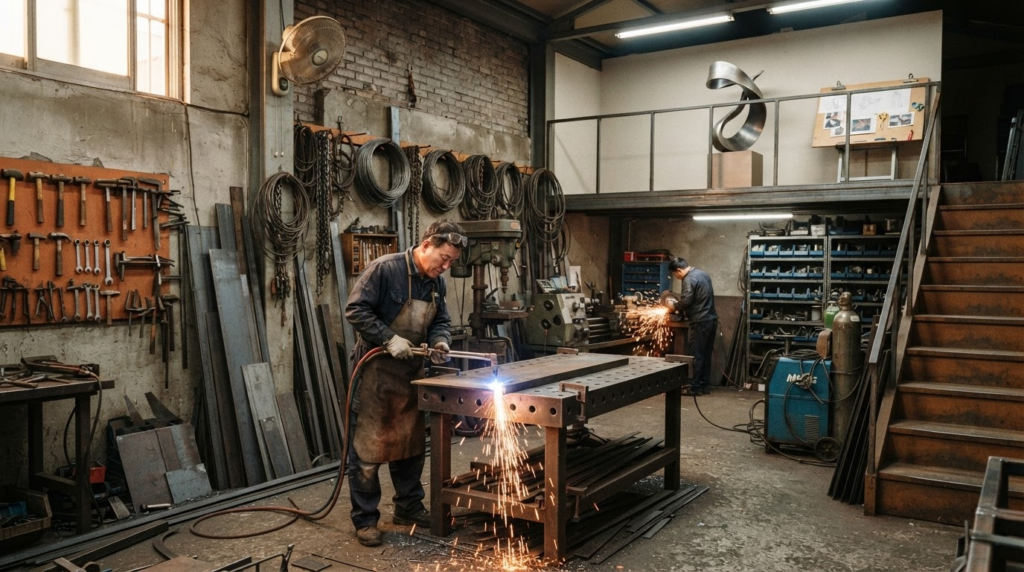
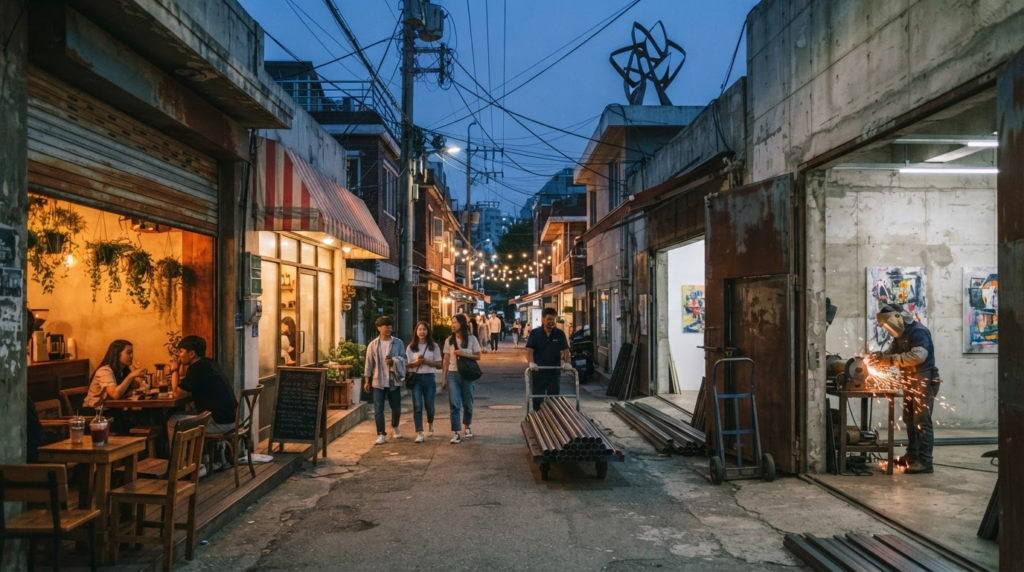
On a weekday afternoon, Mullae-dong in Seoul’s Yeongdeungpo District still runs on the rhythm of its machine shops. Between low factory buildings, the sound of metal being cut and welded carries down the alleys as workers move sheet metal and machine parts between them. Walk a few steps into the same building or deeper into the alley, though, and the scene shifts. Artists’ studios, workshops, cafes, restaurants and bars fill the empty spaces wedged between factories that are still very much in operation.
The scene people most often reach for when describing Mullae Art Village is a machine shop on the ground floor with an artist’s studio one flight up. This isn’t a staged, industrial-chic backdrop built for tourism. For years, a technician cutting metal downstairs and an artist painting or sculpting upstairs has been a genuine vertical coexistence. The path a visitor walks to find a cafe or a mural is, for a machine-shop operator, the working route used to move materials and finished parts.
That contrast is what sets Mullae apart from other Seoul neighborhoods. This isn’t a case of factories clearing out entirely before cafes and shops moved in — manufacturing space and new cultural space still share the same alleys. To a visitor, the rough industrial scenery is a distinctive sight; to a machine-shop operator or an artist, it’s the actual place where production and creative work happen for a living. Understanding Mullae means seeing both the backdrop in the photos and the labor happening in front of it at the same time.
An Industrial Ecosystem That Began With Cheonggyecheon’s Machine Shops Relocating
Mullae’s cluster of machine and metal shops began forming in the late 1960s, when machine shops around Cheonggyecheon started relocating there. As the capital region reorganized and downtown manufacturing was pushed out through the 1980s, more of these businesses clustered around the Gyeongin Road corridor between Sindorim and Yeongdeungpo stations. At its peak, more than 2,500 machine and metal businesses were packed into the area, making it one of southwestern Seoul’s leading pockets of urban manufacturing.
The area’s competitiveness didn’t rest on the number of factories alone. Small businesses handling different stages of the process — cutting, molding, welding, heat treatment, surface treatment, painting — were connected within a short distance of each other. When one business took an order, it would hand off the steps it couldn’t do itself to another shop nearby. Because making a single product required several different skills, the interlocking structure of nearby businesses working like gears was itself the area’s production base.
But as the industrial landscape shifted and manufacturers moved to the outskirts, empty factories and cheap studio space opened up. In the early 2000s, artists priced out of the rising rents in established cultural districts like Hongdae and Sinchon began moving into Mullae-dong. They used the upper floors and empty spaces of factory buildings — spaces that had little appeal as housing — as studios. The starting point of the art village wasn’t a planned cultural district, but a migration toward space people could afford.
The Power of Price That Drew In Artists and Founders
Mullae’s aging buildings were a drawback for ordinary retail tenants, but an asset for some artists. In exchange for noise and dust, they got relatively large spaces at low cost — well suited to creative work like sculpture or metalwork that needs sound and equipment. Being able to draw on materials left over from the machine shops and the skills of local technicians was another advantage hard to find anywhere else.
Rent was also part of why young founders chose Mullae. According to figures cited by Changup & Franchise, an approximately 20-square-meter storefront near Mullae Art Village in 2018 rented for a deposit of 5 million to 10 million won and monthly rent of 500,000 to 700,000 won. For someone starting a small cafe, studio or restaurant without much capital, that was a lower barrier to entry than in other popular commercial districts. Working with an existing factory layout also cut some of the cost of building out a distinctive space.
Even so, it’s hard to call Mullae simply a cheap neighborhood today. Compared with when the district first began taking shape, rents have climbed roughly 1.5 to 2 times over. A 2025 survey found that rents across Mullae Art Village and Mullae-dong 2- and 3-ga generally sat around 150,000 won per 3.3 square meters. Part of Mullae-dong 4-ga was relatively lower, at 70,000 to 80,000 won per 3.3 square meters, but came with the risk of a long-term lease amid redevelopment plans. Low cost is what created the change here — but that change has now entered a phase of pushing costs back up.
Art Drew People In, and Food and Nightlife Followed
The studios, exhibitions and murals artists built gave outside visitors a reason to explore Mullae’s alleys. When the Seoul Foundation for Arts and Culture’s Mullae Art Factory opened in 2010, it added a public hub supporting performance, visual art, crafts and other creative work. Once the art village became known, cafes, restaurants and hands-on workshop spaces catering to visitors began moving in among the machine shops.
The businesses that moved in leaned into the factory traces rather than erasing them. Exposed steel frames, concrete walls, old stairwells and metal signage were kept as part of interior and exterior design. As craft cocktail bars, small restaurants and converted factory-style cafes multiplied, Mullae became a place where the daytime working district and the evening dining scene overlap. The industrial scenery, in effect, became a distinctive commercial identity for new business owners.
The numbers back up that expansion. A 2025 analysis citing Korea’s Small Enterprise and Market Service commercial district data found that sales at bars and restaurants in the surveyed Mullae district rose 36.7% year over year. Total foot traffic reached 174,002, up roughly 8.8%. Sales in the area around Mullae Station in 2023 were tallied at 59% higher than in 2019. That growth can be read as the product of weekday office-worker demand and weekend visitor demand supporting the district together.
It Resembles Seongsu, but It Isn’t Growing the Same Way
Mullae earns the “next Seongsu” label because both neighborhoods paired industrial space with a new consumer culture. The growth path is similar too — factory buildings converted into cafes, restaurants and art spaces that drew in visitors. It’s also plausible that founders and consumers priced out of Seongsu’s rising rents and crowds have turned their attention toward other industrial districts, Mullae included.
But treating Mullae as simply a second Seongsu misses important differences between the two. Seongsu has quickly filled with pop-up stores from major brands and large complex cultural spaces, while Mullae still has small machine shops and studios woven more tightly throughout. Rather than one large factory building being converted wholesale into commercial space, Mullae’s spaces are scattered across small lots and narrow alleys — a difference that also shapes how fast and in what form the district grows.
How people visit needs to differ too. Mullae’s alleys aren’t pedestrian space set aside for tourists — metal materials and vehicles still move through on weekday afternoons. Walking uninvited into a machine shop or photographing workers without permission can disrupt production. Lingering in front of a factory entrance or blocking the movement of materials should also be avoided. Mullae’s appeal lies not in a staged industrial interior, but in the fact that actual manufacturing still operates there.
Can Mullae Still Feel Like Mullae Once the Machine Shops Are Gone?
Mullae’s commercial growth has rested on cheap rent and a distinctive industrial landscape — but it carries a paradox: the more popular the area gets, the more that foundation can erode. As visitors and commercial businesses increase and rents rise, the artists and small business owners who sparked the original change to begin with can end up pushed out. That’s why gentrification — capital flowing into a once-overlooked area, followed by rent increases that push out its original users — is becoming a real concern in Mullae, too.
The future of manufacturing here is another key variable. In 2023, Yeongdeungpo District began pursuing a project to relocate the roughly 1,279 remaining machine and metal businesses across Mullae-dong 1- through 4-ga to Seoul’s outskirts or nearby parts of the metropolitan area, and started a feasibility review. At the time, more than 90% of those businesses were operating on leased factory space, and metal-processing manufacturers made up 75.8% of the total. The concern behind the plan was that if redevelopment and rising rents scattered businesses individually, the connected-process manufacturing ecosystem that depends on proximity could weaken.
A collective relocation has the advantage of improving working conditions and preserving the network of root industries. But it also raises the possibility that once the machine shops leave Mullae en masse, only the outward shell of the industrial landscape will remain. If all that grows is cafes and commercial space built around leftover factory traces, Mullae becomes harder to distinguish from any other regenerated commercial district. The current description of machine shops and art coexisting may no longer hold.
Mullae’s new commercial playbook didn’t come from wiping its old industrial space clean. A mood other districts can’t easily copy emerged from machine-shop craft, artists’ creative work and young entrepreneurs’ space-planning all layering onto the same alleys. What’s worth watching going forward isn’t whether Mullae becomes as famous as Seongsu. It’s whether, once it does, manufacturers, artists and small merchants can keep working in the same alleys.
Source: Changup & Franchise, July 21, 2025; Hankyung Business, December 17, 2015; Newsis, June 8, 2023.