
Table of Contents
Planning for Fall in the Middle of Summer Heat
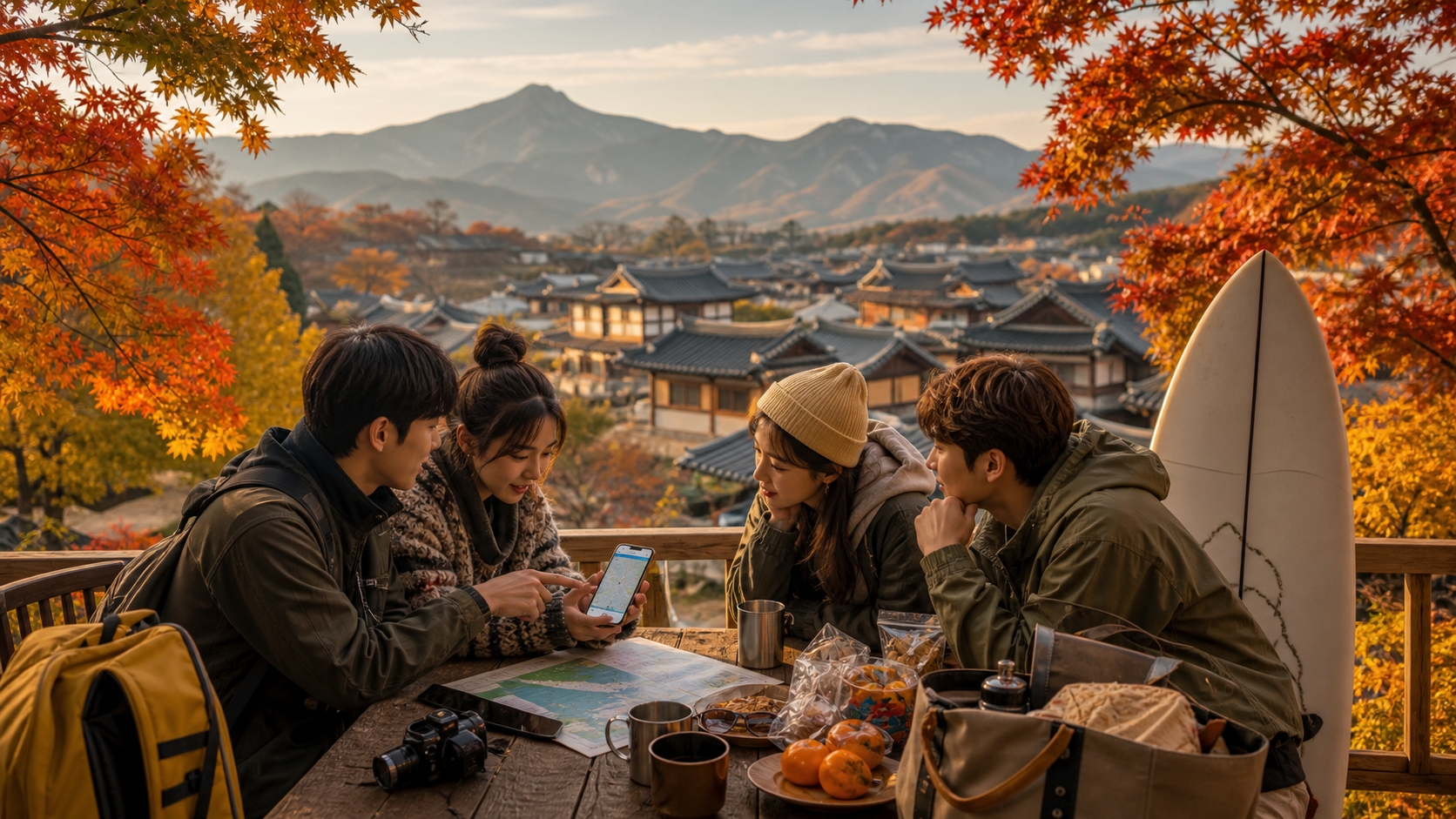
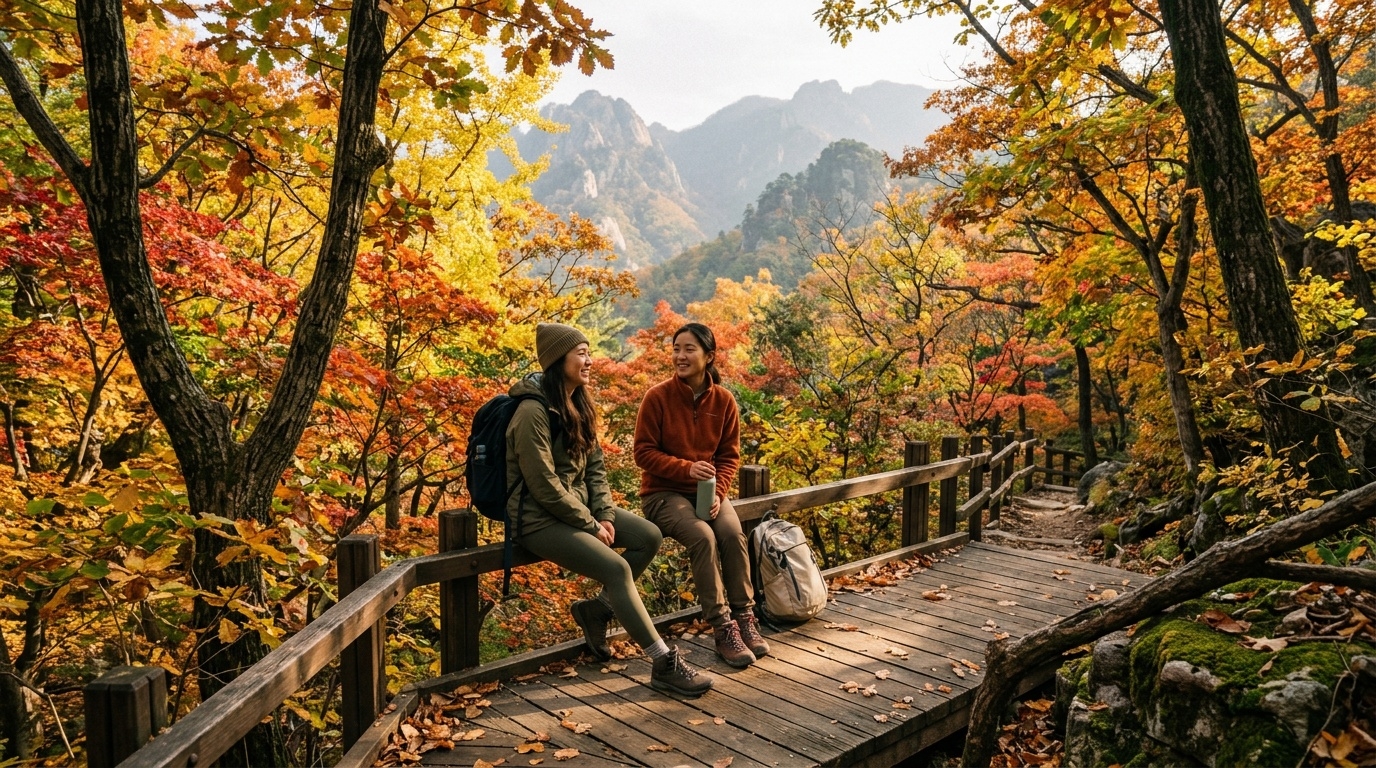
Even as summer heat continues into August, Korea’s travel searches have already shifted to fall. Ahead of the Chuseok holiday in September and the Gaecheonjeol (National Foundation Day) and Hangeul Day holidays in October, searches and bookings are rising for destinations that combine fall foliage with local culture — places like Seoraksan, Naejangsan, Jeonju Hanok Village, and Andong’s Wolyeonggyo bridge. Demand for what’s being called an ‘early fall’ getaway is picking up before summer vacation season has even wrapped, as travelers rush to lock in flights and accommodations.
What stands out in this shift is the purpose behind the trips. It’s not only about racing between famous sights for a photo. ‘Playcation’ — travel built around a favorite activity — and ‘mart attack,’ browsing local supermarkets and convenience stores for regional ingredients and snacks, are emerging as new travel vocabulary. For Gen Z travelers, who are used to comparing prices and reviews online and hunting for local, region-specific tips on social media, a destination has become both a place to spend money and a space to observe how locals actually live.
A Calendar Where a Few Days Off Turn Into Nine or Eleven
Chuseok itself falls on Friday, September 25, 2026. The official holiday runs from Thursday the 24th through Saturday the 26th, and including Sunday the 27th, that’s four consecutive days off. If an office worker adds three days of paid leave from September 21 to 23, that connects to the preceding weekend and stretches the break to nine days, from the 19th through the 27th. What Koreans call a ‘golden holiday’ refers to this practice of placing paid annual leave between public holidays and weekends to build a longer stretch of time off.
October offers an even longer combination. Gaecheonjeol falls on Saturday, October 3, which pushes the alternative public holiday to Monday, October 5; Hangeul Day follows on Friday, October 9. Taking three days of leave from the 6th through the 8th connects those two holidays into nine days off, from the 3rd through the 11th. Adding leave on October 1 and 2 extends that further to 11 days. The public holidays themselves don’t span 11 consecutive days — that total is only possible if an individual uses five separate days of paid leave.
Longer Time Off Is Changing Both Distance and Pace
The Segye Ilbo reported that searches for domestic fall foliage spots aimed at the September holiday surged starting in August, with booking rates for major fall destinations climbing quickly. Early bookings are also picking up around regional festivals held in early September. For the relatively shorter Chuseok break, domestic foliage spots and small towns are getting the most attention, while travelers who’ve strung together nine days or more of leave are increasingly considering farther-flung destinations, including international trips.
October’s nine- or eleven-day stretches favor long-haul destinations like Europe and the Americas, since places that require more than a day of travel time are hard to visit on a short break. On the other hand, more travelers are choosing to spend a long holiday in a single Korean small town rather than automatically going somewhere far away. As trip length increases, managing accommodation and transportation costs while keeping a normal daily rhythm starts to matter more than cramming in as many sights as possible. In effect, a golden holiday changes not just how far people travel, but how they choose to stay once they get there.
‘Playcation’: When an Activity Becomes the Destination
One of the summer 2026 travel trends Airbnb identified is ‘playcation’ — a blend of ‘play’ and ‘vacation’ describing trips where travelers choose their destination and accommodation around an activity they enjoy, rather than the other way around. Rising bookings for lodging near golf courses, lakes, and surf spots are a typical example. Unlike conventional tourism, where a traveler picks a place first and figures out what to do once there, playcation starts with the activity and works backward to the location.
Playcations also tend to come with longer stays. Activities like hiking or surfing aren’t one-off experiences, so they require a more relaxed schedule, and travelers end up paying closer attention to nearby restaurants, shops, and transportation around their accommodation. Airbnb’s research found that one in three travelers overall now spends vacation time relatively close to home. What’s shifting isn’t the distance traveled so much as whether a favorite activity can be repeated comfortably — increasingly, that’s what determines how satisfying a trip feels.

‘Mart Attack’: Choosing the Supermarket Over the Restaurant
‘Mart attack’ is a concept introduced in Skyscanner’s 2026 travel trend report. Instead of hunting down a destination’s famous restaurants, it describes browsing local supermarkets, markets, and convenience stores to check out regional ingredients, snacks, and everyday goods firsthand. In Skyscanner’s survey, 56% of Korean travelers said they frequently or always visit local supermarkets while traveling. The most common reason, cited by 52% of respondents, was that it’s a good way to understand local food culture.
A supermarket shows local prices and eating habits more directly than spaces designed for tourists. What’s stocked on the shelves — the ingredients, the small-portion packaging, the ready-made food, the discount patterns — reflects what people in that region actually eat and how they shop. Travelers can compare a wider range of products for less money than a high-end restaurant would cost, and either eat what they buy at their accommodation or bring it home as a gift. Mart attack combines two things at once: budget-conscious consumption, and a form of cultural experience aimed at getting closer to ordinary local life.
Korean Travelers Who Go ‘Short and Often’
Booking.com’s 2026 global travel trends survey, covering 32,800 respondents across 34 countries, also confirmed how frequently Korean travelers hit the road. Korean respondents reported an average of 3.14 domestic trips per year, above the global average of 2.53, and 1.95 trips within Asia, above the global average of 1.38. Rather than saving a budget for one long trip, Korean travelers show a relatively strong preference for splitting their travel into multiple shorter trips — traveling ‘short and often.’
When choosing accommodation, 72% of Korean respondents said cleanliness matters most, compared with a global average of 62%. Sixty-nine percent reported using AI tools while traveling, versus a global average of 50%. That points to travelers who scrutinize reviews, hygiene, and service quality closely, rather than simply picking the cheapest option. It also lines up with Skyscanner’s finding that Gen Z travelers actively seek out travel information on YouTube and Instagram.
From ‘Where’ to ‘How’ as the New Travel Yardstick
It would be an overstatement to say every member of Gen Z has adopted playcation and mart attack in the same way. Both terms come from separate surveys and datasets — one from Airbnb, the other from Skyscanner. Booking.com’s data, meanwhile, speaks less to any one generation’s supermarket habits and more to Korean travelers’ overall trip frequency and criteria for choosing accommodation. Still, taken together, the three sources point to a shared shift: away from tourism centered on famous destinations, and toward travel centered on personal interests, activities, local everyday life, and baseline quality.
September and October’s golden holidays offer a concrete stage to test that shift. Depending on how much paid leave someone can use, a break can stretch to four, nine, or eleven days, and even within the same calendar, that opens room for a nearby activity-focused trip, a long-haul international trip, or an extended stay in a small Korean town. What’s worth watching is whether a long holiday simply drives more bookings, or actually accelerates a new kind of travel spending — one centered on local daily life and personal taste.
Source: Segye Ilbo, August 11, 2026; Airbnb, May 27, 2026; Booking.com, April 6, 2026; Skyscanner 2026 Travel Trends Report, October 14, 2025.