

Table of Contents
18.4% and 18.3%: the generational balance at large corporations flips
For the first time, employees aged 50 and over make up a larger share of the workforce at major Korean corporations than those under 30. A recent analysis by Leaders Index, a corporate research institute, reviewed 2023 and 2025 demographic data from 132 companies out of Korea’s top 500 that disclose employment by age. Over this two-year period, the share of employees 50 and older rose from 17.5% to 18.4%, while the share of workers 30 and under dropped 2.9 percentage points, from 21.2% to 18.3%.
Back in 2023, the younger group held a comfortable 3.7 percentage point lead over their older colleagues. Two years later, the order flipped, with the over-50 group inching ahead by 0.1 percentage points. The margin is slim, but the direction is clear. With overall hiring staying roughly flat, the existing workforce is aging while the flow of young talent coming in shrinks, reshaping the internal age makeup of these companies fairly quickly.
This isn’t a direct comparison between the raw number of older workers and new hires. It compares the overall share of the workforce held by the over-50 and under-30 brackets. What matters is that this shift lines up with a drop of more than 15% in new hires across the 113 companies that disclosed such data over the same two-year span. The generational crossover comes from two things happening at once: the active workforce getting older, and the entry point for young job seekers narrowing.
A drop in new hires sped up the generational flip
The number of employees aged 50 and above grew from 221,333 in 2023 to 231,848 in 2025, an increase of 10,715 people, or 4.8%. Meanwhile the under-30 workforce’s share fell sharply over the same window, dropping from 21.2% to 18.3%. What changed most isn’t the total number of jobs these corporations offer, but who is staying in them and who is newly arriving.
The same pattern shows up in new hiring. The share of new hires under 30 fell by 5.3 percentage points, from 56.4% in 2023 to 51.1% in 2025. The share of new hires aged 50 and above grew from 8.3% to 11.2% over the same period. Young adults still make up more than half of all new recruits, but their overall slice of the hiring pie is shrinking.
It would be wrong to read this crossover as older workers uniformly replacing young new hires. The data reflects two things happening together: existing employees staying longer and aging into the 50-plus bracket, while companies broadly pull back on recruitment. It isn’t a simple story of companies firing people and keeping only seniors either. A cautious hiring climate meeting the natural aging of the current workforce is pushing corporate age structures toward something closer to an inverted pyramid.
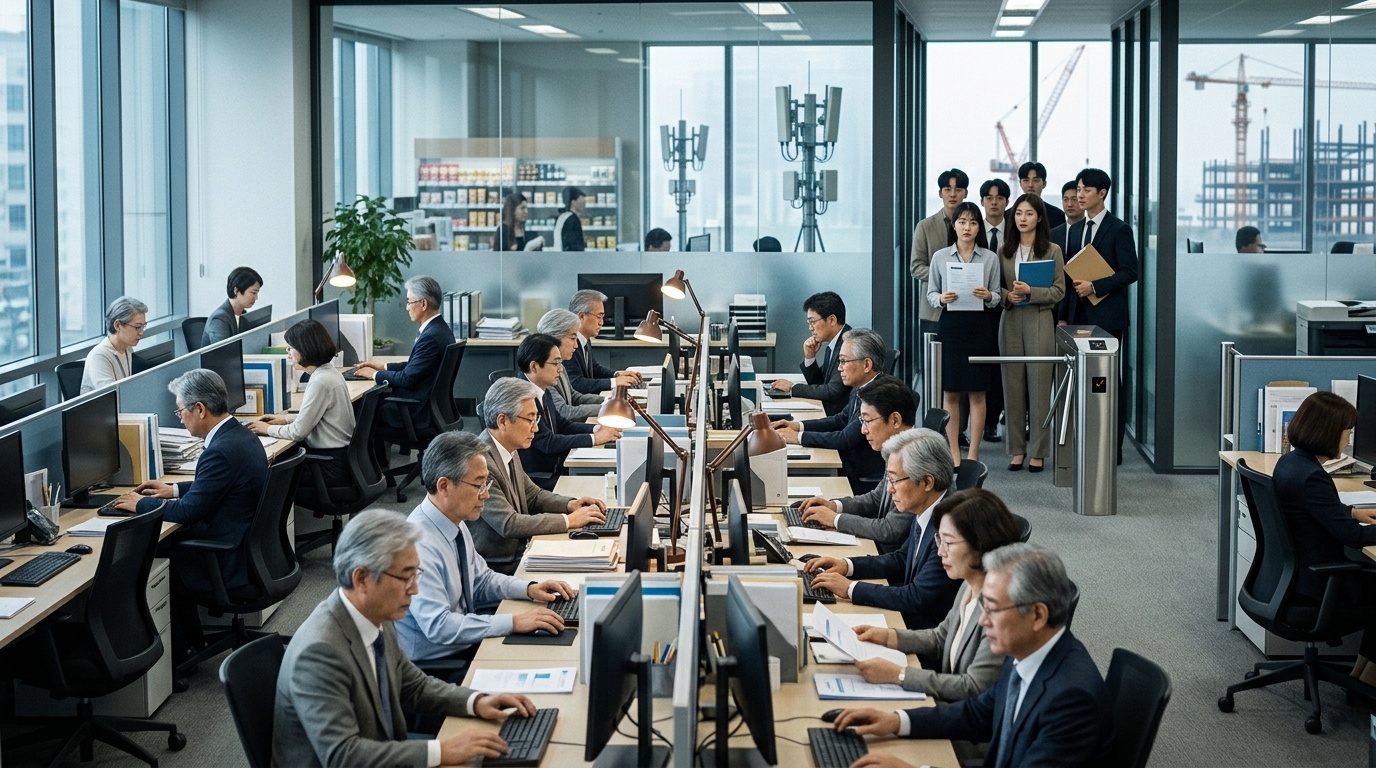
Retail and telecom showed an even wider gap
Differences by sector are stark. In 2025, retail recorded the highest share of employees over 50, at 31.8%. Food and beverage followed at 30.6%, with construction and building materials at 29.7%. In these industries, nearly one in three workers is over 50. The aging of the existing workforce shows up most clearly in sectors that lean heavily on domestic consumption and on-site operations.
Looking at individual companies, the divide gets even wider. At Lotte Shopping, workers over 50 made up 44.1% of staff, while those under 30 were just 5.2%. The older group was more than eight times the size of the younger one. That number says something beyond an industry-wide aging trend in retail. It shows how far the presence of young employees has dropped at specific companies.
At SK Telecom, 37.0% of the workforce was over 50, while the under-30 share stood at just 8.6%, a gap of more than four to one. The telecom sector is closely associated with cutting-edge technology and digital transformation, yet its internal workforce leans notably older. An industry’s high-tech image doesn’t say much about how many young people it actually hires.
Some companies cut young recruitment sharply. HiteJinro’s new hires aged 29 and under fell from 82 people in 2023 to just one in 2025. At Hyundai Motor, youth recruitment dropped 65.1% over the same period, from 16,551 to 5,782. The entry gates for young job seekers can narrow this much regardless of a company’s overall size or financial performance.
Youth hiring hasn’t fallen everywhere, though. SK Hynix sharply increased its young new hires, from 228 in 2023 to 2,560 in 2025. Samsung Biologics also grew its youth hiring, from 205 to 484 over the same stretch. In industries seeing continued investment, like semiconductors and biotech, youth recruitment expanded instead of shrinking.
These differences make it hard to sum up Korea’s youth employment picture with one average. Major corporations as a whole are hiring less and seeing a generational flip, but certain growth-oriented companies are actively recruiting young talent. The jobs young adults need haven’t disappeared evenly across every industry. They’re concentrating in specific companies and growth sectors. For job seekers, that means the overall pool of opportunity is shrinking even as the gap between individual companies grows wider.
An export boom alongside worsening youth employment
The demographic shifts inside major corporations line up with broader trends in Korea’s youth job market. According to the National Data Agency’s May 2026 employment report, the number of employed youth aged 15 to 29 dropped by 255,000 compared with the same month the year before. That is the steepest decline since January 2021, when the pandemic shock peaked. The number of employed young adults has now fallen for 43 straight months since November 2022.
This same period saw a boom in semiconductor exports that pushed Korea’s overall export performance to record highs. That leaves a paradox: strong exports and solid corporate earnings sitting alongside a shrinking number of young people in the workforce. In the past, a surge in big-business exports was expected to trigger facility expansion, more production at partner firms, and a wave of new hires. These days, the gains from economic growth aren’t reaching the broader job market, young workers especially, at the pace they once did.
Industries like semiconductors, which depend on huge investments in equipment and technology, don’t necessarily scale hiring at the same rate they scale production and exports. Even when individual companies like SK Hynix sharply ramp up youth hiring, the effect is too localized to offset the broader decline in youth employment across the Korean economy. That’s why the specific job-creation structure of each industry matters for understanding why record exports and falling youth employment are moving in opposite directions.

A hiring bottleneck that aging alone doesn’t explain
Korea’s rapid aging provides the basic backdrop for an older corporate workforce. If existing employees stay on, the 50-plus group will naturally grow over time. There’s no reason to see longer careers and more people working until retirement as inherently bad. Deep expertise and institutional knowledge are real assets to any company.
But if new hiring were keeping pace, the share of young employees wouldn’t drop this fast. The key detail in this flip isn’t just that the over-50 workforce grew 4.8%, but that new hires at large corporations fell by more than 15% over two years. Employees working longer and new generations struggling to get in are two separate things, but when they happen at the same time, generational turnover at a company slows to a crawl.
For young adults, a first job is the gateway to building a career. The more companies favor experienced people who can start producing right away, the harder it gets for someone without experience to get in the door. Missing that first job means missing the chance to build a track record, which then makes the next application harder too. Even if the total number of jobs stays stable, the real issue for young workers isn’t how much employment exists, but how open the entry gates are.
The long-term stakes of a 0.1-point flip
The gap between the 18.4% of workers over 50 and the 18.3% under 30 comes to just 0.1 percentage points. But the younger group held a 3.7 percentage point lead only two years earlier, so the speed of this shift is not small. One statistical snapshot doesn’t lock in a long-term trend on its own, but if the drop in new hiring continues, this gap will likely widen.
For companies, this is more than a demographic quirk. Passing down knowledge and skills as veteran employees retire requires bringing young talent into the organization well ahead of time. A long hiring slump can leave specific age brackets almost empty inside a company. Young people lose the chance to build a stable career, and companies end up facing generational turnover and skills transfer all at once, later and under more pressure.
Going forward, it will be harder to judge employment recovery just by looking at strong exports or corporate earnings. It matters more which industries and companies are actually expanding or cutting youth recruitment, whether these new roles turn into long-term careers, and whether the older generation’s expertise gets passed down effectively. This generational flip is less a single statistic about more older workers and more a sign that how Korean corporations hire and hand off between generations is genuinely changing.
Source: Leaders Index, August 18, 2026; Herald Economy, August 18, 2026; Hankook Ilbo, June 12, 2026; National Data Agency “May 2026 Employment Trends,” June 11, 2026.


