

Table of Contents
Student Debt That Outlasts Graduation
In South Korea, student loans were long treated as a predictable debt: you finish university, land an entry-level job, and start paying it down. Today, that timetable is unraveling as graduates take longer to enter the workforce and frequently leave their first roles after only a short stint. Official figures show that the financial weight of these loans is spilling past the twentysomething milestone well into graduates’ thirties. The once-expected sequence of graduation, steady employment, independent income, and scheduled debt repayment is increasingly fractured by precarious job markets.
In 2025, a record 8,475 borrowers in their thirties were approved for repayment deferrals under South Korea’s income-contingent student loan program, a jump of more than 15% from 7,346 the previous year. This surge cannot be explained solely by initial post-college hiring freezes. Rather, it reveals that young professionals who found work and began making payments are abruptly losing income streams through layoffs, contract expirations, or resignations. The student debt conversation is shifting from pre-career financing toward income volatility after entering the workforce.
The Lengthening Road to a First Job
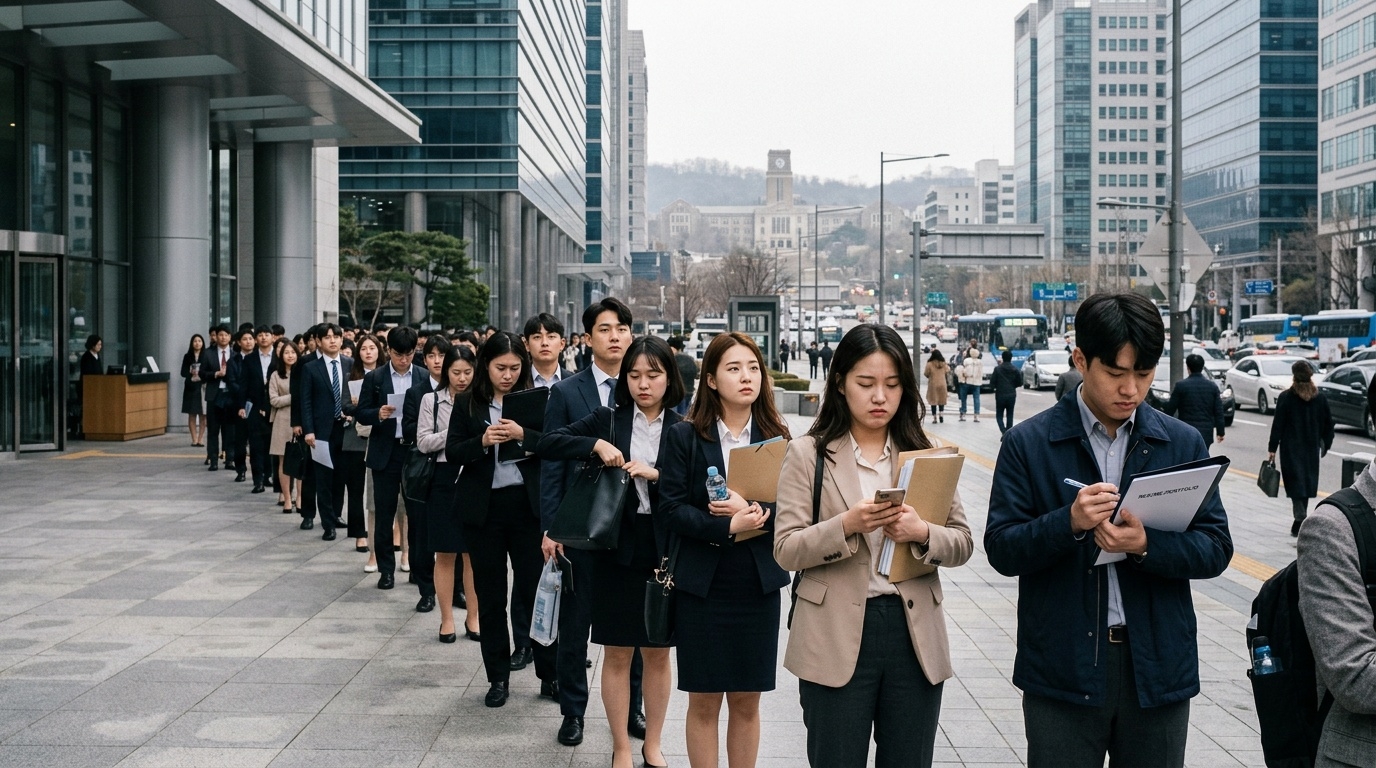
The root of this trend traces back to delays at the starting line. Between 2020 and 2025, the proportion of young adults aged 20 to 34 who spent more than a year landing their first job climbed from 29% to 33%. Roughly one in three college-educated youth now spends over twelve months navigating recruiting seasons after leaving campus. Without dependable earnings during this prolonged job hunt, building a baseline cushion to service loan principal and interest becomes nearly impossible, particularly while juggling everyday living costs and interview prep expenses on limited savings.
When the first job is postponed, every subsequent financial milestone shifts backward. Opportunities to build professional momentum, earn salary increases, and actively pay down balances arrive later, pushing repayment duties directly into one’s thirties alongside rising rent and living costs. While income-contingent loans provide essential breathing room by deferring obligations until salaries kick in, failing to land durable employment doesn’t erase the debt. It merely carries the balance into the next chapter of adulthood. A policy designed as a patient safety net risks turning into a persistent burden when career stability remains out of reach.
This dynamic makes it clear that the growing number of deferral requests among 30-somethings isn’t simply personal budgeting gone wrong. Instead, it reflects narrower entryways into quality positions combined with unstable employment once inside. Evaluating youth employment purely through hiring rates overlooks those who secure a role only to lose their footing shortly after. Understanding the real picture requires examining job durability and the income gaps that emerge between positions.
Working, Then Losing a Footing
South Korea’s income-contingent student loan framework works differently from standard installment loans that demand fixed monthly checks immediately after school. Repayment obligations trigger only once an individual’s annual income clears an established threshold, scaling up with higher earnings. The system aims to expand educational access by shielding graduates while income is modest, collecting payments when their earning power matures. Consequently, the framework’s health hinges directly on whether graduates can secure dependable, enduring jobs.
Complications arise because required payment sums are determined by previous earnings, leaving borrowers exposed if they suddenly lose income due to layoffs, career departures, small business closures, or parental leave. Deferrals serve as a relief valve, allowing those whose financial circumstances have changed to postpone payments until conditions improve. Because a deferral merely reschedules obligations rather than forgiving them, the debt stays intact whenever income fails to rebound.
Crucially, deferrals are not applied automatically when income drops; borrowers must actively submit paperwork documenting verified hardships like unemployment, company downsizing, or family leave to obtain approval. The official tallies reflect only those who knew how to navigate the system and met its formal criteria, leaving out individuals who face similar financial stress but handle repayments through alternative borrowing or family help.
Larger Balances and Repeat Deferrals
In 2025, approximately 477,000 young adults aged 20 to 34 with prior work experience were categorized as officially “resting,” meaning they were neither employed nor actively job hunting. While this group includes varied personal backgrounds beyond student debtors, it underscores that landing an initial role does not automatically guarantee long-term workforce stability, providing important context for the deferral spike.
Thirty-somethings also account for the lion’s share of deferred balances. Of the 24.33 billion KRW in total postponed payments recorded in 2025, borrowers in their thirties accounted for 15.02 billion KRW, or 61.7%. The concentration of both heads and total balances in this demographic confirms that educational debt is lingering far into adulthood. When income abruptly stops, past tuition liabilities collide directly with current living expenses.
At the same time, repeat deferrals are growing more common. Borrowers approved for two or more deferrals within a single year rose from 488 in 2021 to 1,320 in 2025, multiplying by 2.7 times. Relying repeatedly on emergency deferrals suggests that income interruptions are becoming chronic hurdles rather than isolated shocks, leaving workers struggling to regain financial footing even after finding new work. As repeat filings mount, the issue clearly shifts from temporary payment trouble to ongoing employment instability.

From Employment Strain to Mid-Career Debt
These numbers do not mean all 8,475 individuals share identical trajectories of serial layoffs, as deferral reasons span business closures and parental leave alongside job loss. Even so, the combination of delayed first hires, rising numbers of sidelined workers with work experience, and recurring deferral applications points to a shared underlying pressure. Evaluating youth job initiatives based solely on headcount hiring targets misses the instability that frequently follows.
Deferrals offer a vital cushion when paychecks dry up. However, when these pauses become routine, they merely kick the financial can down the road while the root challenges of job insecurity and debt remain unsolved. The central issue moving forward is whether these borrowers can transition into sustainable positions that allow them to resume steady payments. The record deferrals among thirty-somethings highlight that effective youth policy must reach beyond opening doors to initial employment: it needs to support career continuity, smoother transitions between jobs, and dependable income recovery.
Source: Seoul Economic Daily, September 24, 2026; National Tax Service Income-Contingent Student Loan Guidelines.