
Table of Contents
Eyes Drawn to Haewon in Hanbok
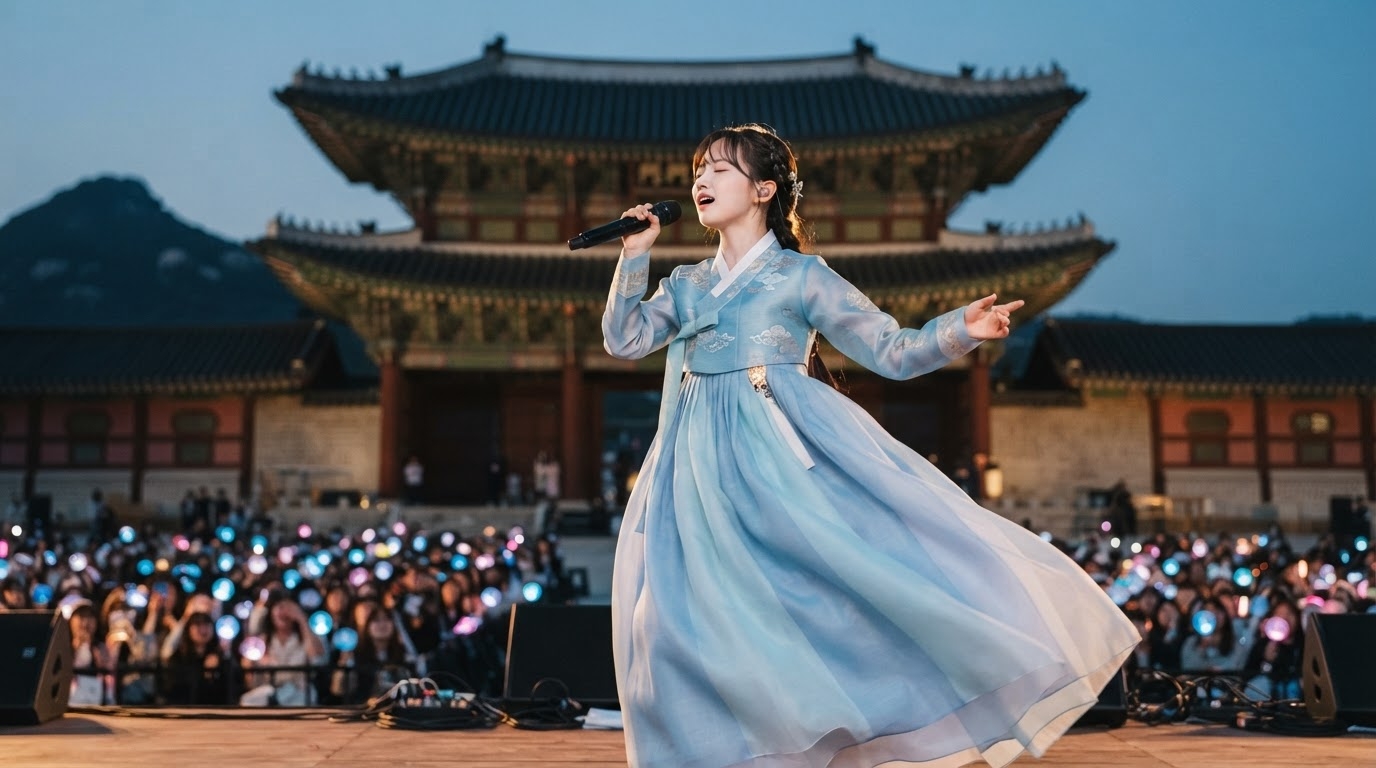
NMIXX’s Haewon, dressed in a sky-blue hanbok, sings “Heavy Serenade” on a stage at Gyeongbokgung Palace. In fancams (videos that focus entirely on a single member’s movements), the outfit and facial expressions capture as much attention as the performance backdrop. The sight of a familiar idol in unfamiliar attire quickly spread across social media. Fans were initially captivated not by the historical context of the palace, but by the transformed appearance of a singer they already knew well. A single performance video inadvertently became their starting point for entering a traditional culture festival.
Related Instagram posts featured reactions like “She looks like a fairy” and “Hanbok suits her so well.” The phrase “hanbok personal color” even popped up. While “personal color” usually refers to the specific color palette that flatters an individual best, fans used it metaphorically to say the hanbok itself perfectly matched Haewon’s aura. This doesn’t need to be read as a critique of Joseon-dynasty sartorial accuracy. It fits better as a warm expression of interest in traditional clothing, phrased through the lens of modern pop-culture vocabulary.
This performance wasn’t a standalone idol event. On October 6, Haewon and her NMIXX bandmates performed at the “Immortal Songs – 2026 Royal Culture Festival Special” at Heungnyemun Square in Gyeongbokgung Palace. The original context of the clips, which were sliced and shared online to focus on individual members, was actually the eve of a national heritage festival. For fans who recognize the artist in the video, the natural next question becomes where they were singing and what kind of event they were a part of.
The Larger Festival Behind the Idol Stage
According to an October 6 press release from the Korea Heritage Service’s Royal Palaces and Tombs Center and the Korea Heritage Agency, the Autumn Royal Culture Festival runs from October 7 to 11 across Gyeongbokgung, Changdeokgung, Deoksugung, Changgyeonggung, and Jongmyo Shrine. Now in its 12th year, the festival transforms the palaces into spaces for exhibitions, performances, and hands-on experiences. It helps to distinguish between the spring and autumn lineups. This autumn’s events center specifically on the four main palaces in Seoul and Jongmyo Shrine, setting it apart in spatial scope from other cultural heritage events held regionally across the country.
The special performance, themed “Palace, Awakening Art,” took place at 5 PM on the eve of the opening at Gyeongbokgung’s Heungnyemun Square. Hosted by Shin Dong-yup, Kim Jun-hyun, and Lee Chan-won, the lineup featured Kim Young-im, the Kim Chang-wan Band, Lyn, Lee Seung-gi, Song Ga-in, La Poem, BTOB, NMIXX, and BOYNEXTDOOR. The programming deliberately placed traditional Korean music, mainstream pop, and K-pop on the exact same stage. Haewon’s fancam zooms in on just one fragment of this expansive event. Therefore, a single idol’s video alone cannot capture the full musical breadth of the opening night.
The mere fact that a palace was the backdrop for a K-pop performance doesn’t fully explain the blending of tradition and modernity, either. What matters is how that stage connects to the rest of the festival’s programs. A reader drawn in by Haewon’s hanbok can easily find other festival programs that explore traditional attire. Someone whose interest is piqued by the location of Gyeongbokgung can expand their curiosity to other palaces and Jongmyo Shrine. Rather than summing up the entire festival, the performance video works as an entry point, sparking a variety of different cultural interests.
From Looking at Hanbok to Listening to Daily Culture
The marquee program most directly tied to Haewon’s outfit is the “Gyeongbokgung Hanbok Banquet.” The official schedule places this event during the evening viewing hours of Gyeongbokgung on October 9 and 10, from 7 to 9 PM. The overarching theme is the national intangible cultural heritage of “Hanbok Living.” The term “intangible heritage” implies that preservation efforts extend beyond buildings and artifacts to include the knowledge, skills, and daily customs carried on by people. The program is structured to view hanbok not merely as a finished garment, but as an active practice of wearing, crafting, and sharing its deeper meaning.
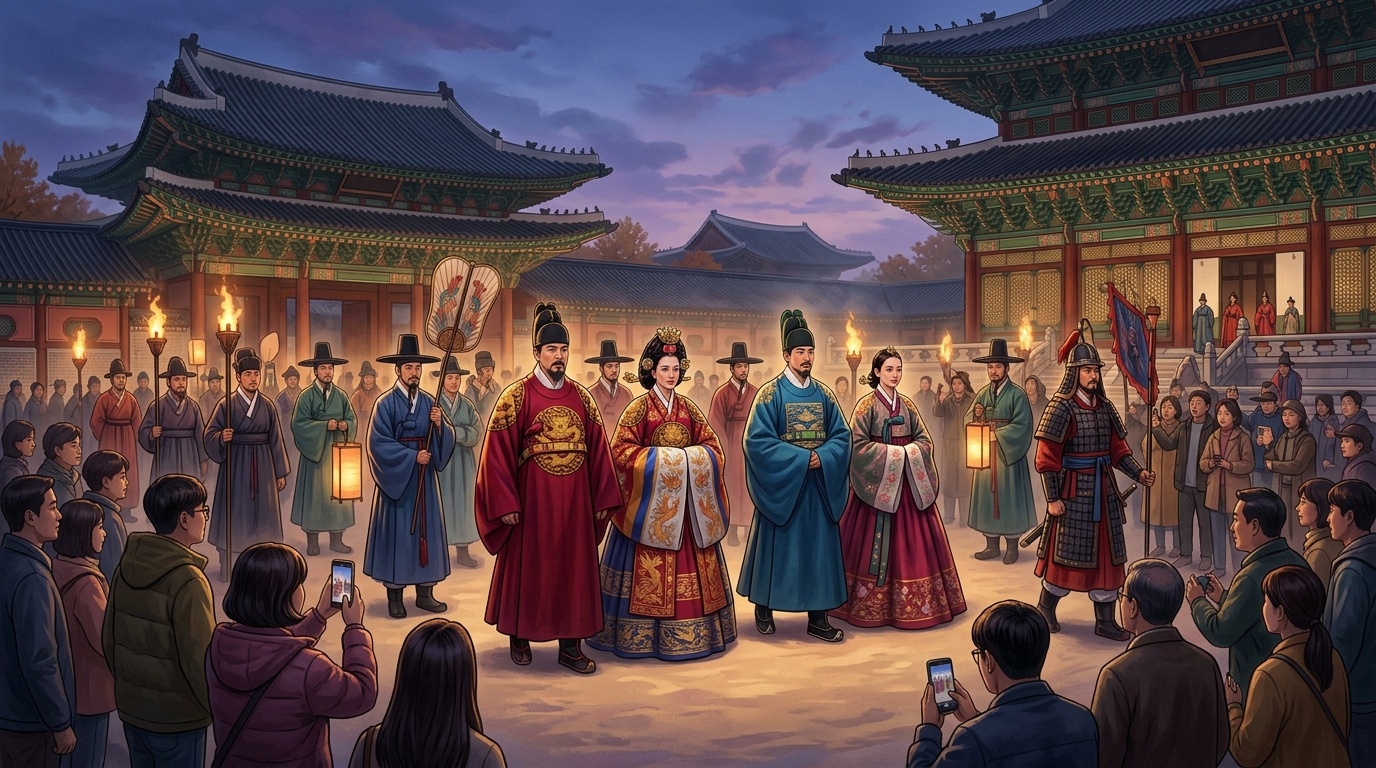
The lineup includes “The Royal Stroll,” which recreates the procession of the King, Queen, Crown Prince, and Crown Princess, alongside a fashion talk show introducing Joseon royal attire. This is where a curiosity sparked by an idol’s stage outfit can bridge over to learning about royal clothing and daily palace life. Of course, this doesn’t mean the hanbok worn in a modern performance is an exact historical replica of a specific royal figure’s attire. It’s about drawing a connection while still distinguishing between the aesthetic appreciation of a stage costume and the understanding of historical dress.
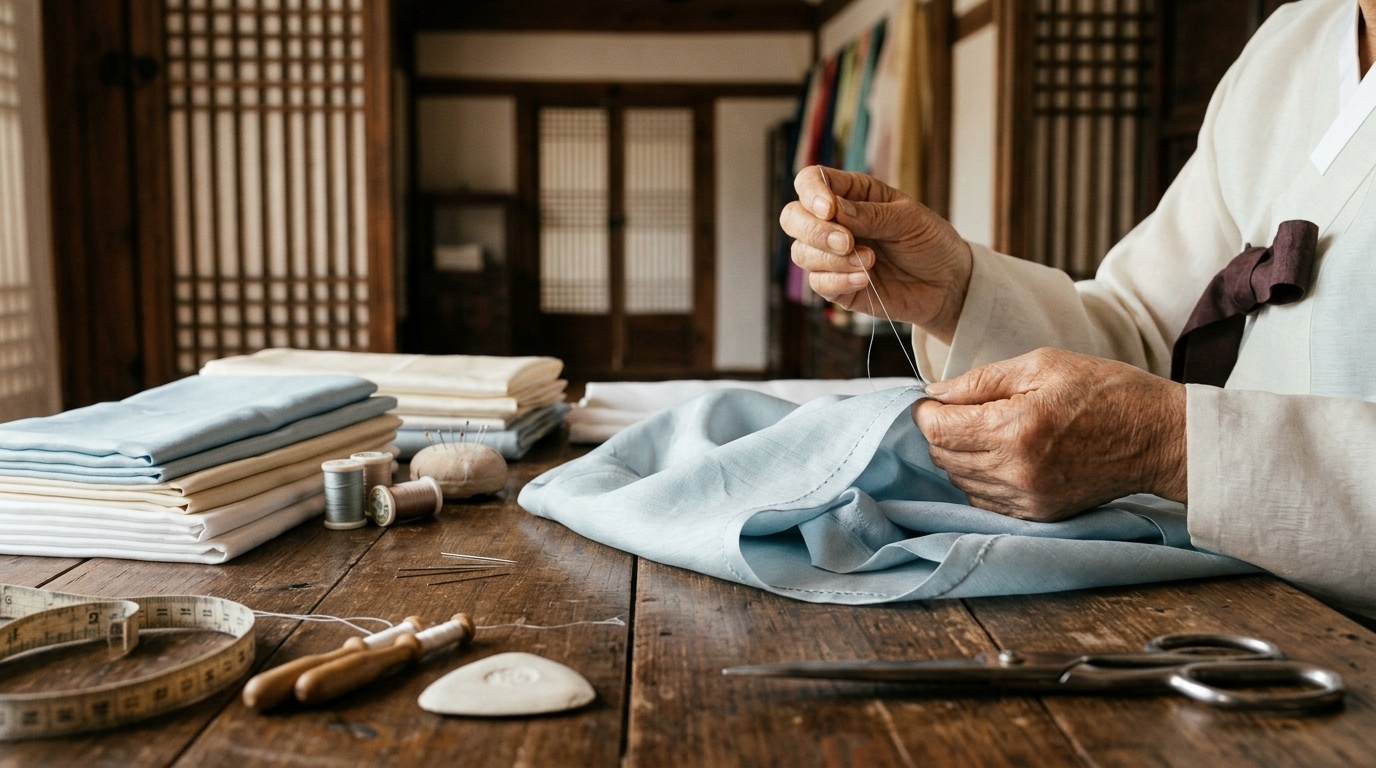
The same program also features an ASMR concert that amplifies the sounds of clothes-making. ASMR, a sensory format that focuses on subtle sounds, is used here to let audiences listen to the crafting process of intangible heritage artisans. While a fancam zooms in on the colors and movements of a finished outfit, this program shifts the focus to the labor and care that go into its creation. Even when dealing with the exact same subject of hanbok, the perspective moves from the final visual product to the technique and effort behind it. The way traditional culture gets presented here is no longer confined to visual appreciation alone.
Royal History Extending Beyond Gyeongbokgung
The festival’s footprint doesn’t end at Gyeongbokgung, where Haewon performed. Changgyeonggung Palace hosts the “Changgyeonggung Time Travel” on October 9 and 10. Official press releases describe it as a program reviving King Yeongjo’s spirit of loving his people and Crown Prince Hyomyeong’s court dances. For international readers, engaging with this means learning to tell apart palaces with similar-sounding names while understanding the specific historical narratives chosen for each space.
Over at Jongmyo Shrine, the “Jongmyo Gate Guard Patrol Ceremony” takes place from October 9 to 11. The gate guards were responsible for defending the entrances, while the patrol involved walking the perimeter to maintain security. If the palace programs focus on royal daily life and performance culture, this event shifts the gaze to the entirely different functions of access control and defense. Because Jongmyo is a ritual space housing the spirit tablets of kings and queens, it shouldn’t be viewed as a residential space like the palaces. Even within the same festival, each location carries a distinct context that needs to be unpacked.
A stamp tour connecting the four palaces and Jongmyo offers a way to experience these differences spatially. Because it requires collecting stamps from designated spots, the physical range of movement is vastly different from watching a show at a single venue. Someone who discovers the festival through hanbok might stick to the clothing-focused programs, or they might choose to compare the roles of the different locations. Rather than demanding the same level of interest from every visitor, the festival’s structure spreads out so that a single spark of curiosity can lead into many different cultural directions.
Fandom Interest and Visitor Numbers Are Different Metrics
According to an early October report by Asia Today, the spring iteration of the Royal Culture Festival drew roughly 725,000 visitors, hitting a record high for the spring season. This figure isn’t a result of the autumn events or Haewon’s viral video. It reflects the already established scale of attendance from the spring. Looking at this data clarifies that the Royal Culture Festival isn’t a fledgling event that just got discovered via an idol fancam; rather, it is a well-established festival with a solid visitor base that has recently captured an additional layer of online attention.
A direct line shouldn’t be drawn between online video views and actual festival attendance, either. To determine whether the people who watched the clip actually visited the palaces or attended other programs requires separate data. What’s confirmed right now is the simple fact that Haewon’s hanbok performance was widely shared and drew an enthusiastic reaction. There is no concrete evidence yet showing exactly how much a specific video boosted foot traffic. The potential for a K-pop fandom to pivot their interest toward traditional culture must be evaluated separately from actual visitor impact.
Still, the way a fancam reframes a traditional culture festival is worth examining. A fan is naturally going to search for their favorite member’s name before the event’s name, and they’ll likely notice the color of the outfit and the facial expressions before grasping the overall structure of the performance. There’s no need to dismiss this approach as being shallower than a deep dive into history. Starting with something you already love is a valid way to gradually expand your questions to include the location, the clothing, and the event itself. However, it’s also true that a short video clip doesn’t automatically provide the deeper historical context needed for that next step.
Returning to the Stage of the Sky-Blue Hanbok
In Haewon’s fancam, the hanbok is far from a static museum exhibit. It moves with the song and choreography, acting as a garment that reveals a fresh side of an artist the fans already know. Conversely, in the festival’s dedicated hanbok programs, the focus shifts entirely to the history of royal attire, crafting techniques, and everyday customs. These two perspectives aren’t competing; they are answering completely different questions. One explains why the garment catches the eye in the first place, while the other traces the history woven into the fabric itself.
For international readers, what makes this case fascinating is the exact sequence in which tradition meets contemporary pop culture. Studying the history of the Joseon royal court before watching a performance isn’t the only way in. A new pathway has opened up: watching a favorite singer perform, and then looking into the palace and the hanbok. For this to work, the festival must be equipped with concrete content ready to absorb that incoming fan interest. The sounds of hanbok being made, the royal strolls, and the time travel programs at other palaces become the very material that continues the story long after the video ends.
The remaining question is how far a simple reaction like “the hanbok suits her” will travel. Appreciating the beauty of the attire is a perfect starting point. Yet, the next chapter offered by the Royal Culture Festival turns to the culture of the people who made and lived in those clothes, and the distinct histories of the different palace grounds. If a short clip of Haewon in a sky-blue hanbok can connect audiences to this expansive context, then the K-pop fandom’s renewed interest will have evolved far beyond simply sharing pretty clips of a celebrity.
Sources: Korea Heritage Service Royal Palaces and Tombs Center and Korea Heritage Agency Press Release, October 6, 2026, https://www.kh.or.kr/brd/board/578/L/menu/531?brdType=R&bbIdx=119904; Korea Heritage Service Royal Palaces and Tombs Center and Korea Heritage Agency Press Release, April 7, 2026, https://www.kh.or.kr/brd/board/578/L/menu/531?brdType=R&bbIdx=119017; Asia Today, Early October 2026, https://www.asiatoday.co.kr/kn/view.php?key=20261001010010938; YouTube ‘OnlyOne’ Haewon Fancam and Instagram ‘GetG Magazine’ / ‘I Want Friday With Music’ Posts, accessed October 10, 2026, https://www.youtube.com/watch?v=3GMypg8CjEo, https://www.instagram.com/reel/DeLj245vaWA/, https://www.instagram.com/reel/DeOkPDXjqXf/.


