Table of Contents
The 3.7% Increase Is Still a Committee Proposal
On July 14, 2026, the Minimum Wage Commission held its 14th plenary session at the Government Sejong Complex and approved a 2027 minimum wage proposal of 10,700 won per hour. This is an increase of 380 won, or 3.7%, from the 2026 minimum wage of 10,320 won. Applying a 40-hour workweek and the standard monthly conversion of 209 hours, the monthly equivalent comes to 2,236,300 won.
At this stage, the correct term is ‘minimum wage proposal’ rather than ‘minimum wage.’ The proposal approved by the commission is submitted to the Minister of Employment and Labor, where it undergoes review and possible objections from labor and management organizations. The minister must decide and announce the 2027 minimum wage by August 5. While the commission’s proposal is usually announced as is, as of July 28, the legal process has not yet been completed.
On July 27, the Korea Federation of Micro Enterprise submitted an objection to the 10,700 won proposal to the Ministry of Employment and Labor. If the ministry finds the objection justified, it can request the commission to reconsider. Therefore, it is more accurate in reporting to distinguish between the commission’s approval and the final announcement rather than using the term ‘confirmed.’
Looking only at the 3.7% increase rate does not reveal the tension in the decision-making process. The initial demands differed by 1,680 won, but by the final vote, the gap had narrowed to just 30 won. To understand the final amount, it is necessary to consider this final gap alongside the initial proposals.
The Final Proposals Were 10,730 Won and 10,700 Won
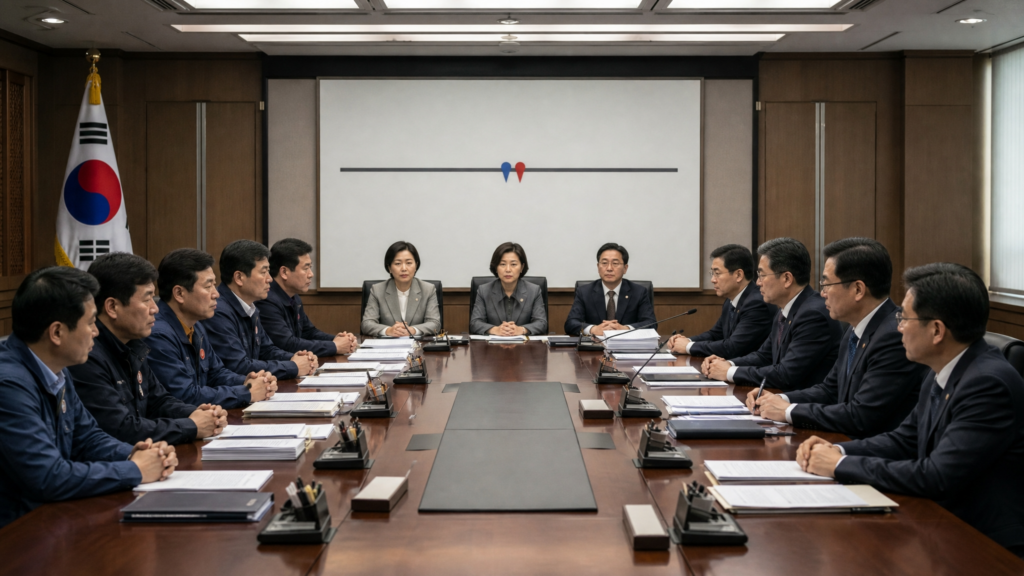
The Minimum Wage Commission consists of 27 members: nine each from labor, management, and public interest. All 27 members attended and voted at this plenary session. The labor side’s final proposal was 10,730 won, and the management side’s final proposal was 10,700 won.
The vote resulted in 15 votes for the management proposal, 11 for the labor proposal, and one invalid vote. The difference between the two final proposals was 30 won per hour. For an eight-hour workday, that amounts to 240 won; applying the standard monthly conversion of 209 hours, the difference is 6,270 won. After lengthy negotiations, the gap was narrowed to this extent, but no agreement was reached.
Because the vote was secret, it was not disclosed which public interest members voted for which proposal. From the result that the management proposal received 15 votes, one cannot determine the choices of individual public interest members. While it is true that the public interest members’ votes significantly influence the outcome due to the commission’s composition, it is inappropriate to speculate on individual votes and present them as fact.
Before the vote, the public interest members proposed a deliberation facilitation range of 10,600 won to 10,860 won per hour. Labor and management repeatedly submitted revised proposals within this range. Ultimately, both final proposals fell within the facilitation range, but the 30 won difference could not be resolved through consensus. The fact that both final proposals were submitted within the facilitation range suggests that both sides accepted the negotiation framework set by the commission.
Negotiations Started at 12,000 Won and a Freeze
Labor’s initial demand was 12,000 won per hour. This is 16.3% higher than 2026, and applying 209 hours per month gives 2,508,000 won. Labor groups including the Federation of Korean Trade Unions and the Korean Confederation of Trade Unions cited inflation, cost of living, and real wage preservation as key justifications. Management started negotiations with a freeze at the current 10,320 won.
One of the data points cited by labor was the Minimum Wage Commission’s 2025 standard cost of living of 2,754,000 won per month. Labor argued that the monthly minimum wage at that time was only 78.3% of this amount. However, this figure is a cost-of-living estimate selected by labor as a basis for their demand. It is not a legally defined adequate living cost uniformly applicable to all households and workers.
Management emphasized the ability of small businesses to pay, the burden of labor costs, and the potential for reduced employment. In particular, industries with high labor cost ratios such as food and lodging and retail argue that if the wage floor rises when sales are not increasing sufficiently, they may reduce working hours or hiring. In contrast, labor counters that low wages weaken household purchasing power and fail to keep up with rising living costs.
The effect of minimum wage increases on employment is difficult to summarize with a single number. This is because the increase size, economic conditions, industry, business size, and labor market institutions all interact. The actual impact of this 3.7% increase on employment and working hours will have to be judged from data after implementation.
The Meaning of 2,236,300 Won Per Month
The monthly equivalent of 2,236,300 won is the pre-tax amount of 10,700 won multiplied by 209 hours. The 209 hours per month is a conversion standard that includes paid weekly rest hours for workers who work 40 hours per week and meet certain conditions. If actual working hours differ or the conditions for paid weekly rest are not met, the monthly wage will vary.
This amount does not mean the net take-home pay deposited into a bank account, because income tax and social insurance premiums may be deducted. When determining whether the minimum wage has been violated, one should not look only at the total monthly salary. It is necessary to check which wage components, such as regular bonuses and welfare benefits, are included in the scope of calculation.
The Minimum Wage Commission estimated the number of workers directly affected by this proposal differently depending on the survey method. According to the Survey on Labor Conditions by Employment Type, it is 660,000 workers; according to the Economically Active Population Survey supplementary survey, it is 2,978,000 workers. The impact rates are 3.8% and 13.3% respectively. The difference between the two numbers arises because the survey targets and wage capture methods differ. Considering the differences between the two surveys, one should also note that the actual number of affected workers can vary widely depending on the survey method.
In principle, the minimum wage applies equally to foreign workers. Foreigners working under non-professional employment (E-9) or working visit (H-2) visas are also covered. International students and working holiday participants who sign employment contracts within their permitted scope cannot be paid less than the minimum wage solely because of their nationality.
However, the scope of permitted employment and working hour limits by visa type follow separate immigration regulations. Whether the minimum wage applies and the scope of legal work are separate issues. Foreign workers should check the hourly wage, weekly working hours, paid weekly rest allowance, and wage components listed in their employment contract.

Real Wages and Institutional Reform Are the Next Issues
The real value of 10,700 won will depend on inflation in 2027. Even with a 3.7% increase, if consumer prices rise by a similar rate, the increase in purchasing power is limited. Conversely, if inflation is lower, the real hourly wage for minimum wage workers will be higher. The actual effect should be evaluated with 2027 price data, not forecasts.
The decision-making process is also a next issue. Again, the conclusion came through a vote between two final proposals rather than a labor-management agreement. Through a public interest members’ recommendation, the Minimum Wage Commission advised the Ministry of Employment and Labor to establish a task force for institutional improvement in the second half of 2026 and to review the entire system, including the scope of application and decision criteria.
Therefore, there are three points to watch. First, whether the 10,700 won proposal is announced as is by August 5. Second, the real increase compared to 2027 inflation. Third, whether the task force for institutional improvement will produce an actual reform proposal regarding the role of public interest members, decision criteria, and scope of application.
There was a difference of 1,680 won between labor’s initial proposal and management’s initial proposal. The difference between the final proposals was 30 won. The fact that they could not reach an agreement even after narrowing the gap this much shows that the minimum wage debate is not simply a matter of amount but a fundamental issue of decision criteria and burden sharing.
Sources: Minimum Wage Commission ‘2027 Minimum Wage Proposal of 10,700 Won per Hour’, July 15, 2026; Ministry of Employment and Labor ‘2027 Minimum Wage Proposal’, July 15, 2026; Labor initial demand data from FKTU and KCTU, June 2026; Easy-to-Find Living Law Information ‘Working Conditions for Foreign Workers’; News1, July 27, 2026.