
Table of Contents
The First Thing Riders Will Feel Isn’t the Train — It’s the App
For years, Korea’s high-speed rail passengers had to make a different choice depending on which station they left from. KTX, departing from Seoul Station or Yongsan Station, ran on Korail’s booking system. SRT, departing from Suseo Station, ran on a separate system built by SR. Even when the destination was identical, which app to open, which account mileage accrued to, and whether a transfer discount applied could all differ. The railway’s split operating structure was reproduced, unchanged, on the screen of every passenger’s phone.
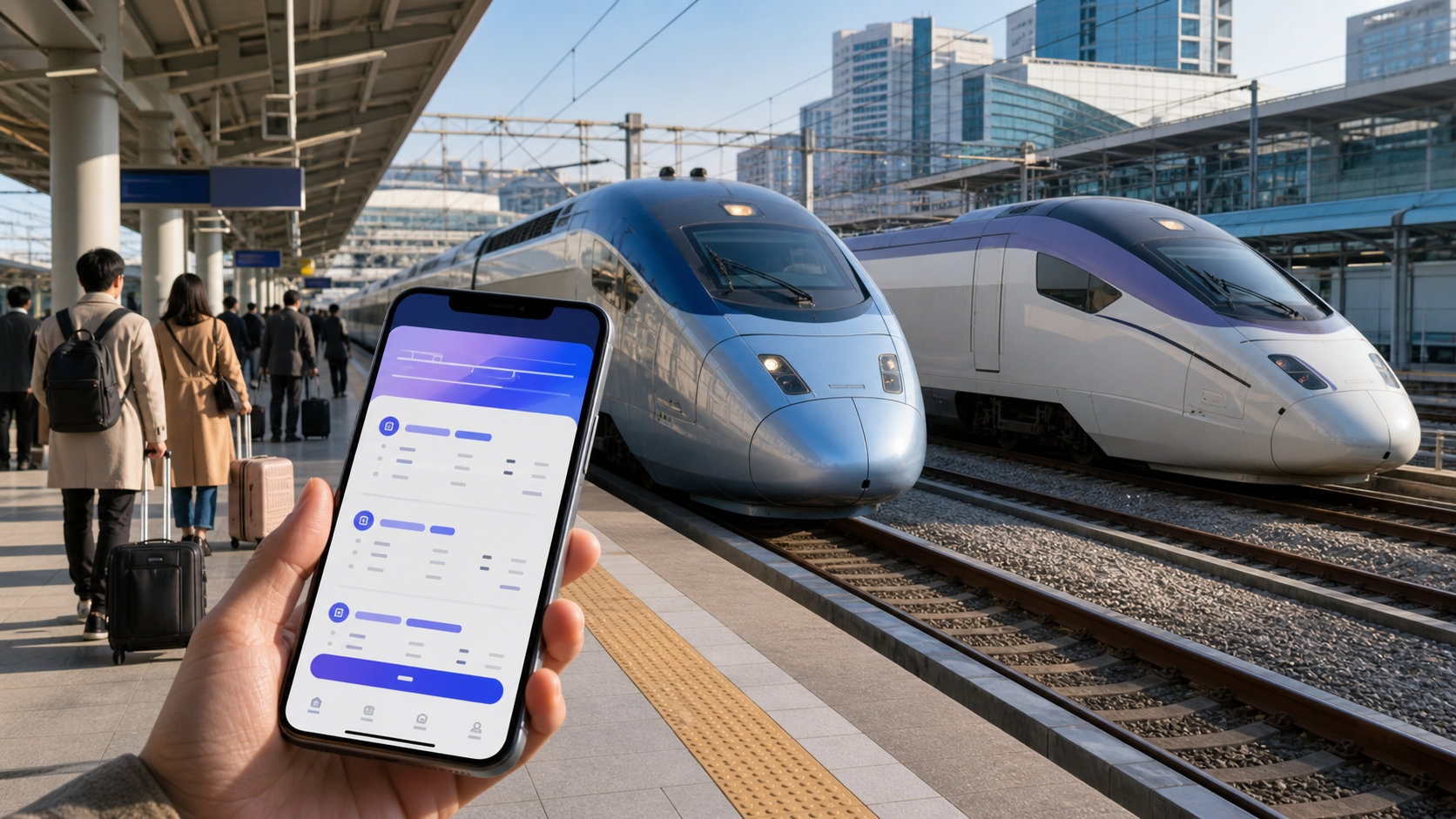
The integrated app “Korail+,” launched on August 3, is the first step toward closing that split. It works as an update to the existing Korail Talk app, or as a fresh install, and is built to let users look up and buy both KTX and SRT tickets in one place. The government said it had pre-secured server capacity to handle twice the expected demand, anticipating a surge of traffic on launch day. Then, at 10 AM on August 5, booking opened — through the app and Korail’s website — for tickets on the integrated KTX-SRT trains that begin running September 1. What matters about the August 5 date isn’t another announcement; it’s that users can now actually select a seat on an integrated train. The app itself had already been live for two days, but only from today could you buy a real seat inside it.
What You Can Book Today Is a Train That Doesn’t Run Until September 1
The first distinction worth making is between the app’s launch date and the integrated trains’ start date. Korail+ has been usable since August 3, but the integrated service that runs KTX and SRT as a single connected system doesn’t start operating until September 1. So the booking window that opened at 10 AM on August 5 covers only trips from September onward. Existing KTX or SRT tickets for trips departing in August still follow the old operating structure and old booking rules. The arrival of an integrated app doesn’t mean every train switched over to one system overnight.
That distinction matters for international visitors too. Korean rail already makes it easy to plan a trip around an app, given how short intercity travel times are and how standard assigned seating and mobile tickets have become. Travelers who’ve relied on KTX from Seoul or Yongsan Station and SRT from Suseo Station will likely feel the biggest change first: going forward, you can plan an itinerary in one app regardless of departure station. But during this August-to-September transition, you still need to check which system a given departure date falls under. According to the schedule the Ministry of Land, Infrastructure and Transport and Korail have laid out, timetable and fare information has been viewable on the website and at stations since August 3. Starting today, that information can actually be turned into a real reservation.

Account Conversion Works Differently Depending on Who You Are
Hearing that the service got more convenient isn’t a reason to delete your old apps right away. Users who only ever held a Korail membership get converted to Korail+ automatically. But anyone who held an SR-only membership, or held accounts with both agencies, has to go through a separate integrated-membership conversion process. That’s because when the same person built separate accounts at two different agencies, someone has to sort out which personal data and membership history carries over. In any digital merger like this, the hard part usually isn’t the new feature — it’s stitching together accounts and benefits that already existed.
Neither the old Korail Talk app nor the SRT app disappears the moment September 1 arrives, either. But the SRT app will only support non-member bookings going forward, which means features tied to integrated benefits — mileage, discounts — could be limited. In other words, whether you can keep using an app and whether you’ll get the same level of service are two different questions. Frequent riders would do well to check, before their next trip, whether they’ve completed the membership conversion, what happens to mileage they’ve already earned, and what discounts they still qualify for.
Whether the Fare Cut and Added Seats Hold Up Will Decide If This Works
The economic effects the government has laid out are fairly specific. Starting in September, fares on the integrated KTX-SRT trains are set to run about 10% below current KTX fares, on average, for the next three years — effectively bringing them down to existing SRT levels. Under the old, split-agency structure, cost could vary by departure station and operator even on the same high-speed network. Post-integration, the goal is to close that gap and let riders calculate travel costs by one simple standard instead of two.
Added capacity matters just as much. The Ministry of Land, Infrastructure and Transport says linking KTX and existing SRT rolling stock, among other measures, will add roughly 116,000 seats a week — about 15,000 more seats on an average weekday and over 17,000 more on an average weekend day. That puts the total seat increase at roughly 6%. The Suseo line in particular is expected to see about a 30% jump in seat capacity, with weekend service itself increasing by 26 runs. Suseo-line departures have long drawn complaints about tight supply, so this is the stretch most likely to show a difference first. None of this solves Korea’s recurring booking crunches around major holidays, Friday evenings, or weekend mornings just by existing as an app. The real test will be whether riders can actually grab the route they want during those peak windows more easily than before.

Integration Is a Promise of Convenience — Verification Starts in September
The integration also folds in discount policy. In what used to be SRT territory, a transfer discount that never applied when switching between a high-speed train and a regular train is being introduced, cutting 30% off the regular-train fare. Online discount fares of up to 30%, previously exclusive to KTX routes, are being extended to former SRT routes as well. Existing programs like discounts for pregnant riders and teenagers will be folded into the merged system in whatever direction benefits users more, according to the government’s explanation. Until now, only KTX riders got access to online discount fares, while SRT riders had comparatively narrower discounts — that gap is what’s closing. For riders, the integration is likely to be remembered less for a new logo and app name than for exactly this kind of shift in cost and connectivity.
Korail and SR framed the point of the merger, when the app launched on August 3, as “unifying rail transport service.” Still, integration doesn’t automatically solve every problem. What still needs checking is whether timetables actually connect reliably once real integrated service begins on September 1, whether the booking system holds up without errors through the transition, and how much the seat shortage on the Suseo line and regional routes actually eases. The merger was also completed institutionally when Korea’s Fair Trade Commission approved the Korail-SR business combination. The government has said it will monitor how fares, seat supply, and service commitments are actually carried out for three years after integration. Today’s 10 AM launch of integrated booking is the starting line for that evaluation. The next metric riders will actually feel isn’t a download count — it’s whether they can get the seat they want, at the time they want, going forward. And that answer won’t show up on the app’s screen first. It’ll show up in a booking window on an ordinary Friday evening in early September, no holiday, no long weekend attached.
Source: Ministry of Land, Infrastructure and Transport and Korail, August 2–5, 2026; Electronic Times, Dong-A Ilbo, eToday, Asia Economy, and Newspim, August 2026.