

Table of Contents
100,000 Won Has Become the New Baseline, but It’s Not the Answer
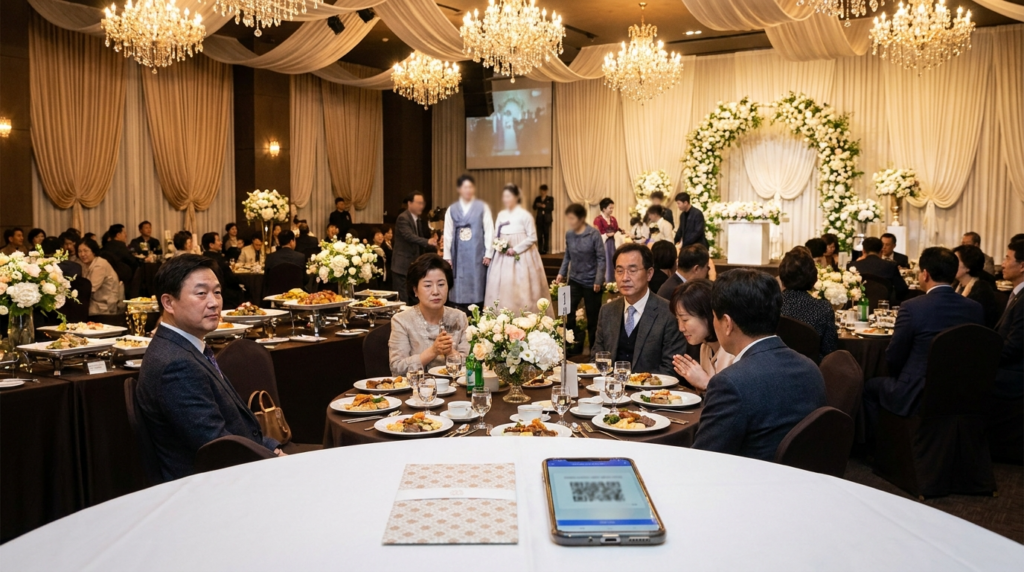
One of the first questions foreigners invited to a Korean wedding ask is usually this: “How much should I give?” In the United States or Europe, it’s common to pick an item from a gift registry or contribute a set amount to a honeymoon fund. In Korea, cash wedding gifts are far more direct. You hand an envelope at the reception desk near the entrance, and these days, bank transfers or mobile payments are also common. The amount isn’t just a simple gift; it becomes a social language that reflects the distance of the relationship, whether you attend, the venue, the region, and your economic capacity.
Recently, the baseline of this language has been shifting rapidly. According to KakaoPay’s 2025 Money Report, the average wedding gift amount exceeded 100,000 won for the first time. Compared to the 2019 average of about 50,000 won, it has roughly doubled in five years. A report by NH Nonghyup Bank, which analyzed 5.33 million gift transfer data points over the past three years, confirms a similar trend. The average annual gift was 110,000 won in 2023, 114,000 won in 2024, and 117,000 won last year, rising each year. The absolute figures differ depending on the aggregation method and sample, but the direction is the same. So among those who receive wedding invitations, the debate is growing not just over whether 50,000, 100,000, or 150,000 won is appropriate, but whether the gift itself should even be calculated as part of the meal and wedding costs.
The Explanation That Prices Have Risen Is Sufficient, but Not Enough
Price changes are a clear starting point. According to a February 2026 survey by the Korea Consumer Agency of wedding service prices in 14 regions nationwide, the most common type of wedding meal—buffet style—accounted for 83.2 percent of all cases. The average per-person meal cost was 62,000 won. In Seoul’s Gangnam area, the average meal cost was higher at 88,000 won. If you choose a hotel wedding or a course meal, the food cost goes even higher.
Wedding venue costs don’t end with the meal. Items like venue rental, basic decorations, photography, staffing, and minimum guaranteed guest numbers combine. According to the Korea Consumer Agency survey, the nationwide average total cost of wedding services was 21.39 million won. From the couple’s perspective, they can’t help but be aware of the gap between the gift each guest pays and the meal cost. Especially in the practice of inviting many guests, the number of people becomes a direct cost risk.
But a common misconception arises here: the wedding gift is not an invoice settling the meal cost. There is no social consensus that if the couple chooses an expensive venue, the guests must make up the difference in that choice. The rise in wedding costs is a real phenomenon, but it’s hard to argue that it directly translates into a minimum increase in gifts for every guest.
Korean Wedding Gifts Sit Between a Gift and Mutual Aid
The roots of wedding gifts lie in the culture of mutual aid. It’s the custom of contributing money, goods, or labor to a household hosting a major event like a wedding or funeral. In the past, sending rice, alcohol, or items needed for the ceremony, and helping with the work, were also widespread. Cash-based wedding gifts became more common after urbanization and the rise of wedding hall culture. The key point is that this custom was never solely a market transaction from the beginning.
Today, there is a strong record and memory of giving back what you received. That’s why people are conscious of how much someone gave at their wedding and how much they gave at that person’s event. In Korean, this can be described as nunchi—the sense of reading others’ expectations and the atmosphere. But nunchi is not a fixed rule. The same 100,000 won can be normal for a close friend, but a significant amount for a work acquaintance you haven’t contacted in a long time.
That relationship is the standard is repeated in various surveys. When deciding on a wedding gift, many respondents cite closeness and the length of acquaintance as the most important factors, while attendance and number of accompanying guests also play a role. For a guest traveling from a province to a Seoul wedding, transportation and accommodation costs are added. Conversely, for a close family member or old friend’s wedding, they may prioritize the relationship over the meal cost and give a larger amount. That’s why it’s difficult to judge every situation with a single number.
In practice, average amounts vary by age and region. According to NH Nonghyup Bank data, the average gift by age group was highest among those in their 20s and 30s at 138,000 won, followed by those 60 and older at 118,000 won, and those in their 40s and 50s at 107,000 won. By region, Seoul was highest at 134,000 won, followed by Busan at 128,000 won, Gwangju at 124,000 won, and Incheon at 119,000 won. This is interpreted as a reflection that wedding costs in Seoul are higher than in other regions, so gifts tend to be prepared more generously as well.
The ‘At Least 200,000 Won’ Debate Shows Generational and Regional Differences
In a July online story introduced by Financial News, a guest who attended two weddings in Seoul from a province and gave 100,000 won at each was told that in Seoul, at least 200,000 won is considered proper etiquette. Reactions were split: some said, “Why not count the heart of spending time and transportation costs to attend?” while others said, “It’s hard for the couple to bear the skyrocketing wedding costs alone.” The core of this debate is less about the number 100,000 won and more about who should bear the cost.
Korean weddings are often large-scale social events combining a short ceremony and a meal. Guests attend to celebrate, but the couple provides the meal and space. So the boundary between gift and invitation easily blurs. It differs from the American-style reception with a smaller guest list and a long meal, and from the European approach where gifts are centered on a registry. The Korean wedding gift carries both the cost and the emotion of this network of relationships.
That said, expensive wedding halls in Seoul cannot set the etiquette standard for the entire country. Meal costs, travel expenses, income by age, and the nature of relationships all differ. For someone in their 20s, 100,000 won can significantly disrupt a month’s budget for social events, but for a more stable income generation, it may mean something different. The phrase “100,000 won is the baseline” can describe an average, but it is not a rule that defines an individual’s obligation.
Behind this debate lies a polarization in gift amounts. According to NH Nonghyup Bank data, the proportion of high-value gifts of 1 million won or more rose from 2.95 percent in 2023 to 3.17 percent last year, and the share of 10 million won or more also grew from 0.22 percent to 0.36 percent. In 2024, the number of wedding-related transfers of 100 million won or more jumped 14 times compared to the previous year, and last year it increased 1.6 times. While the majority of guests remain in the 50,000 to 100,000 won range, a small number of ultra-high gifts are pulling the average up. As such, it’s problematic to accept the figure of “average 100,000 won” as a standard applicable to all guests.

What to Check Before the Invitation: The Context of the Relationship
For someone invited, a practical approach requires reordering priorities. First, consider the closeness of the relationship and its future trajectory; then look at attendance, accompanying guests, and travel costs. The meal cost can be a reference, but it should not be the sole calculation. If attending is difficult, sending money with a congratulatory message is also a common choice. If it’s a financial burden, it may be better to honestly assess the situation rather than force yourself to meet a baseline—that can be a way to preserve the relationship in the long run.
The same principle applies to the couple. If they excessively calculate guests’ gifts as expected income, the invitation can easily appear less like an expression of gratitude and more like a cost-recovery mechanism. The moment you treat expected gifts like a business balance sheet when deciding the scale and venue of the wedding, the celebration becomes a place where everyone compares each other’s burdens. The data showing the average gift exceeding 100,000 won indicates that Korea’s prices and wedding culture are changing. The indicator to watch going forward is not the average amount itself, but how that rise affects the number of guests, the scale of weddings, and young people’s decisions about marriage.
Sources: Ahn Ga-eul, Financial News, July 10, 2026; Korea Consumer Agency, Wedding Service Price Trend Survey, March 30, 2026; NH Nonghyup Bank, Wedding Gift Trend Report, May 2026.