
Table of Contents
The Blockbuster Squeeze: 50-100 Billion Won Films Disappear
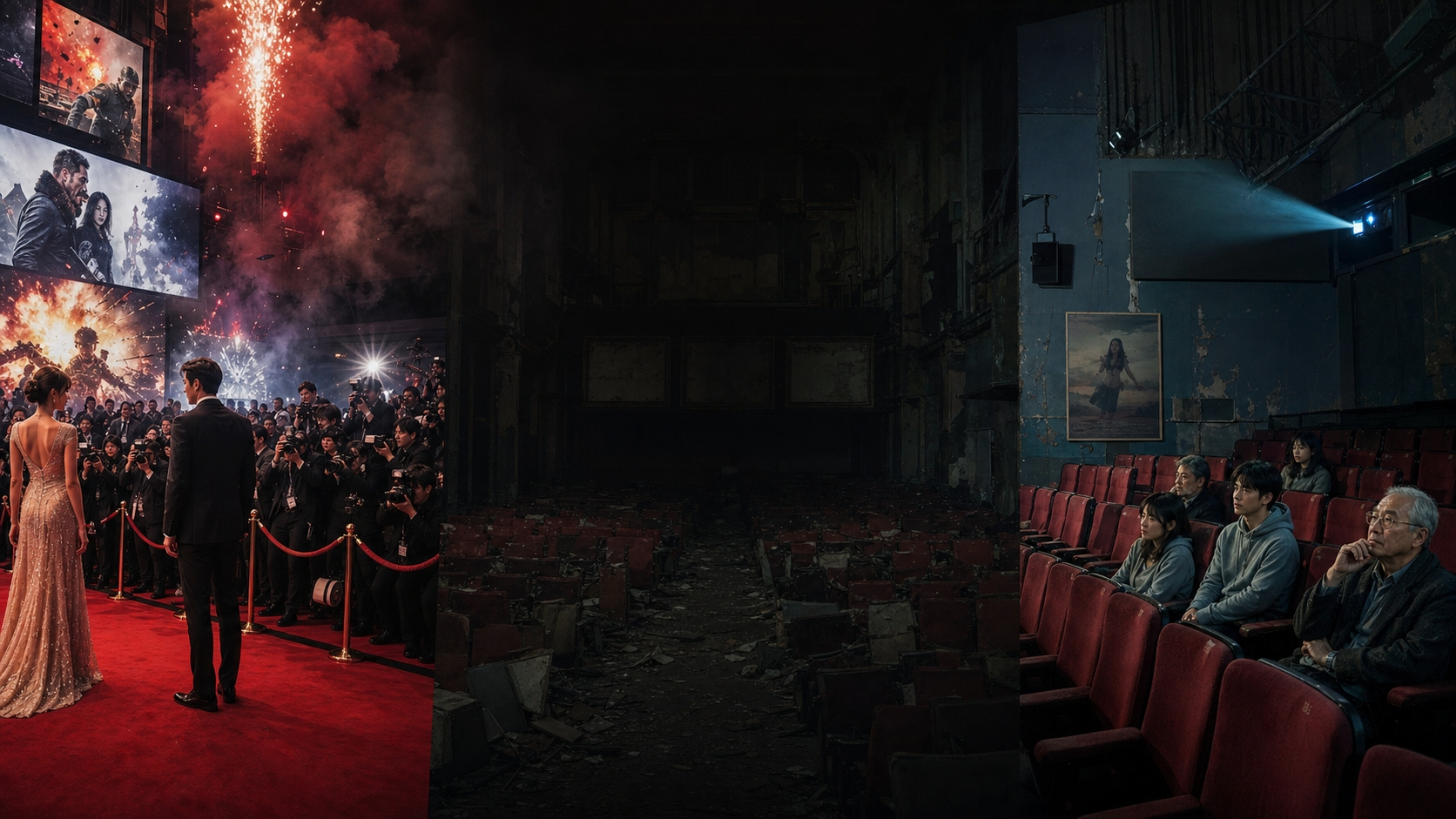
Korean cinema faces a structural crisis. The summer 2026 box office tells the story clearly: there is no middle ground anymore. Studios chase either tent-pole productions with budgets exceeding 100 billion won or ultra-low-budget indie films. The 50–100 billion won mid-range that once anchored Korea’s film calendar has evaporated.
Why Blockbusters Dominate
The economics are brutal. A 100+ billion won film can command premium pricing, IMAX screens, and ancillary merchandising—all pushing margins higher. Meanwhile, production costs for mid-budget features haven’t shrunk. Actors’ salaries, location permits, post-production standards remain fixed. A film costing 60–80 billion won to produce faces the same theatrical costs as a 120 billion won tentpole, yet competes for screens and audience attention at a disadvantage. The math no longer works. Studios have learned: spend big enough to dominate, or spend small enough to limit exposure risk.
The Indie Surge and Its Limits
Independent and low-budget films have filled part of the void. Crowdfunding platforms and OTT investment have democratized film finance. Yet indie productions—even successful ones—rarely generate the commercial velocity to survive theatrical windows against blockbuster competition. They often skip cinema entirely for streaming releases, further eroding the mid-budget theatrical ecosystem.

What Directors and Talent Lose
The casualty is narrative diversity. Mid-budget films historically gave established directors room to experiment—intimate dramas, genre hybrids, character studies—without gambling studios’ entire portfolio. Emerging directors built careers on mid-budget productions. Now, first-time filmmakers either shoot ultra-indie or bet everything on a major studio’s franchise tentpole, with no runway for failure. The pipeline is broken.
An Industry at an Inflection Point
Korean cinema is consolidating. Production houses merge. Financing pools concentrate. Exhibition screens are hoarded by event films. The summer 2026 slate—dominated by Na Hong-jin’s 120-billion-won “Hope” and international blockbusters like “Moana”—feels less like a healthy market and more like an endgame. Without mid-budget theatrical investment, Korean film risks becoming a two-tier ecosystem: Hollywood-scale productions and niche indie content, with no center holding the industry’s creative backbone.
Source: Korean Film Council (KOFIC) / Korean box office data, July 2026