
Table of Contents
Step Out of Mangwon Station Exit 2, and the Market Is the Neighborhood’s Center
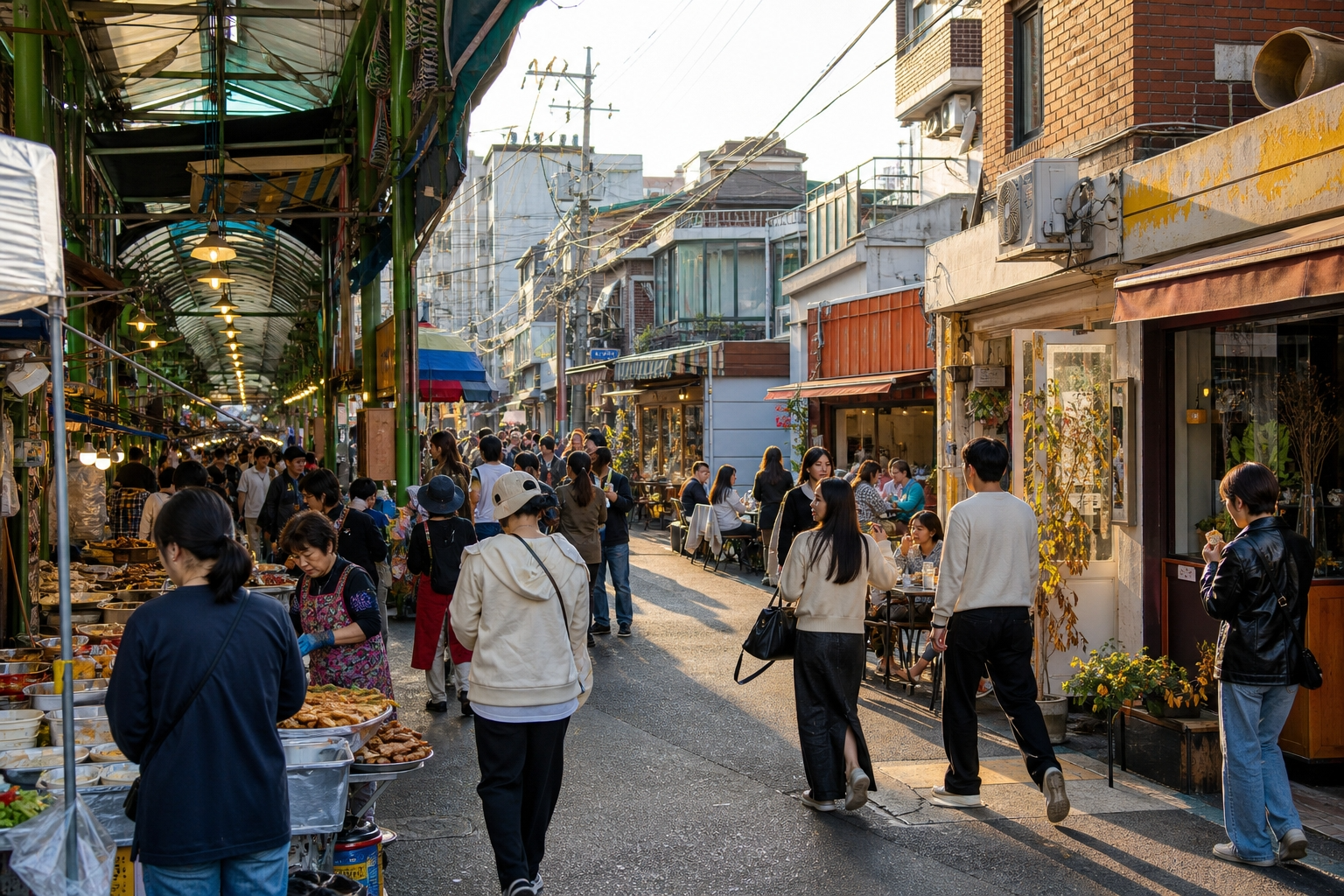
Mangwon-dong is a neighborhood that feels a little incomplete if you only pick one destination. Come out of Exit 2 at Mangwon Station on Line 6 and walk toward Mangwon Market, and the first thing you see is a working-class, everyday traditional market. Residents out shopping for side dishes, someone carrying a bag of fruit, and travelers picking out fried chicken or croquettes all share the same path. Keep walking past the market toward Poeun-ro and Mangwon-ro, and the mood shifts — small cafés, independent restaurants, vintage shops, and workshops line every alley. This stretch is usually called Mangridan-gil.
What makes Mangwon-dong fun is that the traditional market and the newer shops don’t push each other out — at least on the street, they sit side by side. Seoul’s official city guide describes it as a neighborhood spreading out from Mangwon Market, full of modest, distinctive shops. If you’re a traveler who only wants Korean food, you can start right at the market; if you want to add a dish from somewhere else to your meal, you can widen the loop out into the alleys beyond it. Mangwon-dong felt like a small map of how different food cultures can settle into everyday life within one city.
At the Market, “A Few Small Bites” Beats “One Big Meal”
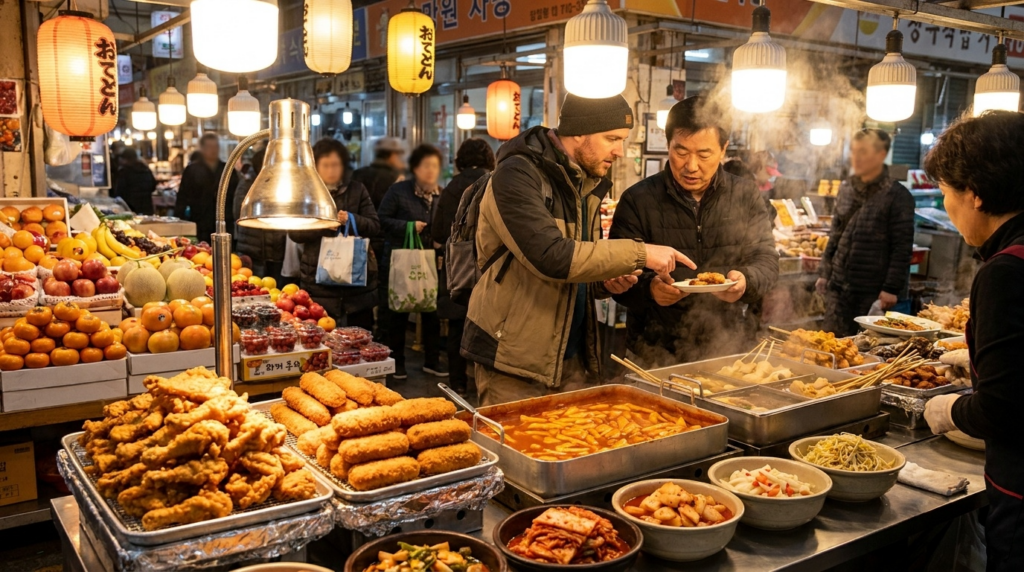
Mangwon Market is known as a traditional market with roughly 40 years of history. Inside it, the natural move isn’t to sit down at one stall for a long meal — it’s to buy a little from several different stalls and taste as you go. There’s plenty of food that’s easy to carry around: fried chicken, croquettes, donuts, bunsik, side dishes, fruit. The Seoul Tourism Organization lists spicy and fruit-flavored fried chicken, croquettes, and donuts among Mangwon Market’s signature foods. The menu shifts with the season and with each stall, so there’s some fun in just picking whatever looks best in the moment.
If it’s your first time, it’s better not to walk through the market on an empty stomach. It’s easy to get pulled in by the smells and the lines, buy a bit of everything, and end up missing the actual meal you wanted. A good plan is to split two or three snacks, then have a proper meal at a restaurant outside the market. Think ahead about where you’ll actually eat your takeout food, too — standing around in the middle of a market aisle for a long time can get in the way of residents doing their shopping. Heading to Mangwon Hangang Park, or packing food to eat back at your accommodation, tends to be more comfortable.
In Mangridan-gil, Korean, Japanese, Chinese, and Mexican Menus Share the Same Alleys
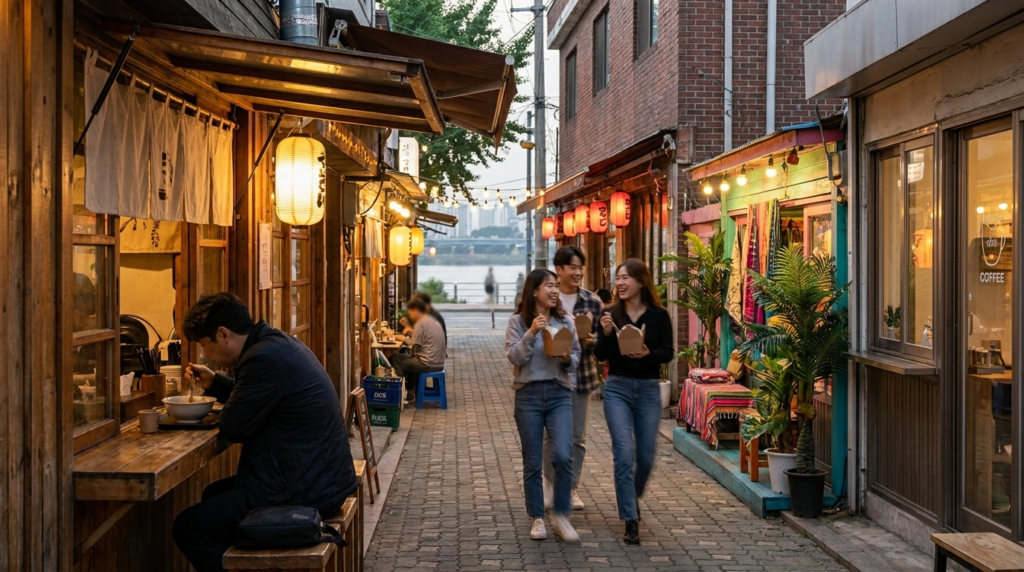
Walk through the Mangwon-dong alleys for a bit and you’ll quickly realize the area around the traditional market isn’t only Korean food. Seoul’s own guide to Mangwon-dong’s restaurant scene features food from Korea, Japan, China, Mexico, Bali, and more, all showing up together. Tacos and quesadillas, Japanese noodle dishes and izakaya spots, dishes built around Chinese spices, and small Southeast Asian food shops sit right alongside old-school soup-and-rice joints and bunsik stalls. It’s less that this multinational dining scene was set up as decoration for tourists, and more that it’s folded into what residents actually choose for dinner.
This mix connects to the fact that Mangwon-dong sits close to the Hongdae and Hapjeong commercial areas and is home to a lot of single-person households, newlywed couples, and residents in their 30s and 40s. KB Kookmin Card and other commercial-district analyses explain that Mangridan-gil formed as young entrepreneurs opened shops around the market. That’s part of why the restaurants here tend to have fewer seats and a sharper sense of identity, rather than being built oversized purely for tourists. Some spots do have solo-friendly bar seating, but keep in mind that even solo diners can end up waiting during busy hours.
Trust the Shop’s Same-Day Notice Over the Map for Prices and Hours
Mangwon-dong is an alley-based commercial district, so days off and business hours vary a lot shop by shop. According to city guidance, quite a few places close on Mondays specifically. Some shops take reservations only through social media messages and put more emphasis on their account handle than their physical signage. If you’re traveling, check the restaurant’s official account, recent reviews on your map app, and its phone number on the same day you plan to go. Trusting outdated hours left online is a more common way to end up with a wasted trip than you’d think.
Public transit is your easiest bet on weekends. The streets around Mangwon Market and Poeun-ro are narrow and shared by both cars and pedestrians, and parking isn’t plentiful. The simplest route is straight from Mangwon Station through the market and into the alleys. After eating, you can walk to Mangwon Hangang Park, but summer daytime heat can be intense, so bring water and plan for shade. Some market food needs temperature care, too — meat, fried items, and dairy-based dishes are better eaten soon rather than carried around for a long stretch.
The Best Way to See Mangwon-dong Is to Stop Chasing Only the “Hot Spots”
The commercial district around Mangwon Market is a good example of how younger generations’ interest in traditional markets can turn into actual neighborhood spending. According to KB Kookmin Card’s analysis, people in their 20s made up the largest share, 26%, of new visitors to traditional markets in 2023. Around Mangwon Station and Mangwon Market, one analysis found that sales in the interior-goods category jumped 225% in March 2024 compared with the previous three months. Buying a snack at the market, then stopping by a small goods shop or café in the alleys, has become something like a walking course of its own.
Still, it would be a shame to see Mangwon-dong purely as a photogenic café street. This is a living neighborhood where residents buy dinner side dishes, longtime restaurants serve meals they’ve been making for years, and new business owners introduce other countries’ flavors in their own way. Try leaving market aisles clear, following reservation and waiting etiquette at the small restaurants, and cleaning up your own takeout trash. In the morning, try Korea’s everyday flavors at the market; in the afternoon or evening, pick one unfamiliar dish from the alleys. Walking between the two might be the tastiest part of the whole Mangwon-dong experience.
Source: Seoul Metropolitan Government’s Seoul Love, May 2026; Seoul Tourism Organization guide to Mangwon Market and Mangridan-gil, 2026; KB Kookmin Card and KB Think, April 2024.