

Table of Contents
Clothes Are Showing Up Between the Old Signs
Walk through the alleys of Gwangjang Market and, between the smell of bindaetteok and the vendors calling out, you’ll catch a completely different scene. Right next to old fabric shops and vintage stores, a contemporary fashion brand’s sign hangs overhead, and foreign tourists browsing clothes and cosmetics move through the crowd with market snacks still in hand. A traditional market is starting to read as a fashion district too.
This isn’t happening only at Gwangjang Market. Neighborhoods with old alleys and traces of everyday life still intact, like Sindang-dong, Seochon, and Bukchon, are being mentioned as the next fashion hubs after Seongsu and Hannam. Seochon and Bukchon aren’t traditional markets in the strict sense, to be fair. What they share isn’t market status so much as a backdrop of Seoul you simply can’t build from scratch.
Why Brands Are Choosing Old Neighborhoods
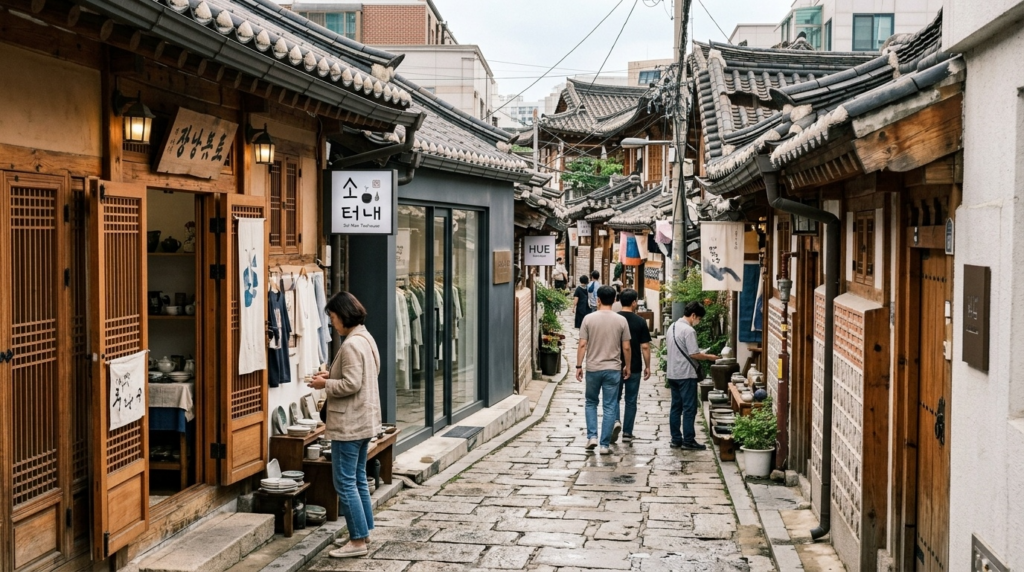
A new mall has convenient layout and neatly proportioned storefronts, but every angle can end up looking the same. A market’s low ceilings and narrow passages, a hanok alley, worn tile — these show a neighborhood’s time, unedited. Brands can use that backdrop to turn the store visit itself into a piece of the Seoul experience.
It also matters that foreign tourists are already gathering there. At Gwangjang Market, people who came for the food end up browsing clothes and cosmetics too, and in Bukchon, people who came to see hanok houses go on to visit fashion stores and exhibitions in the same trip. Rather than spending on ads to draw in new crowds, it’s a way of placing a store directly inside an existing tourist route.
Gwangjang Market Is Changing the Fastest
At Gwangjang Market, which has 120 years of history, a market-style Kodak store has opened, and according to fashion industry reports, brands including Setter, Marithé + François Girbaud, Matin Kim, and Kirsh are expected to open additional storefronts starting in October. If a store hasn’t opened yet, it’s worth confirming it’s actually running and checking the date before you go.
Gwangjang Market was already a place where fabric, hanbok, textiles, and used clothing gathered, so the arrival of fashion brands isn’t a total invasion by an unfamiliar industry. It’s more like contemporary brands layering back onto what was once a clothing market. What’s interesting is that “retro” here isn’t just decoration — it’s actually tied to the market’s real history.
How Sindang, Seochon, and Bukchon Differ
Sindang-dong mixes Jungang Market and its tteokbokki alley with old factories and workshops, giving it a slightly rougher feel. Seochon has low buildings and small shops strung together, good for a slow walk. Bukchon, with its hanok houses and craft spaces, carries a much stronger traditional image. Even under the same label of “Korean-ness,” the texture is quite different across the three.
So I wouldn’t recommend trying to hit all four neighborhoods in one day. Gwangjang Market and Bukchon can be linked on a Jongno-area route, while Seochon is better walked separately, centered on the alleys west of Gyeongbokgung. Sindang-dong comes alive if you pair the evening market scene with a meal. It’s a route for reading the rhythm of a neighborhood, not just checking off one store.
What the New Shopping Districts Need to Protect
When brands move in, empty storefronts fill up and foot traffic rises, but rent increases and the displacement of existing merchants can follow too. If all the old shops disappear, the market’s expression — the very reason people came in the first place — disappears with them. What matters is whether new stores collaborate with local merchants and operate in ways that don’t block the market’s paths and business.
When you visit, don’t just aim for the fashion stores and leave — take in the fabric shops, vintage stores, and old restaurants too. During busy hours in the market aisles, be mindful with large bags and camera gear, and ask permission before photographing vendors. Seoul’s new fashion districts aren’t just about what’s new — they’re a place to watch how the old and the new share space.
Source: Apparel News, August 2, 2026; Korea Textile News, August 2026.