Table of Contents
Trusting a Stranger on an Unseen Path
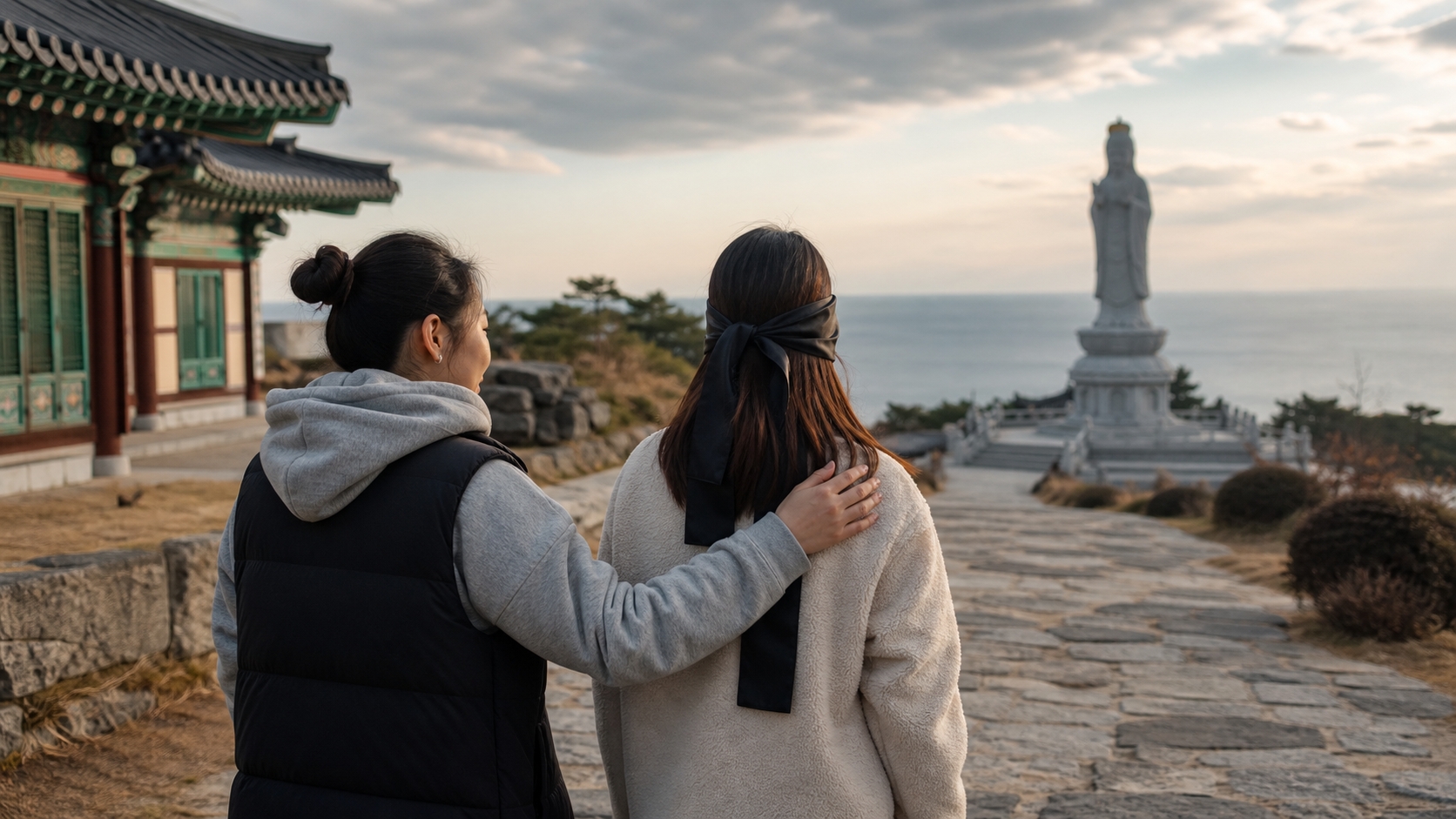
At Naksansa Temple in Yangyang, Gangwon Province, a participant took cautious steps while wearing a blindfold. The partner standing next to them guided the way, gently explaining the direction and describing the surroundings. Their destination was the temple’s Haesu Gwaneumsang (Bodhisattva of Compassion statue), and the path they walked together was the “Path of Wishes” leading up to it. This activity, where participants surrender their sight and sense of direction to someone they just met, was the “blindfold trust walk” organized by the two-day, one-night matchmaking program, I am Jeollo.
One person had to rely entirely on their partner’s descriptions without being able to see, while the other had to adjust their pace and direction to ensure a safe walk. This setup is cleverly designed to reveal the kind of thoughtfulness and communication styles that rarely surface during a typical, conversation-heavy blind date. Through this brief shared activity, it naturally becomes clear how carefully a participant listens and how reassuringly the other explains things to prevent anxiety. The serene space of the temple and Naksansa’s stunning backdrop facing the East Sea created a dating atmosphere vastly different from your average restaurant or cafe meetup.
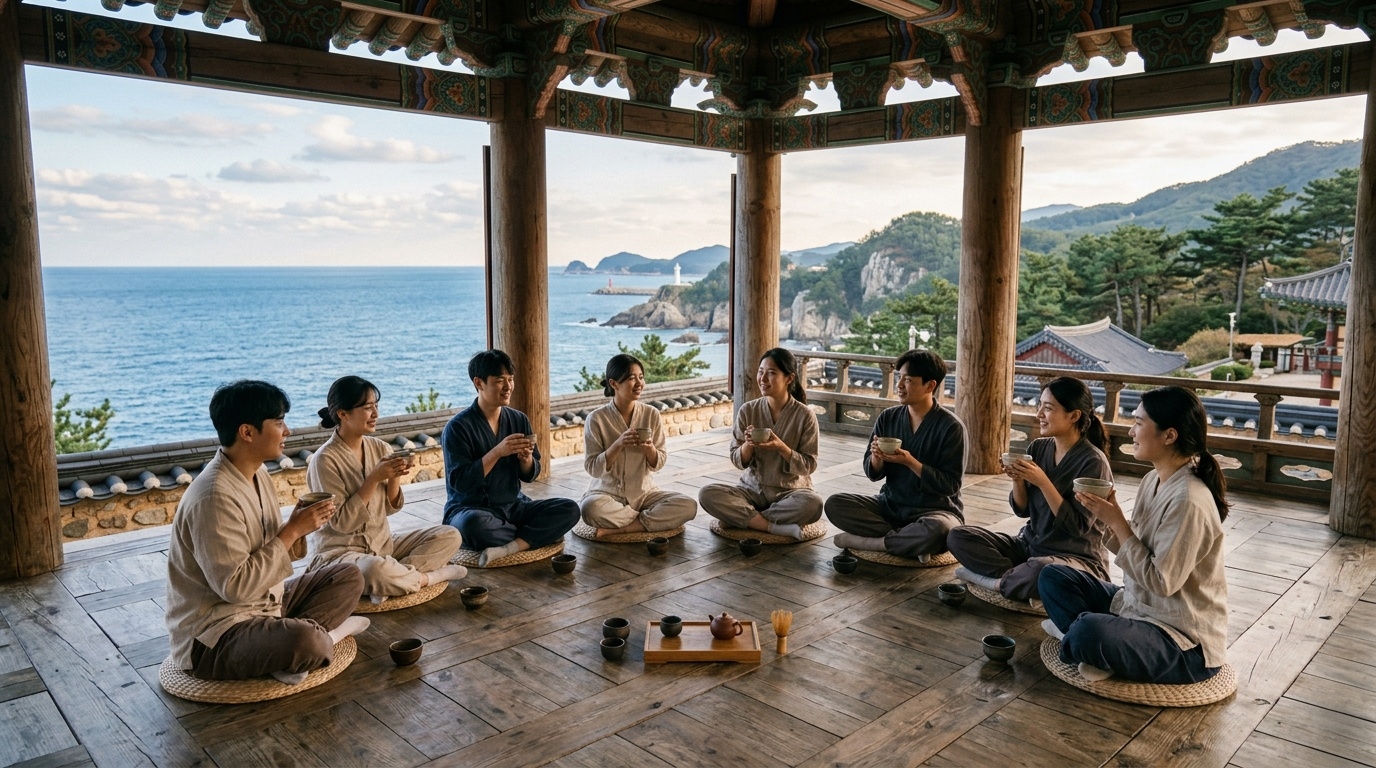
A total of 20 single men and women arrived at Naksansa Temple that day. However, a staggering 4,225 applicants had vied for these spots. Selected from this massive pool, the participants engaged in tea ceremonies, deep conversations, yoga, walking, and even environmental cleanup activities together. This unique program—where people sip tea at a Buddhist temple and guide each other to find a romantic connection—is deeply intertwined with South Korea’s severe low birth rate issue.
Turning a Templestay into a Matchmaking Event
I am Jeollo is a matchmaking program for singles run by the Jogye Order of Korean Buddhism’s Social Welfare Foundation. Its name playfully riffs on the wildly popular Korean dating reality show I am Solo. The word Jeollo means “going to a temple (jeol),” neatly adapting the original show’s title to fit the Buddhist setting. At its core, the program blends the traditional templestay—where visitors reside at a temple to experience Buddhist culture—with dating, conversations, and group activities.
A templestay typically involves staying at a temple for a set period, experiencing tea chats with monks and meditative walks. I am Jeollo takes this foundational framework and applies it to singles looking for love. Instead of just swapping basic information about looks and jobs in a rushed setting, participants are encouraged to observe each other’s personalities and attitudes while doing various activities together. By alternating between conversations and collaborative tasks, the program ensures that participants don’t judge each other based on a single interaction.
The program is operated with support from the Ministry of Health and Welfare’s initiative to tackle the low birth rate. The government isn’t trying to force relationships or dictate marriages; rather, it’s providing a venue for single men and women who lack opportunities to naturally meet and mingle. Although it takes place in a Buddhist space, the program doesn’t pressure participants into any specific religious choices. It functions more as a facilitator, utilizing the calming environment of the temple to foster genuine conversations and shared experiences.
4,225 Applicants for Just 20 Spots
When applications for the Naksansa edition closed in June 2026, 1,655 men and 2,570 women had thrown their hats in the ring. With only 10 spots available for each gender, the competition was fierce: 165.5 to 1 for men, and 257 to 1 for women. There were 915 more female applicants than male, making the battle for a women’s spot even more intense. Seeing a triple-digit competition rate across the board proves this wasn’t an event that only appealed to one demographic.
The total of 4,225 applicants shattered the all-time record for the I am Jeollo program. The previous high was 2,620 applicants for the Sinheungsa Temple edition. Naksansa had previously hosted the event in August 2024, drawing 1,501 applicants at the time. This latest round saw an explosive increase of 2,724 applicants compared to the earlier run. Even considering it was held at the same temple, public interest has clearly skyrocketed.
The Naksansa event managed to attract 1,605 more hopefuls than the previous overall record set at Sinheungsa. With thousands vying for a mere 20 seats, this “temple blind date” has become a vivid indicator of the strong desire for connection among young Koreans. The actual participants were just a tiny fraction of those who applied, highlighting a stark gap between the overwhelming demand and the available opportunities.
From Tea Ceremonies to Beach Plogging
The chosen participants spent a two-day, one-night retreat at Naksansa on July 11 and 12. The itinerary was a mix of serene moments designed for getting to know one another, such as tea ceremonies and group chats, alongside more active physical activities. Sharing stories over tea and mingling with different people allowed them to gauge each other’s lifestyle habits and interests—traits that are often hard to pinpoint from just a brief first impression.
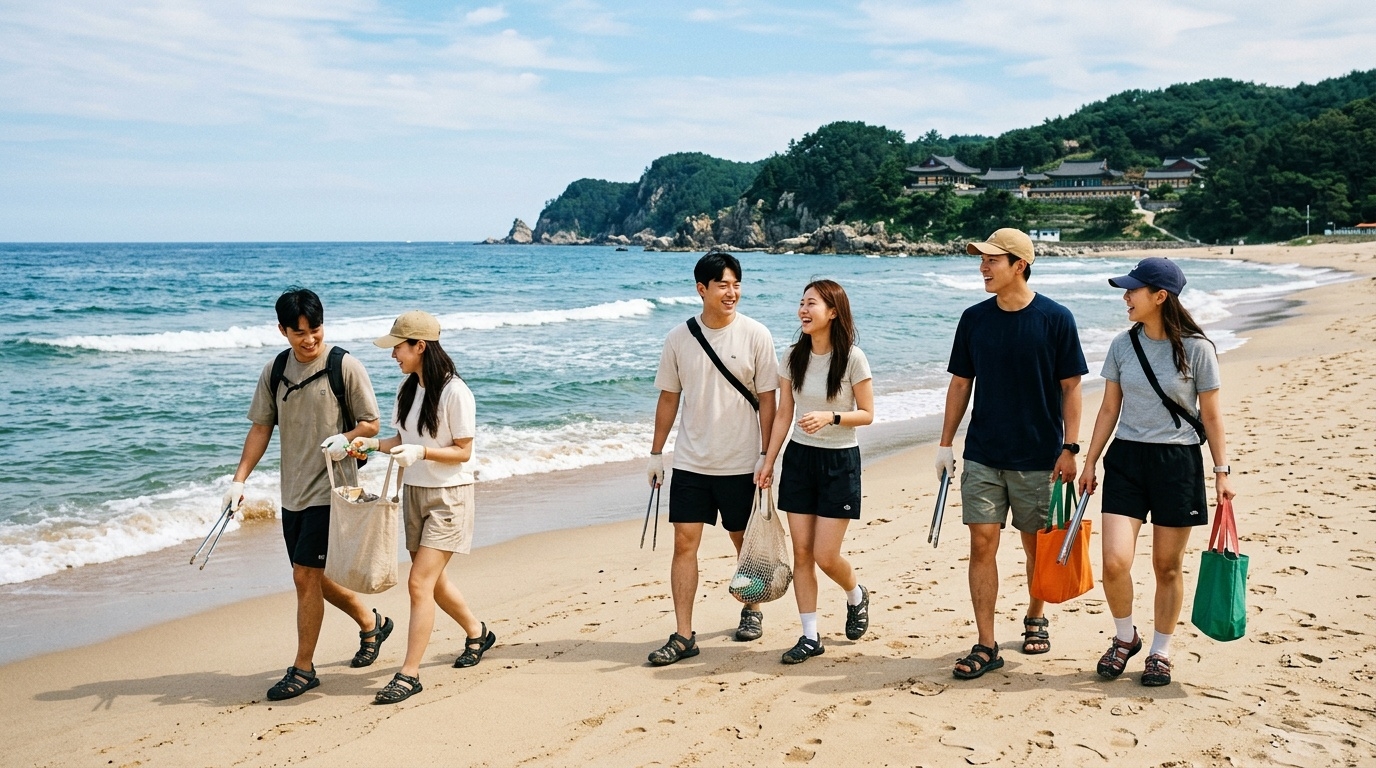
During couple’s yoga set against the backdrop of the East Sea, pairs worked on syncing their movements and breathing. Out on the beach, they went on a “plogging” date—an eco-friendly activity that involves picking up trash while walking or jogging. Instead of just admiring the scenery, participants tackled the shared task of cleaning up the environment, giving them a glimpse into how their potential partners cooperate with others. While the group chats and tea ceremonies focused on words, yoga and plogging offered a chance to understand each other through actions.
The blindfold trust walk was perhaps the activity that most beautifully utilized Naksansa’s unique setting. One person wore a blindfold while the other guided them along the “Path of Wishes” toward the Haesu Gwaneumsang statue. The guide had to continuously describe the surroundings to keep their partner at ease, while the blindfolded participant had to actively listen and pace themselves alongside a stranger. What would normally be a simple stroll was transformed into a profound exercise in trust and responsibility.
5 Matches and a 0.80 Birth Rate
At the end of the two-day retreat, 10 out of the 20 participants mutually chose each other, resulting in five new couples. Essentially, half of the attendees found a match in the final selection. Of course, becoming a couple on the program simply means they’ve decided to get to know each other better; it doesn’t guarantee an immediate marriage or a long-term commitment. What I am Jeollo successfully did was create that crucial initial spark for strangers to start a connection.
The reason this program has garnered attention beyond being just a quirky dating event lies in South Korea’s demographic crisis. In 2025, the country’s total fertility rate stood at 0.80. The total fertility rate represents the average number of children a woman is expected to have over her lifetime. While this marks a slight increase from the previous year and the second consecutive year of improvement, it’s not nearly enough of a shift to quell concerns about the declining number of births and the aging population structure. It’s a nuanced reality where we must acknowledge both the two-year upward trend and the fact that the absolute numbers remain critically low.
The low birth rate is a deep structural issue that can’t be explained away solely by personal reluctance to marry or have children. It’s also unrealistic to expect a single matchmaking program to directly boost the fertility rate. However, I am Jeollo illustrates how the scope of tackling the demographic crisis is expanding. It’s moving beyond just offering post-childbirth support, reaching back to the very first steps: creating safe, welcoming spaces and providing opportunities for people to start building relationships.
A Connection That Doesn’t End at the Bodhisattva Statue
In this journey, the temple serves a distinctly different purpose than a commercial date spot. Instead of a meetup centered around drinking or spending money, participants engaged in activities that naturally fostered conversation and teamwork—like tea chats, walking, yoga, and environmental cleanup. They weren’t forced to quickly judge one another; they navigated various situations together over a set schedule. Rather than jumping to conclusions after one brief chat, they had the time to observe how their partner’s demeanor adapted to different activities.
The image of a blindfolded participant walking toward the Bodhisattva statue, relying entirely on their partner’s guidance, perfectly encapsulates the spirit of I am Jeollo. You can’t build complete trust in such a short amount of time. But by matching paces, explaining the way, and arriving at a destination together, they experience a microcosm of how genuine relationships begin. It’s a poignant reminder that a blind date doesn’t have to be a sterile exchange of questions and answers.
Out of 4,225 hopefuls, only 20 got to participate, and five couples ultimately chose each other. The staggering number of applicants not only points to the program’s success but also highlights a profound yearning for trustworthy opportunities to meet new people. Even with a slight bump in the fertility rate for two years running, South Korea’s demographic challenge remains a long-term hurdle. What remains to be seen is whether these sparks ignited at a temple will blossom into lasting relationships, and how much further these low-pressure, supportive avenues for connection will expand in the future.
Sources: The Chosun Ilbo, June 23, 2026; The Korea Times, June 23, 2026; Reuters, July 13, 2026; The Dong-A Ilbo, July 12, 2026.