
Table of Contents
Record-Breaking First Half
Here’s the news that dropped on July 2. South Korea’s Ministry of Food and Drug Safety announced cosmetics exports for the first half of 2026 hit $7 billion USD (about 10.84 trillion won)—the highest ever for any six-month stretch. That’s a 27.3% jump year-over-year. After 2025’s landmark $10 billion annual total, 2026 has already bagged 70% of that in just half a year.
The Quality Shift: Diversification Over Dependence
But the growth’s quality matters more than the sheer number. Historically, K-beauty exports leaned heavily on China—every tremor there shook the whole industry. That structure has changed. The U.S. share in Q1 climbed steadily: 11.7% (2022) → 12.5% (2023) → 16.5% (2024) → 17.0% (2025) → 19.8% (2026). This isn’t one market surging—it’s distributed growth across the U.S., Japan, Southeast Asia, and Europe. That’s the real story behind this record.
Indie Brands Driving the Surge
Large conglomerates aren’t the engine here. Korea’s ODM (original design manufacturing) infrastructure is so robust that a small company with an idea and branding can launch products fast. Brands like COSRX, Chosungah22, Anua, and Illiyoon saw overseas sales outpace domestic recognition early on. Amazon and TikTok Shop’s distribution and promotional channels accelerated this structure.
Product Trends Point to Performance Competition
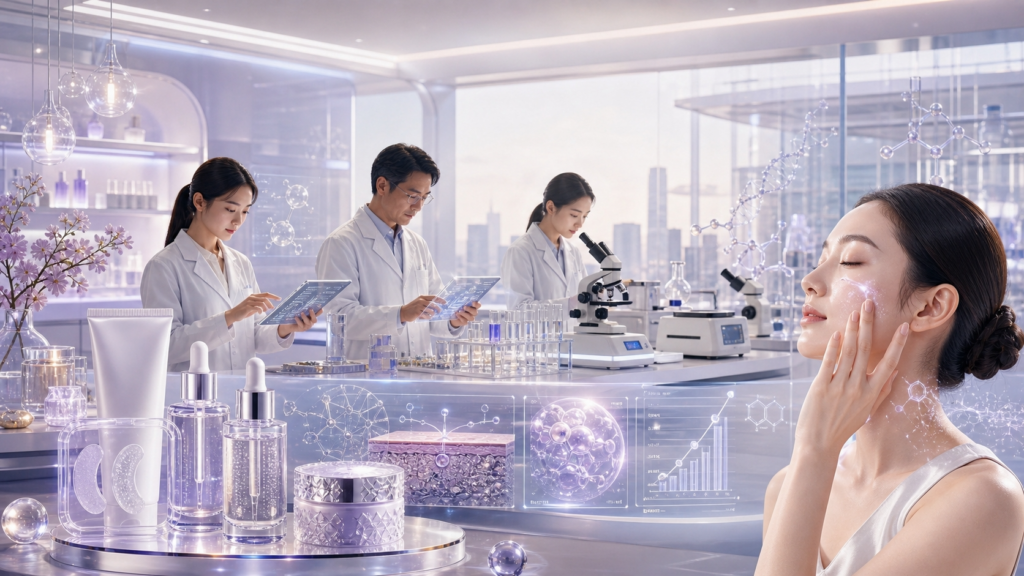
CosmoBeauty Seoul 2026, held May 27–29 at COEX, turned 40 years old and delivered its trend report by analyzing 4,700+ product descriptions across 530+ brands. The conclusion: K-beauty remains skincare-focused, but the axis has shifted. Ingredient formulas now compete less on novelty; what matters is “delivery method” and measurable efficacy. Microneedle stamps and patches, sponge-spicule serums and creams dominated. The question became: how do active ingredients penetrate skin deep? Hair care expanded into “scented damage care,” slow-aging and barrier-recovery messaging followed.
Performance Competition Phase Underway
K-beauty has entered a performance-driven stage. It entered via attractive packaging and low prices; now it competes on clinical data and technology. The vulnerability remains: inconsistent quality across proliferating indie brands, and uneven compliance with overseas regulations. The next billion dollars will hinge on whether these weaknesses hold. So next time you’re eyeing a K-beauty product, check if it has the clinical backing—that’s what’s driving the billion-dollar wave.
Source: Ministry of Food and Drug Safety / CosmoBeauty Seoul 2026 trend report, July 2026