
Table of Contents
Two Young Koreans Who Came to Mount Palgong in Search of a Match
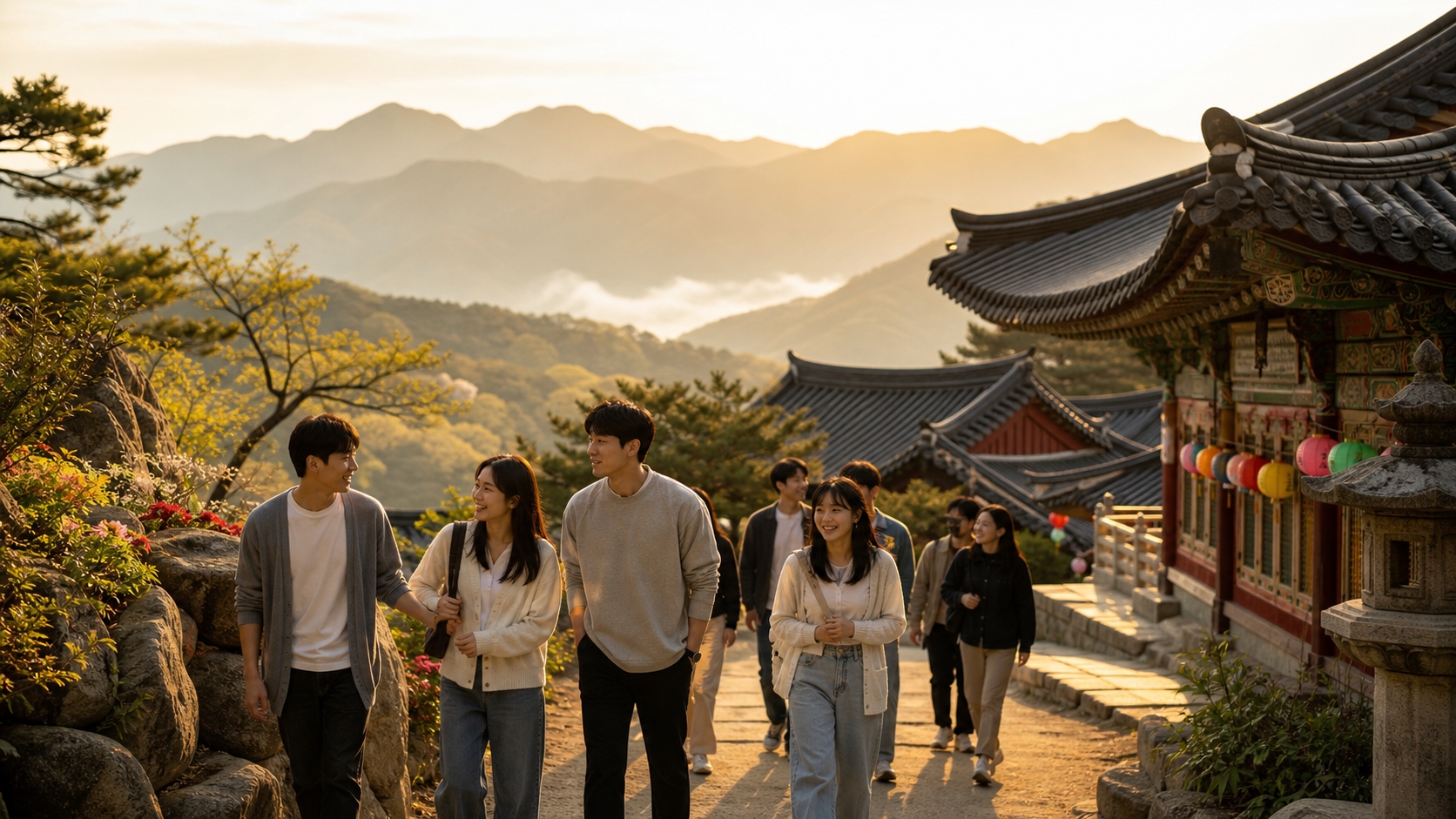
Kim A-kyung, who goes by the Buddhist name Seonhyeji, took part in a matchmaking event held at Donghwasa Temple on Mount Palgong in Daegu. The 28-year-old said her chances of meeting someone new had shrunk sharply after she left the Seoul area for a job in the provinces. Her life had become a routine of commuting between work and home, and the hobbies she tried to pick up were mostly solitary activities. Her co-workers were also much older than her, leaving little natural chance to meet people her own age.
Kwon Seung-o, who goes by the Buddhist name Enyo, faced a different situation but reached a similar conclusion. The 30-year-old works at a dairy factory in Daegu, where most of his co-workers are men. Friends had set him up on about 10 blind dates, none of which led anywhere, and he personally felt uneasy about meeting strangers online. Unable to find a romantic partner within their everyday routines, both of them ended up applying for a 30-hour matchmaking event at a centuries-old temple.
The monk who greeted the participants told them they had come to find a partner and, one day, have children — a mission to help save the country. The young attendees laughed nervously as they eyed the people around them who might become their future match. It looked like a scene from a dating reality show, but these were real people who had come to Donghwasa for an actual meeting. From the very first moment, the event made clear that it saw individual romance as directly tied to Korea’s low birth rate.
A 30-Hour Temple Matchmaking Event With Over 1,600 Applicants
More than 1,600 people applied for the Donghwasa matchmaking event. Of them, 24 men and women were selected as final participants. The selection process alone was highly competitive, showing that demand among young Koreans for meeting new people offline is not small. Rather than a brief one-on-one blind date, participants stayed at the temple and spent a full 30 hours together.
The schedule began with self-introductions, followed in turn by a first date, choosing a lunch partner, a talent show, speed dating with several partners in short conversations, and choosing a dinner partner. Rather than judging a match after a single conversation, participants could observe each other across a range of situations: walks, meals, group activities and talent performances. With the program running continuously, there was little room to avoid awkwardness; participants had to keep trying to talk to one another.
When his turn came, Kwon introduced himself by handing out French pastries he had baked himself, aiming to be memorable through something he had made rather than simply describing his job and hobbies in words. Kim walked a forest trail with her first-date partner, talking about everyday topics like work, hobbies and favorite shows. Even against the unusual backdrop of a mountain temple, the questions participants asked to get to know each other were not so different from an ordinary blind date.
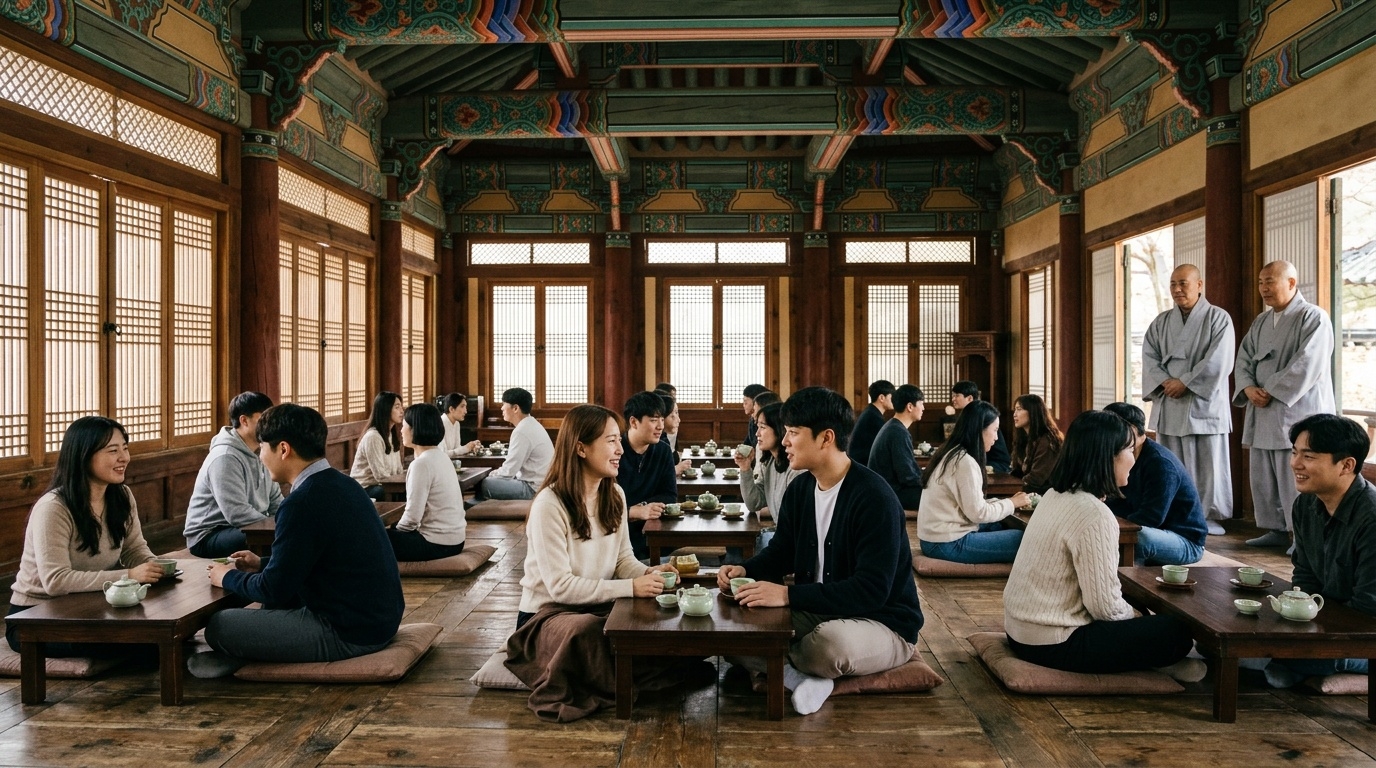
During the short rotating conversations, participants talked with several people in turn over green tea. Afterward, they had to choose whom to have dinner with. The structure moved from first impressions and self-introductions to shared activities and finally to choosing a partner, combining the quick judgment required by speed dating with the extended observation made possible by a 30-hour stay.
How a Temple Became a Venue for Romance
Temples in Korea are generally seen as spaces for religious practice, prayer and heritage tourism. The Donghwasa event instead used the space as a place where strangers could live together for a set period and form relationships. Unlike a typical blind date that lasts an hour or two over coffee, participants shared meals and took part in multiple activities together. Watching each other’s talent-show performances and repeating walks and brief conversations let them observe sides of one another that a first impression alone would not reveal.
Event organizers tied the program’s purpose directly to Korea’s low birth rate. Yoo Cheol-ju, who led the event, invoked the historical tradition of Buddhist monks taking action in times of national difficulty, linking Donghwasa’s role as a base for warrior monks who defended Joseon against Japanese invaders in the 1500s to today’s demographic crisis. Unlike the external threats of the past, he explained, the crisis to be addressed this time is the falling number of births.
That framing carries real weight, casting personal romance as a national task. Participants came looking for a partner, but the organizers had in mind a longer path leading from meeting, to marriage, to childbirth. By drawing on a communal space like a temple and the Buddhist community’s tradition of social engagement, the event supported young people’s search for partners while presenting it as a practical response to Korea’s population problem.
The Everyday Points of Contact That Have Disappeared
In Korea, a “sogaeting,” or blind date, refers to a one-on-one meeting arranged by a mutual friend, colleague or family member between two people who do not know each other. It can be an important path for people who have not naturally met a partner through school or work. But once someone graduates and moves to a place with no existing ties, or works in a job with few people of a similar age and the opposite sex, the social network they could ask to arrange an introduction shrinks along with it.
Kim’s and Kwon’s experiences illustrate, in concrete terms, the situation facing young Koreans who want to meet someone but cannot find the right opening. For Kim, relocating for work created distance from her existing relationships; for Kwon, working in an overwhelmingly male environment was the constraint. Neither had rejected the idea of dating outright — what they lacked was a realistic way to meet new people.
Kwon personally felt uneasy about meeting people online. For him, someone who had not found a partner even through multiple blind dates arranged by friends, the Donghwasa event offered an offline alternative with an organizing institution and a set program. Rather than searching for a partner through an app on his own, he chose to spend 30 hours in one place with other participants who shared the same goal.
The fact that dating apps have not fully established themselves as the leading way to meet people in Korea is also part of the backdrop for offline events like this one. Tinder has repositioned itself for Korean users by emphasizing that it can be used to find friends as well as romantic partners. The Donghwasa case is an example of a religious institution and an organized program stepping in to meet a demand for connection that neither apps nor traditional introductions through acquaintances fully satisfy.
Low Birth Rate Statistics and the Rise of Public Matchmaking Events
The Donghwasa event is difficult to separate from Korea’s long-running low birth rate trend. Korea’s total fertility rate hit an all-time low of 0.72 in 2023. The total fertility rate refers to the average number of children a woman is expected to have over her lifetime. As the figure fell well below the level needed to maintain the population, the declining number of births became a central policy issue for the national government and local authorities alike.
The decline in the birth rate is often attributed to high housing and childcare costs, work environments that make it difficult to balance a job with caregiving, and the career burden that childbirth and child-rearing place on individuals. The government has expanded parental leave and offered childbirth grants and public housing support for newlywed couples. These policies focus mainly on easing the burdens that arise after marriage or childbirth.
But there is also the problem of not having enough opportunities to meet a partner before marriage in the first place. In response, local governments have organized events that let unmarried men and women meet directly. Local matchmaking events have continued since the early 2000s, and their formats have diversified to include woodworking dates and riverside DJ parties. Rather than simply arranging conversation, these events use shared activities to help participants naturally get to know one another.
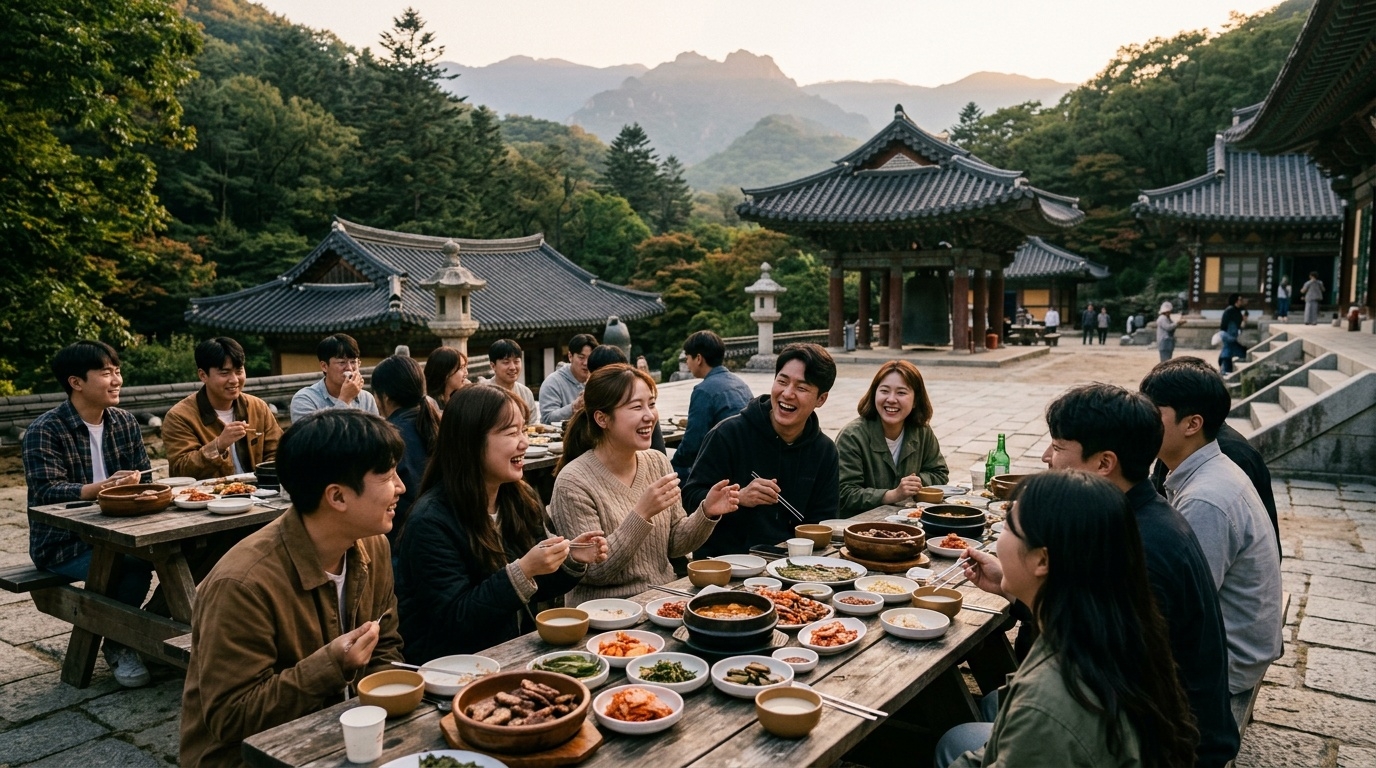
The Donghwasa event added the space of a religious institution and a communal experience to this existing current of public matchmaking. Where woodworking or music events connect participants through a shared hobby or entertainment, the temple matchmaking event drew on an extended stay that included lodging, meals, walks and tea together. The organizing body and the venue differ, but the goal is the same: giving young people who struggle to find a partner within their existing routines a new point of contact.
There are also recent signs of change in birth statistics. Korea’s total fertility rate has ticked up slightly since 2024, and the BBC reported that the average number of births per woman in 2026 stood at 1.0, though the confirmed annual figure has not yet been released. That would be higher than the 0.8 recorded in 2025. Still, this uptick cannot simply be credited to matchmaking events or any specific government policy; shifts in the timing of marriage and childbirth, among other factors, need to be considered together.
A shift in attitudes has also been observed. A survey released in March found that unmarried people’s positive views on marriage and childbirth had risen by about 10 percent compared with two years earlier. But holding a positive attitude toward marriage or childbirth is different from actually meeting the right partner. Practical conditions such as housing, employment and caregiving continue to shape whether a relationship, once formed, leads to marriage and children.
Eight Couples, and Other Outcomes Beyond Romance
As the 30-hour schedule drew to a close, participants made their final choices. The event produced eight couples in total, including two pairs formed between staff members and participants. Not all 24 selected participants found a partner, but the brief event still produced several pairs who chose to get to know each other further.
Kwon did not find a final match at the event. Though visibly disappointed, he said he would be willing to take part again if given the chance. Despite not finding a partner through roughly 10 blind dates arranged by friends or through the temple event, he had not given up on this new kind of offline meeting.
Kim also did not find a romantic partner, but she built a different kind of connection. She stayed up talking with fellow female participants who shared her room until 3 a.m. and made plans to have brunch together afterward. For Kim, the 30-hour experience was both a chance to choose a romantic partner and an opportunity to quickly grow close to strangers her own age. The male participants who took part also agreed to keep in touch after the event.
These outcomes make it difficult to judge the temple matchmaking event solely by the number of couples formed or by birth statistics. Organizers emphasized the goal of addressing the low birth rate crisis, but what participants actually gained was not limited to romantic relationships. Some made new friends; others gained the confidence to talk to strangers and try meeting people again. Widening one’s circle of social relationships can itself be a foundation for future connections.
The experience of the young people who gathered on Mount Palgong in Daegu shows that Korea’s low birth rate problem cannot be explained by childbirth subsidies alone. Young people who have moved to places with no existing ties, who work in jobs with few colleagues of the opposite sex, or who are reluctant to meet people online all need a point of contact where they can meet others directly. The 30 hours at Donghwasa created that point of contact, but whether the relationships that began there continue once participants return to their everyday lives remains to be seen.
Source: BBC News Korea, July 11, 2026.