Table of Contents
The Resurrection of a Nearly-Forgotten Art
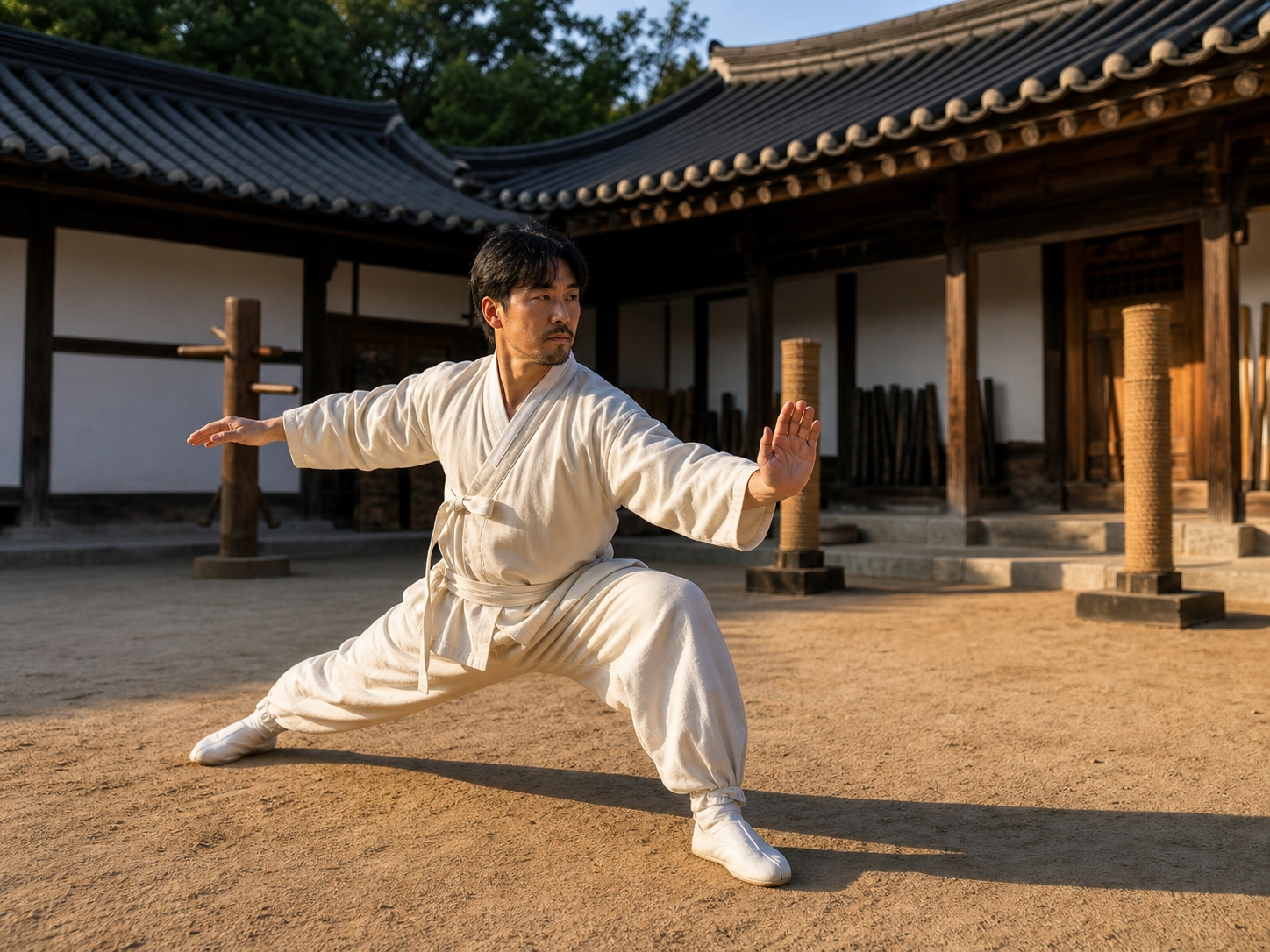
In the autumn of 1935, in a colonial Korea where the very word Joseon was fading from official use, a young man named Song Deok Ki could be found practicing alone in the fields outside Seoul, his bare feet tracing a rhythm the Japanese colonial authorities dismissed as village horseplay. That rhythm was taekkyon (택견), a martial art built not on the rigid punch-and-block grammar familiar to most Westerners but on flowing, almost dance-like footwork, low crouching stances, and a kind of physical conversation between two bodies rather than a straightforward contest of force against force. It survived, improbably, through Song alone. When the Korean government finally recognized him in 1983 as the holder of Widae Taekkyon and designated the art National Intangible Cultural Property No. 76, it functioned less as an honor than as a rescue certificate for something that had nearly not made it. Then, on November 28, 2011, taekkyon became the first martial art in human history to be inscribed on UNESCO’s Representative List of the Intangible Cultural Heritage of Humanity — a recognition that placed a half-forgotten village game in the same category as royal court music and mask dance dramas.
That history matters because it explains why Seoul, this April, is staging an experiment that Taekwondo, Korea’s other and far more famous martial export, never needed to run. Taekwondo found its future in the Olympic stadium. Taekkyon, lacking that stage, is instead betting on something older: direct transmission from master to student, magnified for an international audience.
Seoul April 2026: An Elite International Seminar
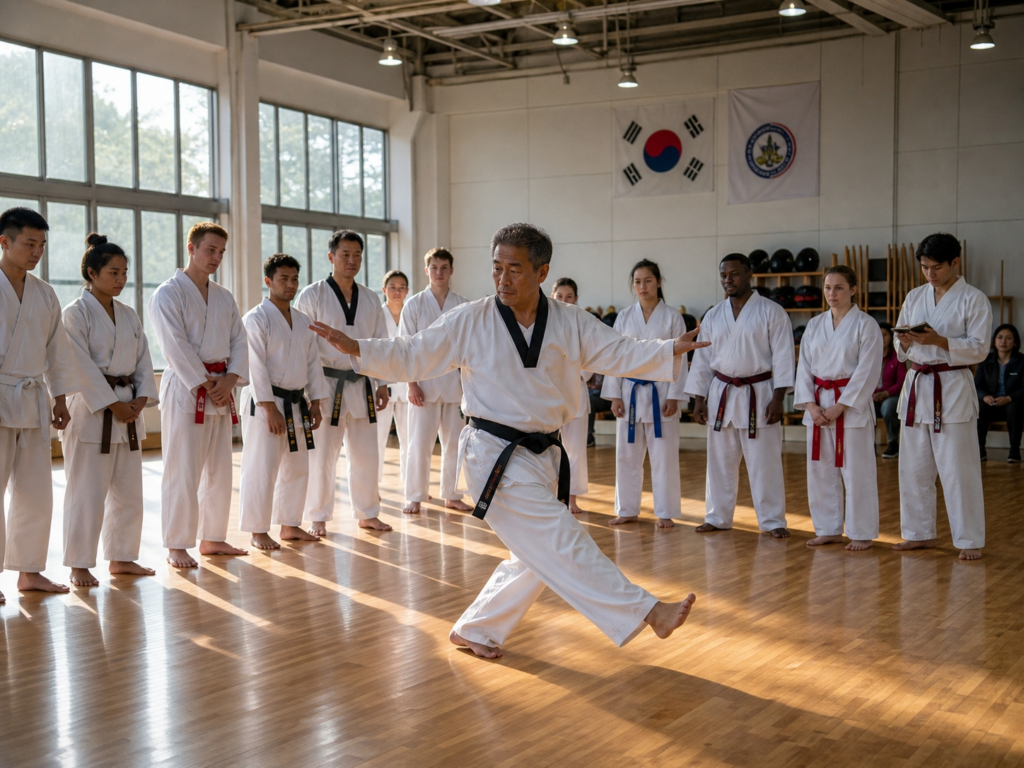
From April 10 to 15, 2026, Seoul and the mountain town of Muju will host what its organizers call the “Authentic World Master Class Martial Arts Seminar,” a six-day program run by the World Culture Exchange Foundation with the backing of ten major Korean martial arts bodies, among them Korea Kido Hwe, Kukmuwon, and Korea GongKwon YuSul. The curriculum reads like a survey of Korea’s fighting traditions in miniature: taekkyon itself, alongside hapkido, hosinsul, and gongkwon yusul, taught in sequence rather than in isolation. Two of the six days will be spent at the Muju Taekwondowon, a sprawling campus built explicitly for the preservation and teaching of Korean martial culture — the closest thing the country has to a martial arts cathedral.
The seminar’s most striking offering is its access to Taekkyon Moosol, also called Tukgong Moosol, a hybrid discipline that fuses traditional taekkyon technique with the close-quarters combat methods developed for the Republic of Korea Special Forces. Instruction reportedly involves trainers connected to the Presidential Blue House Secret Service, meaning civilian participants will, for a few days, study methods normally reserved for the people whose job is protecting the president of South Korea. As one report on the event observed, “the capital of South Korea is a recognized center for the development and preservation of traditional Korean martial arts” — and this seminar is Seoul’s way of proving that claim to a paying, international audience of instructors and masters rather than casual tourists.
Taekkyon’s Paradox: Can Rules That Save the Art Destroy Its Soul?
Here is where the story complicates itself, and a useful comparison might be a folk song transcribed into sheet music: the transcription preserves the melody for posterity, but something of the improvisational looseness that made it feel alive in the first place can drain away in the writing down. Taekkyon has undergone its own version of this transcription. To qualify as an official competitive sport, organizers introduced pre-arranged forms, formal ranking systems, and an extensive set of prohibited actions meant to keep matches safe and orderly. The unintended consequence, according to critics of the modern competitive scene, is that today’s taekkyon matches can look almost static — two competitors standing close, absorbing pushes and trips rather than initiating the fluid, attacking exchanges that supposedly define the art. UNESCO’s own description of taekkyon praises its “fluid, rhythmic dance-like movements to strike or trip up an opponent” and its emphasis on “consideration and moderation” — qualities that, ironically, become harder to display once a rulebook decides exactly how much force, and what kind of movement, is permissible.
This is not a uniquely Korean dilemma. Any folk practice that seeks the legitimacy of formal sport status faces the same trade: standardize the movement, and you gain judges, brackets, and international recognition; standardize it too much, and you risk keeping the choreography while losing the spontaneity that made practitioners fall in love with it in the first place.
From Private Master-Student Lineage to Global Platform
The April seminar’s design suggests Korean martial authorities have drawn a lesson from this paradox: rather than chasing Olympic-style standardization, taekkyon’s advocates are experimenting with a model closer to how the art survived in the first place — one master, a handful of devoted students, knowledge passed down through repetition and correction rather than through a printed manual. Scaling that intimate transmission to an international seminar of paying instructors is a genuine departure. It resembles, in a way, the difference between learning a family recipe by standing beside your grandmother in her kitchen versus reading the recipe off a card; the seminar tries to offer something closer to the kitchen experience, just compressed into six days and delivered to people who flew in from other countries rather than grew up down the road.
Whether that compression can carry the same weight as decades of apprenticeship is an open question the organizers themselves seem to acknowledge by pitching the event squarely at “experienced practitioners, instructors, and martial arts masters” rather than curious beginners. This is transmission as concentrate, not transmission as childhood.
The Factions, the Costs, and the Future
Two practical realities temper any triumphant reading of taekkyon’s April moment in Seoul. First, the art remains institutionally fractured, split across roughly four major organizations whose competing claims to authenticity have historically slowed any unified push for growth — a seminar sanctioned by ten bodies does not necessarily speak for all of them. Second, access is not cheap: registration runs USD 1,700 for a shared room and USD 2,000 for a single, covering six nights of accommodation and meals alongside instruction, a price that effectively limits participation to relatively well-resourced international practitioners rather than the wider public that UNESCO’s heritage listing was meant to serve.
Song Deok Ki practiced in an open field because there was, in 1935, nowhere else that would have him. Ninety years later, his art’s descendants will practice at a purpose-built training campus in Muju, alongside Special Forces techniques and Presidential Security Service instructors, in a seminar priced like an international conference. The distance between those two scenes is itself the story: proof that something once nearly extinguished can be resurrected, and a quiet reminder that resurrection and preservation are not always the same project.