
Table of Contents
Sales Grew by Double Digits. Profit Didn’t Follow.
CJ CheilJedang reported second-quarter 2026 revenue of 4.195 trillion won and operating profit of 161.9 billion won on August 11. The figures exclude logistics subsidiary CJ Logistics. Compared to the same period last year, revenue rose 10.2 percent, but operating profit fell 18.4 percent. The company sold more, in double-digit terms, and still ended up keeping less.
CJ CheilJedang is South Korea’s largest food company, having led the overseas expansion of Korean food with products like frozen dumplings and instant rice brand Hetbahn. Its overseas food sales already surpass its domestic sales, which is why the company’s quarterly earnings are often read as a gauge of how far K-food has come. That a company like this delivered growing revenue and shrinking profit on the same report card sets this announcement apart from the “record-breaking exports” narrative that has repeated itself in recent years.
The company attributed the profitability slowdown to sluggish domestic consumption, cost pressure from high oil prices, and rising prices for raw materials and packaging. In other words, demand didn’t collapse — the cost of making and selling the same products simply went up, and that ate into profit.
A Caveat for Reading the Consolidated Numbers
On a consolidated basis, including CJ Logistics, revenue was 7.3621 trillion won and operating profit was 257.6 billion won — changes of 9.5 percent and negative 18.5 percent, respectively, according to the company. But those percentages come with a caveat. CJ CheilJedang has signed a stock purchase agreement for 14 subsidiaries in its feed and livestock (F&C) division, and plans to reclassify that division’s results as discontinued operations, which means last year’s comparison figures will also be recalculated. The 9.5 percent and 18.5 percent figures already reflect that reclassification.
The comparison figures listed in the same-day preliminary earnings disclosure, however, are different. Measured against last year’s results before reclassification, revenue rose just 1.7 percent while operating profit fell 27.1 percent. Neither figure is wrong — they’re simply measuring against different baselines. The confirmed numbers will appear in the half-year report to be filed later.
The bottom-line figures also need to be separated by scope. The 23.9 billion won net loss the company announced excludes CJ Logistics; the preliminary disclosure’s fully consolidated net loss is 3.877 billion won. Both point in the same direction — a swing into the red — but citing the size of the loss requires specifying which scope it refers to.
Overseas, Dumplings and Hetbahn Kept Selling
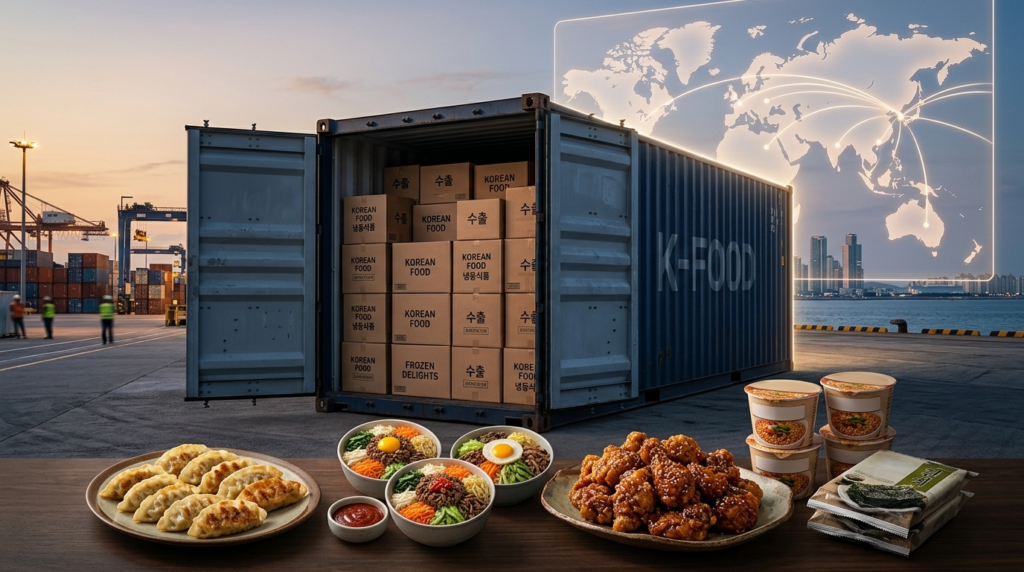
By segment, the growth engine was overseas. Total revenue in the food business division was 2.8441 trillion won, up 5.8 percent, and within that, overseas food sales reached 1.5072 trillion won, up 10.1 percent — outpacing domestic food sales of 1.3369 trillion won, up 1.4 percent. The double-digit growth belongs specifically to this overseas food segment, not to the company’s overseas sales as a whole.
By region, growth was highest in Asia-Pacific at 21 percent, followed by Europe at 19 percent, the Americas at 10 percent, and China at 5 percent. The company credits this to expanded sales of what it calls Global Strategic Products, or GSP — an internal term for a small set of core items the company promotes simultaneously across multiple countries, including dumplings, Hetbahn, chicken, noodles, and seaweed. In Europe, dumplings, chicken, and noodles drove sales; in Asia-Pacific, dumplings along with shelf-stable and frozen items like rolls and seaweed did the same.
And yet operating profit in the food division fell 21.3 percent to 70.9 billion won — a steeper decline than the company posted overall. This quarter, the fact that K-food sells well and the fact that K-food turns a profit pulled apart from each other.
The Pressure That Built Up Over the Past Year
This gap didn’t appear overnight. The won’s depreciation against the dollar, which has continued since last year, works in the company’s favor when overseas revenue is converted back into won — but it feeds directly into manufacturing costs for a company that imports grain and other raw materials. On top of that, rising global oil prices pushed up packaging and logistics costs. Products that are bulky and require cold-chain transport, like frozen dumplings, are especially exposed to this cost structure.
Domestic market conditions compounded the problem. The ingredients business faced both higher costs from the exchange rate and falling sale prices at the same time, and strong sales of new health-and-wellness products only partly offset those losses. In short, it was an environment where the company had little room to pass rising costs on to domestic prices.
The same pressure shows up outside of food. The bio business division, which produces amino acids and related products, posted revenue of 1.3509 trillion won, up 20.8 percent, while operating profit fell 15.9 percent to 91 billion won. Sales of specialty amino acids like arginine and isoleucine, along with lysine, drove the top-line growth, but competition intensified in the high-margin tryptophan market, and the division was also working against a high base from a strong prior-year quarter. Still, bio division operating profit rose 85.5 billion won from the previous quarter, so the recovery trend itself continued.
The Market Reacted the Same Day
The stock market’s verdict came fast. On August 11, the day the earnings were released, CJ CheilJedang shares fell 6 to 7 percent early in the session — a reaction that weighed the profit decline more heavily than the revenue growth.
That fits a broader pattern in how the market has been reading Korean consumer-goods earnings lately. Top-line figures, like overseas sales growth, are largely already priced in; what investors are checking for now is whether that growth actually converts into profit.

Why the Third Quarter, After the Rebalancing, Is the One to Watch
CJ CheilJedang says it will fully apply a recent business-division rebalancing starting in the third quarter. Food will be reorganized into a Lifestyle Food division tasked with expanding sales of core GSP items like dumplings and Hetbahn while defending profitability at home by leaning on higher-margin categories; a technology materials division will be responsible for new-business revenue, and a core materials division for improving second-half results. A company official said the focus would be on improving profitability through cuts to manufacturing costs and fixed expenses.
The question left by this earnings report isn’t whether K-food’s growth has stalled — overseas food sales are still growing by double digits. The real issue is how much of the rising cost of raw materials and logistics a Korean food company can pass on to consumers abroad, and if it can’t pass much of it on, how much it can restructure its cost base instead. That’s the test hiding behind the export headlines. Third-quarter results will be the first report card on that rebalancing.
Source: Newspim, August 11, 2026; Digital Today (consolidated financial statements preliminary earnings disclosure), August 11, 2026; Ajou Kyungjae [Asia Economy], August 11, 2026.