
Table of Contents
Hitting the $10 Billion Mark 19 Days Earlier Than Last Year
South Korea’s agricultural and seafood exports have just crossed the $10 billion threshold in a record-breaking 253 days. The Korea Agro-Fisheries & Food Trade Corporation (aT) announced on the 14th that as of September 10, total export volume had officially surpassed the $10 billion mark, shaving 19 days off last year’s pace. Ever since the country first hit this milestone in 2021, the timeline to reach it has been shrinking year over year. Reaching the target faster shows that global demand for Korean food is picking up speed.
What makes this milestone stand out is that it doesn’t rely on a single market or just one trendy item. Instead, growth has been fairly balanced across both processed foods and fresh produce. The US and China held their ground as the biggest buyers, and Europe and the Middle East also posted notable growth. Shipments to the US jumped 12.9% from the same period last year to hit $1.81 billion, and the Chinese market grew by 14.0% to reach $1.66 billion.
Ramyeon Leads the Charge While Grape Exports Soar
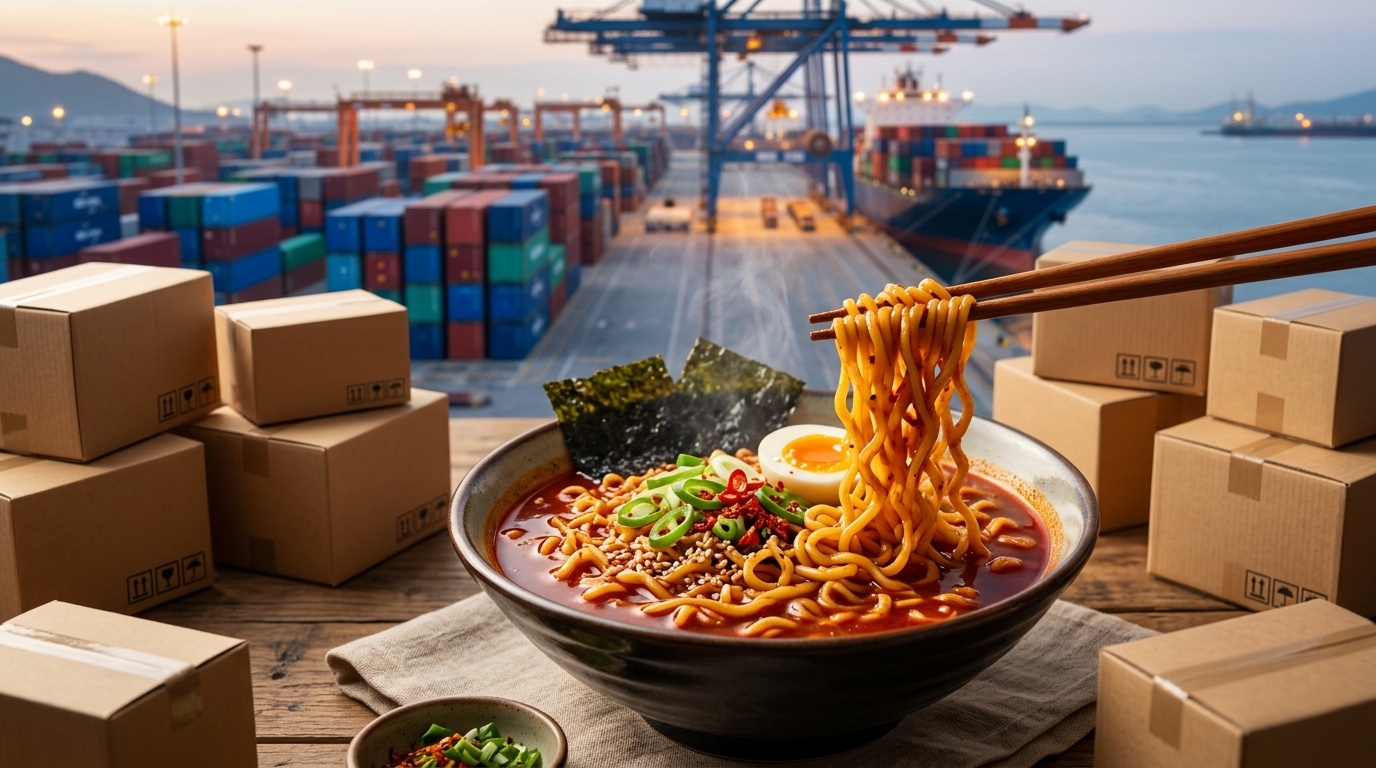
Ramyeon led the growth by a wide margin. Export sales for Korean instant noodles hit $1.3 billion this year, marking a 27.2% surge compared to the same period last year. As global palates grow increasingly accustomed to Korean-style heat and convenience, ramyeon has moved past being a viral trend and become one of the largest categories in Korea’s food exports, now accounting for more than 10% of total agricultural and seafood exports. Both the growth rate and the dollar amount show that ramyeon is driving most of this year’s gains.
Fresh produce also grew fast. Strawberry exports rose 15.5% to $60.98 million, while grapes climbed 64.6% to $45.18 million. Unlike processed goods, fresh fruit has a short shelf life and needs strict temperature control, so this kind of growth suggests that overseas distribution networks and cold-chain logistics have gotten better. Seasoned seaweed and oysters also saw solid gains of 8.0% and 8.2%.
Expanding Beyond Viral Hits: Diversifying Markets and Products
To keep this momentum going through the end of the year, the government and aT are rolling out a five-pronged “Boost” plan. It focuses on nurturing bestsellers, opening new sales channels abroad, driving on-the-ground marketing, providing unified “one-team” support, and dismantling trade barriers. Marketing will be tailored to local tastes: kimchi and Korean sauces in the US, and street food and halal products across Southeast Asia. For grapes, the goal is to expand into major mainstream supermarkets so the fruit can reach $100 million in exports on its own.
Logistics infrastructure is also getting an upgrade. Plans are in place to stabilize operations at the new multimodal logistics hub in Vietnam while supporting cold-chain networks that have expanded into the CIS region and Latin America. In the Middle East, a joint cold-chain pilot project is in the works. To help companies navigate non-tariff barriers, such as the EU’s packaging regulations or Indonesia’s mandatory halal certification, a one-stop export support hub involving 15 partner organizations will step in. Dealing with these shipping and certification hurdles matters just as much as marketing when it comes to turning export shipments into actual retail sales on the ground.
Looking Ahead: Why Sustainability Matters More Than Records
Crossing the $10 billion mark in just 253 days shows that global appetite for Korean food is growing fast. The challenge now is to take the success already built around ramyeon and repeat it for strawberries, grapes, kimchi, and sauces. It also matters to move away from relying so heavily on the US and China, and branch further into Southeast Asia, the Middle East, Europe, and Latin America. The final year-end numbers will be the real test of whether this early milestone was a quick burst of speed or a genuine shift toward lasting product and market diversity.
Sources: Korea Agro-Fisheries & Food Trade Corporation announcement, September 14, 2026; Nongmin Shinmun, September 16, 2026; Dong-A Ilbo, September 14, 2026.