
Table of Contents
The Earthen Fortress That Once Looked Down on the River
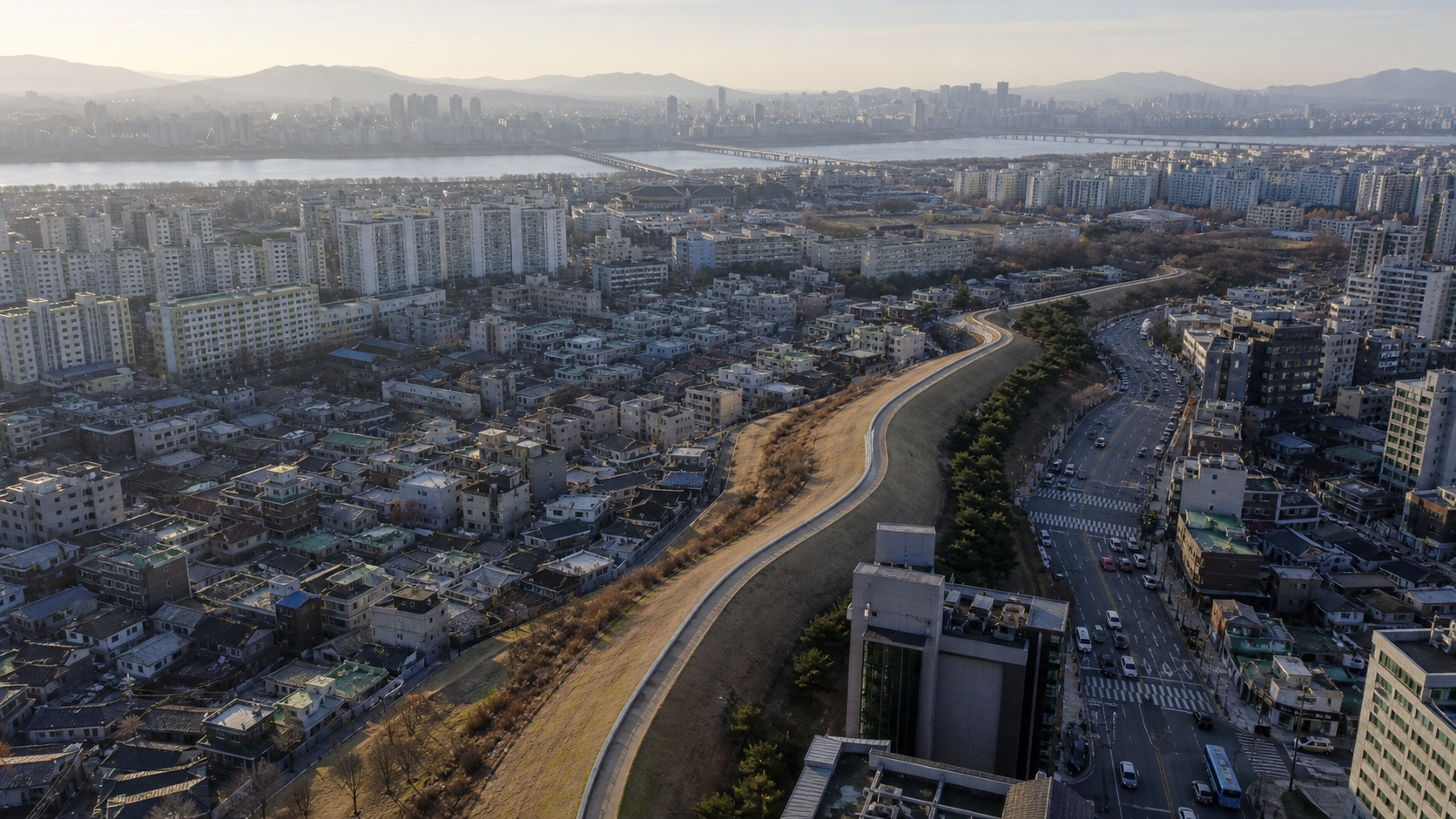
Walking between Seoul’s subway lines, apartment complexes, and roads thick with traffic, one can pass the low, long earthen mound in Pungnap-dong without quite registering that it was once the wall of a royal capital. It is not a stone rampart rising high, nor a palace column, but toseong — a wall of packed earth. Yet this oblong earthen fortification south of the Han River has long been understood as the central space of the period, roughly two thousand years ago, when Baekje held its capital at Hanseong, and it testifies, quietly but firmly, that today’s Seoul has been a city where river, people, and power intersected since far earlier than most would assume.
On July 9, 2026, the Korea Heritage Service announced a preliminary notice to expand the designation of the Historic Site “Pungnap-dong Earthen Fortification, Seoul.” The parcels under review — two lots including 297-5 Pungnap-dong, Songpa District, Seoul — remain open for comment through August 10. “Additional designation” here does not mean a newly discovered relic being registered for the first time; rather, it means bringing the boundaries of a site already protected as a Historic Site into closer alignment with what excavation and survey have confirmed, folding it more precisely into the existing framework of preservation. Preservation, more often than not, begins not with some grand declaration but with the quiet work of correcting a boundary line on a map and explaining to the public what that line actually means.
A New Way to Read the Name Wiryeseong
Pungnap Toseong has long been proposed as the early royal capital of Baekje — the center where the king resided and where the state conducted its administration and rites. The Samguk Sagi records that Baekje, after growing to prominence in the Han River basin, established its capital at Hanseong, but matching a place-name in a chronicle to an actual patch of ground is always a delicate undertaking. It was the 2000 excavation of the Gyeongdang district that turned Pungnap Toseong into one of the most important pieces of archaeological evidence for imagining the “Hanam Wiryeseong” of the texts, after royal-capital-grade remains and artifacts were confirmed within the large earthen enclosure.
For readers outside Korea, Baekje’s Hanseong period tends to sit in less familiar territory than Silla’s Gyeongju or Joseon’s Hanyang. Yet Baekje was an ancient state that grew on the strength of the Han River basin’s transport routes and productive capacity, and on the waterways that connected it to China and neighboring regions. That Pungnap Toseong sits close to the Han River is not merely a matter of geography. The river was a channel for carrying food, people, and goods, and at the same time a line that had to be watched against incursion. The fortress functioned as a wall against enemies, and also, one could argue, as an administrative apparatus for managing the world that arrived by water. The reason this site must be read against today’s riverside scenery lies in that old, inescapable condition: a royal capital could never be separated from its waterway.
Excavation Is Not Only a Matter of Digging Up the Past
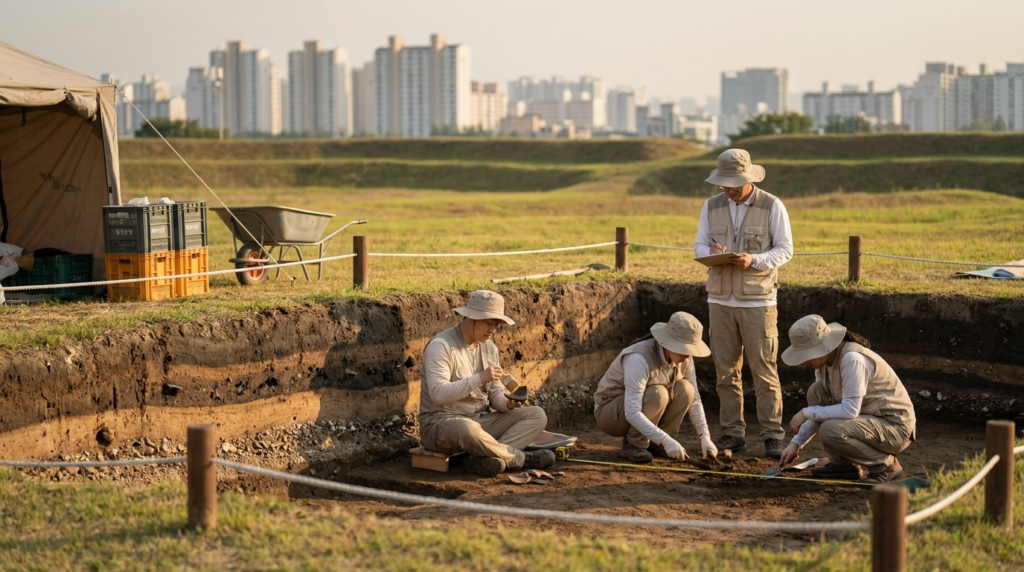
Unlike many other historic capital sites, the preservation of Pungnap Toseong runs directly into the problem of present-day housing. The site does not sit whole inside a museum display case; it remains in the middle of a city where today’s residents live, work, and move about. Excavation, for that reason, is never only a matter of “what was found.” It also asks which parcels of land should be surveyed, how the site should be preserved once dug, and what compensation and consensus might be possible between private property and public memory. Archaeology may begin with a trowel and a brush, but its findings must ultimately be translated into the language of urban planning and daily life.
This latest notice of expanded designation is one scene in that ongoing translation. Fixing the site’s boundaries in law creates grounds for preventing indiscriminate damage, but for residents it may also arrive as a new set of procedures governing construction, renovation, and land use. Preservation policy, then, is never complete in the language of regulation alone. It must be designed together with an explanation of why this ground matters to understanding the memory of Hanseong Baekje, with a fair accounting of who bears the burden of living inside a protected zone, and with a plan for returning the results of excavation to residents and visitors as spaces they can actually enter and experience. To protect a heritage site is not to choose the past over the present, but rather to reconcile the claims of different eras upon the same ground.
The Fortress Soil Holds a Record No One Can See
A stone wall looks solid; an earthen one looks as though it might simply vanish. And yet a rampart built of packed earth preserves, layer upon layer, a record of where its builders sourced their soil, how tightly they compacted it, and what repairs followed each collapse. The soil strata are a record without letters, and excavators read their color, grain, and sequence of deposition to reconstruct the fortress’s own timeline. Pungnap Toseong’s value does not stop at “one Baekje-era fortress survives”; it lies in the fact that this earth holds traces of the technology and labor of a state in formation, of how disasters were met, and of how space itself was organized.
The domestic remains and artifacts confirmed around the site put a human face on the word “royal capital.” It was not only kings and nobles who passed through the fortress gates, but artisans, soldiers, the people who hauled goods, and the people who cooked food and used its vessels. A royal capital was never the name of a single palace but the structure of a city woven from many trades and classes. That is precisely the imaginative leap Pungnap Toseong asks of us: to read the low earthen wall not merely as a monument, but as the place where countless people who lived along the Han River organized their daily existence. Only when the labor mobilized to raise the wall is thought of together with the life sustained inside it does the earth stop being an abstract past and start arriving as time that people themselves left behind.
Can Seoul’s Future Hold Room for Its Oldest Layers?
Seoul has always been described as a city in constant renewal. Redevelopment and expansion, taller buildings and faster transit, are this city’s familiar grammar. But Pungnap Toseong insists that a city’s value is not measured by the speed of the new alone. The ground that once held the royal capital of Hanseong Baekje shows that today’s Seoul did not simply spring into being one day. The expanded designation is less a measure to wall the past off from present-day development than an attempt to bring a longer unit of time into development’s own vocabulary. What an aging city needs is not to be stuffed and mounted, halted in place, but the wisdom to choose what it carries forward as it keeps moving.
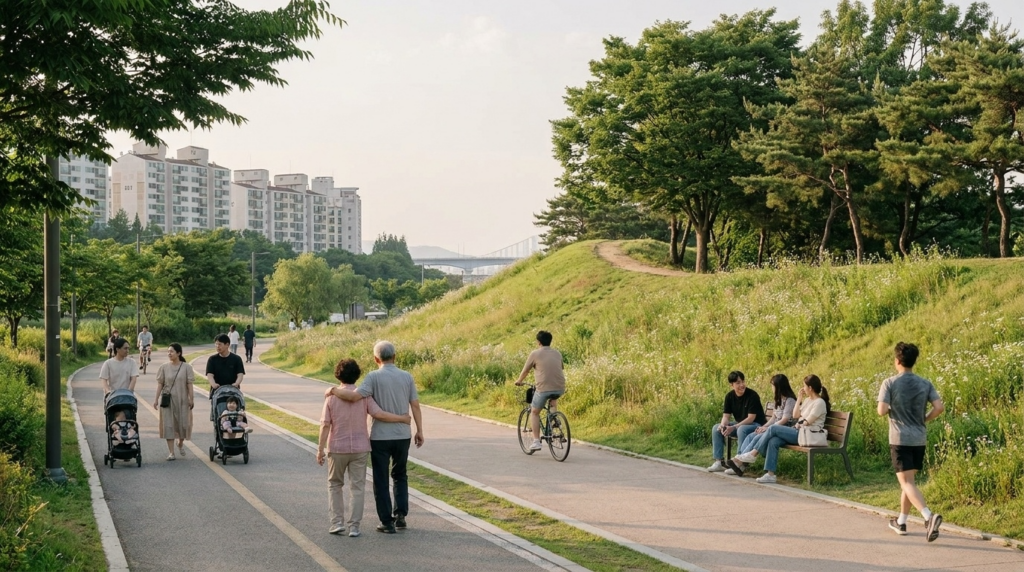
Even once this notice procedure concludes, work remains. The decision to widen the protected area must be negotiated so that it does not collide with the life of the neighborhood, and the results of excavation must be carried beyond specialist reports into education, exhibition, and the paths people actually walk. Pungnap Toseong is a site that speaks not through some grand stone gate but through the contours of the land and the cross-sections exposed at each excavation. Letting visitors walking along the Han River hear that quiet voice — and making sure that voice still reaches Seoul’s next generation — may be the real purpose behind this expanded designation. Whether the traces of a royal capital are left as an inconvenient gap in the city, or turned into a place where citizens come to understand their own city’s time, is the choice that lies ahead.
Source: Korea Heritage Service, Preliminary Notice of Expanded Historic Site Designation for “Pungnap-dong Earthen Fortification, Seoul,” July 9, 2026; Korea Heritage Portal, “Historic Site: Pungnap-dong Earthen Fortification, Seoul.”