
Table of Contents
Where Bone Met Bone
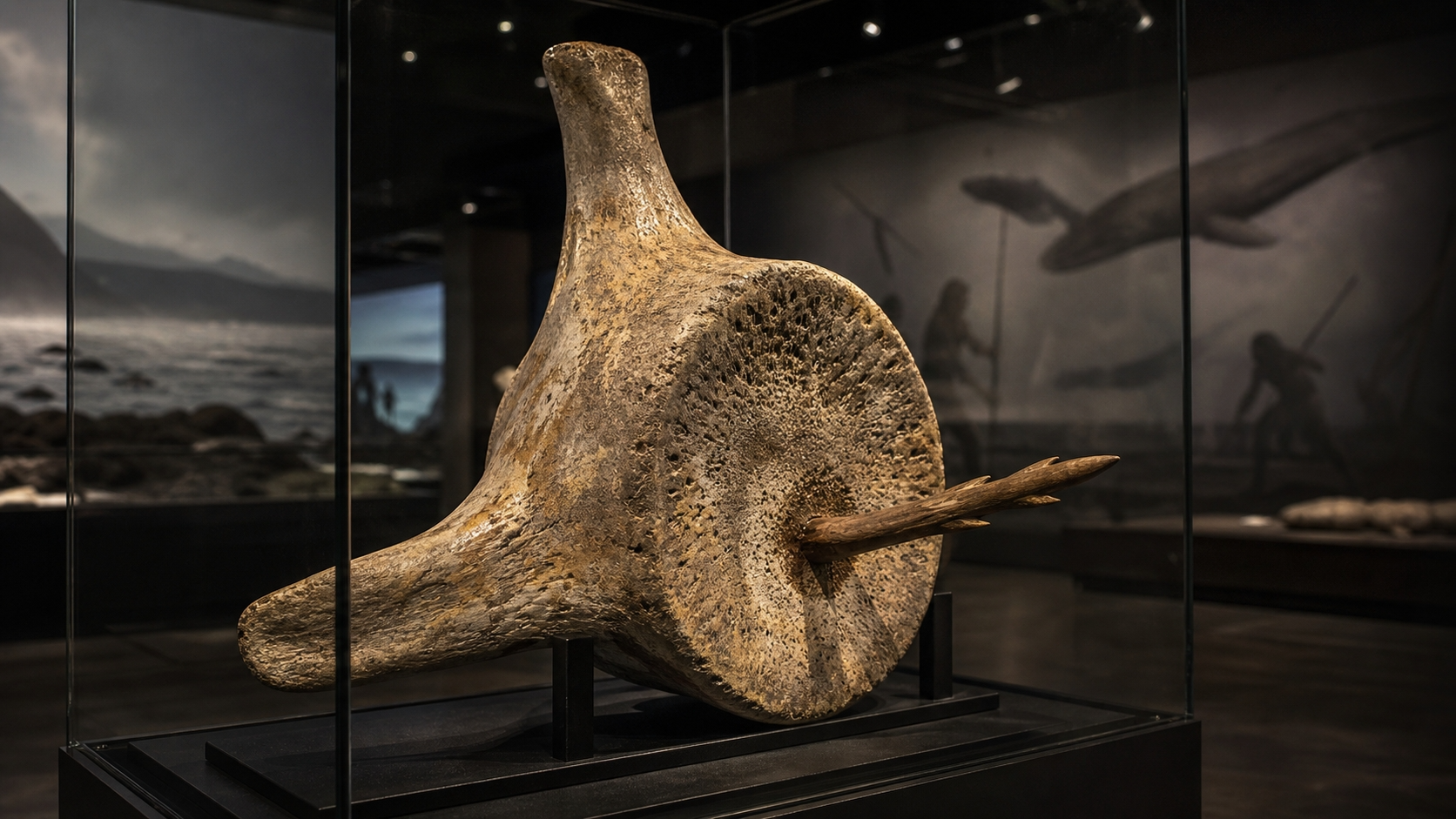
A deer’s antler is lodged inside the bone of a whale. Heard in passing, it might sound like two coincidental remains from land and sea, buried together by chance. But look closely at the sharpened shape of the antler and the mark of impact left in the whale bone, and an entirely different story emerges: this is the trace of Neolithic people on the Ulsan coast who fashioned harpoon tips from hardened deer antler and used them to hunt whales.
On August 5, the Korea Heritage Service designated the “harpoon tip of deer antler embedded in whale bone,” held by the Ulsan Museum, as a National Folk Heritage. The designated item consists of a whale’s caudal vertebra and part of a shoulder blade, each with a deer-antler harpoon tip still lodged inside. Because the tool and its target survive fused together, it stands as a rare artifact that directly shows the livelihood of a Neolithic community.
Unearthed at the Hwangseong-dong Site in 2010
The remains were excavated in 2010 during work at a Neolithic-era site in Hwangseong-dong, Nam-gu, Ulsan. A harpoon tip was found embedded in each of the whale’s caudal vertebra and shoulder blade, and each tip had been shaped by grinding a deer antler to a point. Deer antler is tough and highly durable, resistant to breaking, which is why prehistoric peoples favored it as a raw material for hunting and fishing implements.
The Korea Heritage Service’s designation materials date the artifact to roughly 4000 to 3000 BCE. For eras that left no written record, archaeologists read the shape of a tool, the traces of its use, and the location of its discovery the way one might read a sentence. A harpoon tip alone would leave its purpose to inference; found still embedded in whale bone, this case shows at a glance exactly what it was aimed at.
Proof That Whaling Was Not Just Imagined
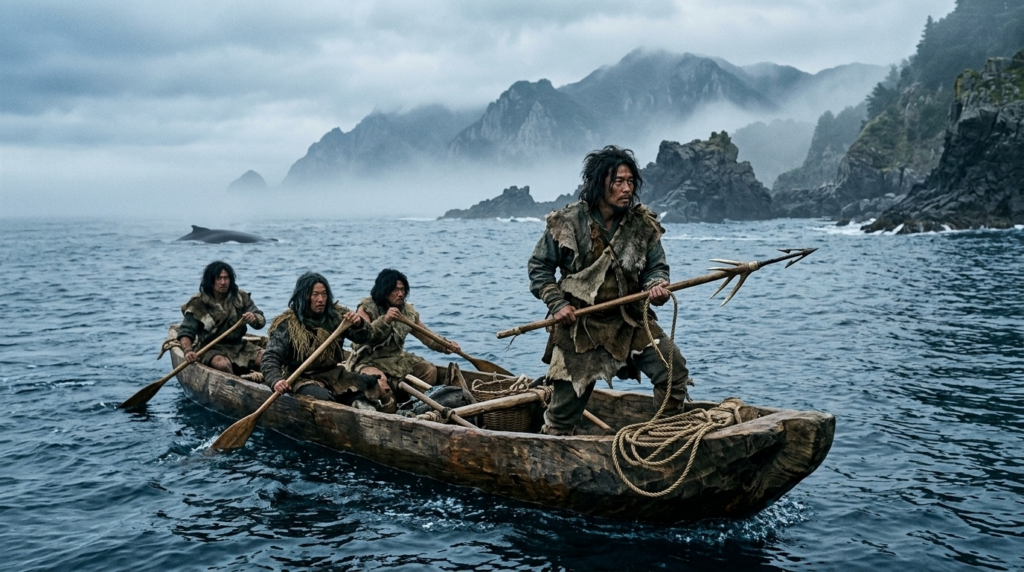
Neolithic fishing on this coast did not stop at gathering shellfish or catching fish close to shore. Taking on a large whale would have required boats, harpoons, coordinated effort among many people, and knowledge of ocean currents and whale movement. A harpoon tip embedded in bone shows that the people of the time did not merely look out at the sea, they engaged it directly, and took on real risk to do so.
A single harpoon, of course, cannot reconstruct the entire process of a hunt. Whether this tool played the decisive role in killing the whale, or was used to finish off an animal already weakened, remains a question for further research. What is clear, nonetheless, is that this is physical evidence of tool and target making contact. A scene once left to imagination now carries the trace of an actual encounter.
A Missing Link to the Bangudae Petroglyphs
The Bangudae Petroglyphs in Ulsan are carved with images interpreted as whales, boats, harpoons, and nets. Inscribed on Korea’s UNESCO World Heritage List in 2025, the petroglyphs are rich with animals observed and hunting scenes recorded by prehistoric people. Until now, there had been room to debate whether the whaling scenes should be read as records of actual livelihood or as symbolic or ritual expression.
The Hwangseong-dong artifact functions like a physical sentence placed beside that image. Because the whale bone and the harpoon tip are directly fused together, it lends strong support to the interpretation that the whaling scenes at Bangudae drew on real, lived experience. Sitting within the same prehistoric cultural sphere of Ulsan, the carving and the artifact explain each other, one shows the scene, the other proves its trace.
Why It Was Designated Folk Heritage, Not Just an Antique
National Folk Heritage status does not necessarily mean an object from the modern or contemporary era alone. It can also cover material that shows a society’s way of life, livelihood, and craft, its food, clothing, and shelter. This artifact concretely shows Neolithic fishing activity, tool-making, and the knowledge of applying materials gathered on land, such as deer antler, to hunting at sea. Its value lies not simply in its age, but in the structure of daily life it captures.
The task ahead does not end with attaching a designation. Whale bone and deer antler are organic materials sensitive to changes in temperature and humidity, so a stable conservation environment is essential, and visitors will need the connection between this artifact and the Bangudae Petroglyphs explained together. Looking closely at a small harpoon tip is, in the end, a way of meeting how the people of Ulsan thousands of years ago read the sea and survived it together.
Source: Korea Heritage Service press release, August 5, 2026; Kim Yong-tae, Yonhap News Agency, August 5, 2026.