
Table of Contents
A Single Monument Looking Out at a Strait
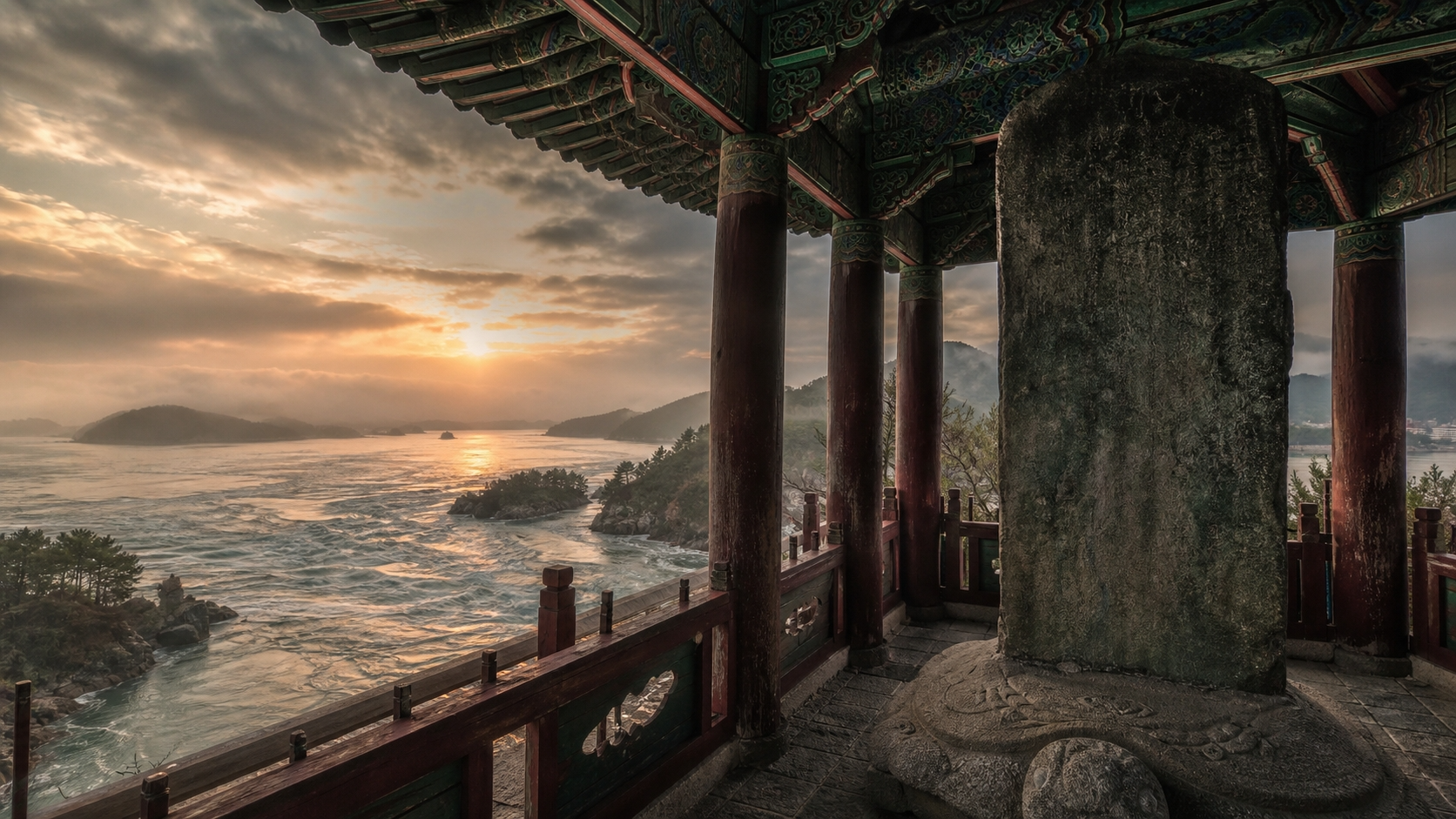
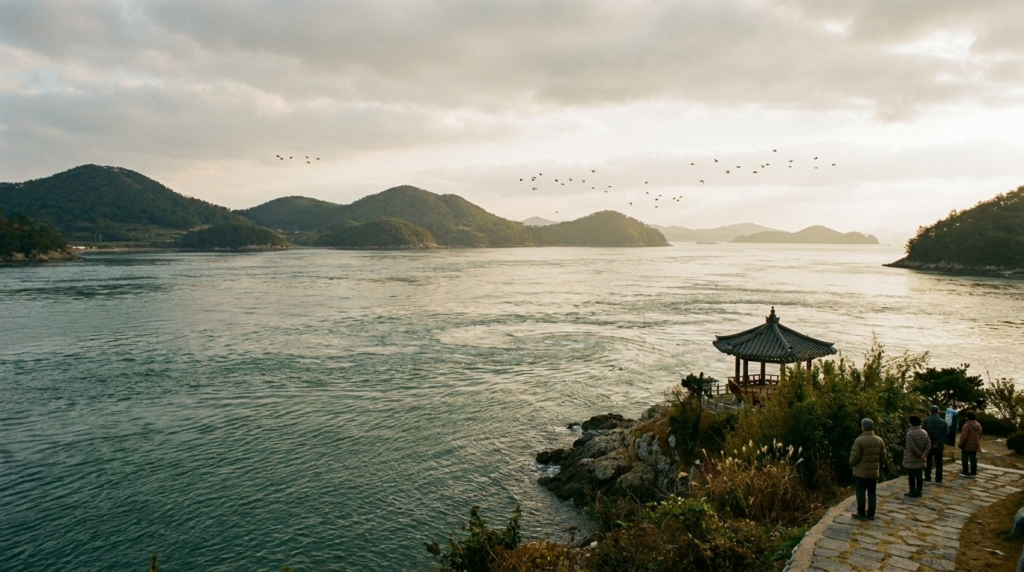
In Munnae-myeon, Haenam County, South Jeolla Province, a stone monument stands with a victory at sea carved into its face. This Treasure, formally known as the Monument to Admiral Yi Sun-sin’s Victory at Myeongnyang (Tongjesa Chungmu Yi-gong Myeongnyang Daecheopbi), commemorates the triumph the Joseon navy under Yi Sun-sin won in the Myeongnyang Strait during the Japanese invasion of 1597. The name Myeongnyang calls up the narrow, violent channel known today as Uldolmok. The current there was never merely a backdrop to the battle — it was, in all likelihood, part of the history itself: a Joseon navy badly outnumbered fought by reading the sea’s own conditions.
On July 15, 2026, the Korea Heritage Service announced a preliminary notice adjusting the heritage zone and protected area around the Treasure “Haenam Myeongnyang Victory Monument,” open for comment through August 13. This procedure does not mean the monument is being newly designated a Treasure. It has held that status as a national heritage item since 1969; this adjustment is instead about managing the monument itself and its surroundings according to today’s cadastral and environmental conditions. A piece of cultural heritage does not exist in isolation as a single object. Only by considering the terrain the monument faces, the paths that lead to it, and the surrounding sightlines and land use together can its full meaning be protected. To preserve the monument, in other words, is also to preserve the relationships of the place it remembers.
A Victory Is Carved Into a Place Before It Is Carved Into Numbers
The Battle of Myeongnyang is often summarized, in Korean history, as a single line: a miraculous victory won by a badly outnumbered fleet. That summary carries the drama of the battle, but it is not sufficient on its own. Yi Sun-sin’s command, the training and courage of his sailors, the judgment that read the strait’s currents and terrain, and the loss and fear that war leaves behind all existed together within that one event. The Myeongnyang Victory Monument compresses all of that complexity into a short inscription and a single standing stone, and hands it down. That is precisely why the memory of this war needs to be read with care, so that it does not harden into the story of one hero alone.
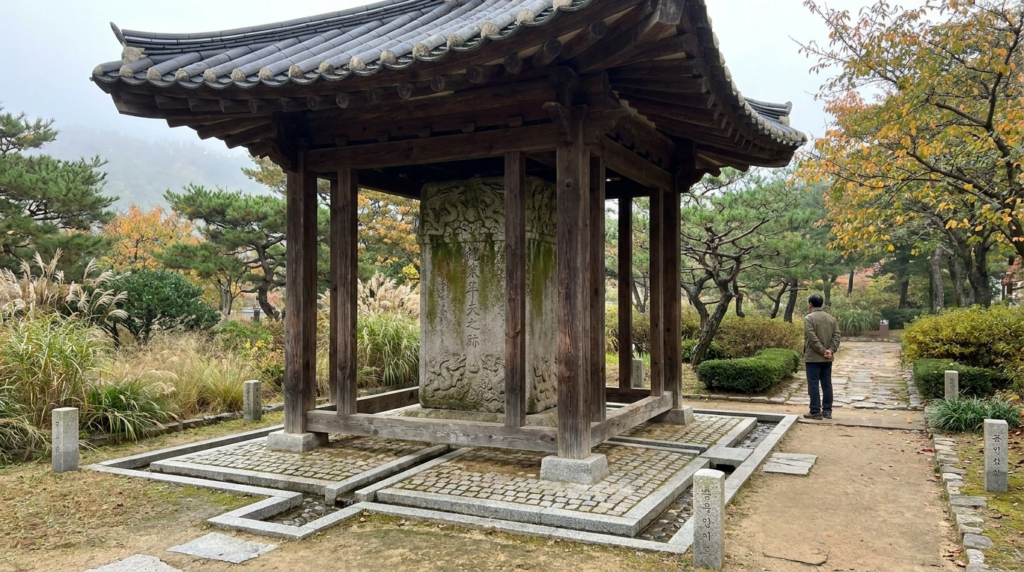
The monument was erected in 1688, nearly a century after the Battle of Myeongnyang itself. What matters is that this is not a record made in the immediate aftermath of battle, but the result of a later generation reassembling the meaning of Yi Sun-sin and Myeongnyang and choosing to commemorate it. The heading inscription at the top of the stone is known to have been written by the late-Joseon literary figure Kim Man-jung, and the body of the text records both Admiral Yi’s military achievements and the significance of the victory at Myeongnyang. A single monument, then, holds not only the moment of battle but also a record of how the memory of that war was constructed differently across time. The characters recording a victory and the impulse a later generation felt to leave those characters behind belong to different eras, yet they meet on the same stone.
A Heritage Zone Is Not Just Empty Ground Around a Stone
Administrative terms like “heritage zone” and “protected area” can sound rather cold. But that boundary line is closer to a promise not to stop at protecting the stone surface of the monument alone. The humidity and drainage around the pavilion that houses it, vibration and construction work nearby, structures that block sightlines, and the routes visitors walk all affect both the physical condition of the heritage item and how it is interpreted. Outdoor stone inscriptions in particular — geumseokmun, meaning texts carved into metal or stone — sit exposed for long stretches to wind, rain, temperature swings, and pollutants, so physical conservation and the management of the surrounding environment cannot be separated from each other. Stone may look unyielding, but a surface that has faced centuries of rain and wind needs a more delicate hand than it appears to.
The area around the Myeongnyang Victory Monument is already more than the site of a single pavilion. The Korea Heritage Portal divides the grounds into the pavilion area, a ganggangsullae performance field, and a shrine area, among others — meaning this is a place of historical education that also brings together local residents and visitors around the seascape, the memory of Yi Sun-sin, and the broader context of Namdo culture. Adjusting the zone’s boundaries should not be a declaration of intent to dress the place up further for tourism, but a process of refining, against present-day reality, the standards for what must be protected and how far use can extend. A historic landscape survives longer when people come to understand slowly why a monument was raised there in the first place, rather than when it lingers only as a good backdrop for photographs.
To Read a Monument Is Not to Glorify War
What must be remembered before the Myeongnyang Victory Monument is not only the cheer of a battle won. The Japanese invasions of 1592 and 1597 left Joseon society with widespread destruction, displacement, death, and wounds. To honor Yi Sun-sin is to respect his tactical judgment and his achievements, but it is also, at the same time, to learn how easily war can dismantle ordinary life. If Myeongnyang is introduced to readers outside Korea by emphasizing only the numbers and the dramatic scenes of battle, the deeper warning this monument has kept for so long gets lost. The language of commemoration needs pride, yes, but it also needs the language of vigilance — a determination not to repeat the war.
Good interpretation, then, offers heroism and context together. It should explain, in turn, why the currents of the Myeongnyang Strait mattered so much, under what conditions Yi Sun-sin led his fleet, why the monument was raised in the late seventeenth century rather than right after the battle, and what memory Haenam’s local community has carried this place through. Heritage is not a textbook cover meant to be memorized for answers; it is a medium that makes us ask, again, in today’s language, about the choices people made in the past. How a society chooses to remember a war’s victory and defeat can, in the end, connect to the values it holds today toward the nation, the community, and the lives of others.
To Adjust a Boundary Is to Widen the Radius of Memory
Should this preliminary notice proceed to a final announcement, the newly organized heritage zone and protected area will become an important standard for future consultations on preservation, maintenance, and development in the surrounding area. What matters most in that process is not leaving local residents outside the protection policy. A historic site does not belong solely to administrative agencies or researchers; the daily lives, economic activity, and freedom of movement of the people who live around it deserve respect as well. Preservation becomes persuasive not by widening the range of what is forbidden, but by demonstrating what public value it returns to local life. When guidance, education, accessibility, and community participation are put in place together, a protected area can become a space of shared memory rather than a line of control.
The current at Uldolmok still runs without rest, and the characters on the monument pass through the years at a pace far slower than that water. Redrawing the protected area around the Myeongnyang Victory Monument is not a matter of placing a single stone inside a glass case. It is an act of acknowledging that the memory of war, the shape of the sea, the calligraphy and commemorative culture of the late Joseon period, and the life of a place called Haenam are all bound together. Visitors need to look out at the strait after they have looked at the monument. Only then does Myeongnyang stop being merely the name of a past battle and become a present-day place that keeps asking how memory ought to be kept. Even after the new boundary is finalized, that question will outlast the administrative procedure — staying, like the sea’s own current, beside everyone who comes to this place.
Source: Korea Heritage Service, “Preliminary Notice on Adjusting the Heritage Zone and Protected Area of Treasure Haenam Myeongnyang Victory Monument,” July 15, 2026; Korea Heritage Portal, “Treasure: Haenam Myeongnyang Victory Monument”; Encyclopedia of Korean Culture, “Haenam Myeongnyang Victory Monument.”