
Table of Contents
The Weight of the Phrase ‘Living Heritage’
The word ‘heritage’ (유산, yusan) can easily sound like something that belongs to the past. We think of old buildings, ceramics in glass display cases, artifacts with explanatory plaques—things already completed, waiting only to be preserved. But intangible heritage is different. It demands that hands move, that bodies remember, that there be time to pass it on to the next person. In English, they call it ‘living heritage’—리빙 헤리티지—and that is precisely why. The event ‘LIVING HERITAGE × ICH,’ held at BEXCO in Busan from July 20 to 29, was a place where that phrase proved to be no mere slogan.
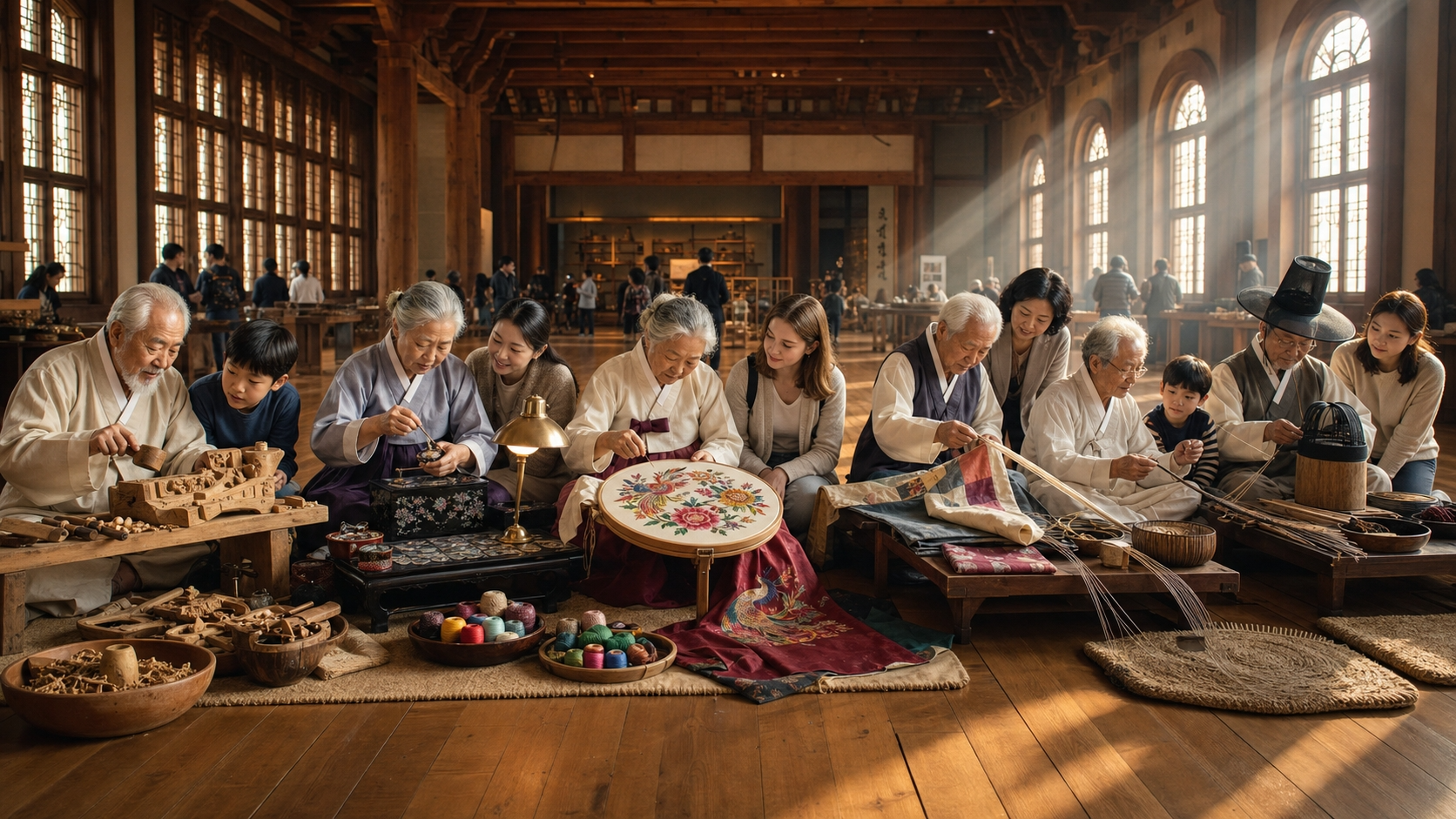
This event was a joint public demonstration organized by the National Heritage Promotion Agency to commemorate the 48th session of the World Heritage Committee in Busan. ICH stands for Intangible Cultural Heritage. Intangible heritage places more weight on the skill of making, the songs and dances, the rituals and knowledge, and the lives of those who transmit them, than on the objects themselves. The event brought together fourteen bearers from eleven craft categories, including gat-il (traditional hat-making), najeonjang (mother-of-pearl inlay), chimseonjang (traditional sewing), and gungsijang (bow-and-arrow making). Visitors were not limited to viewing finished products; they could come face to face with a portion of the time it takes to create them. Unlike a museum exhibition that displays only completed artifacts, this event took a different approach by revealing the very process of making, showing what labor and time the word ‘heritage’ actually contains.
Decades Accumulated in a Single Pair of Hands
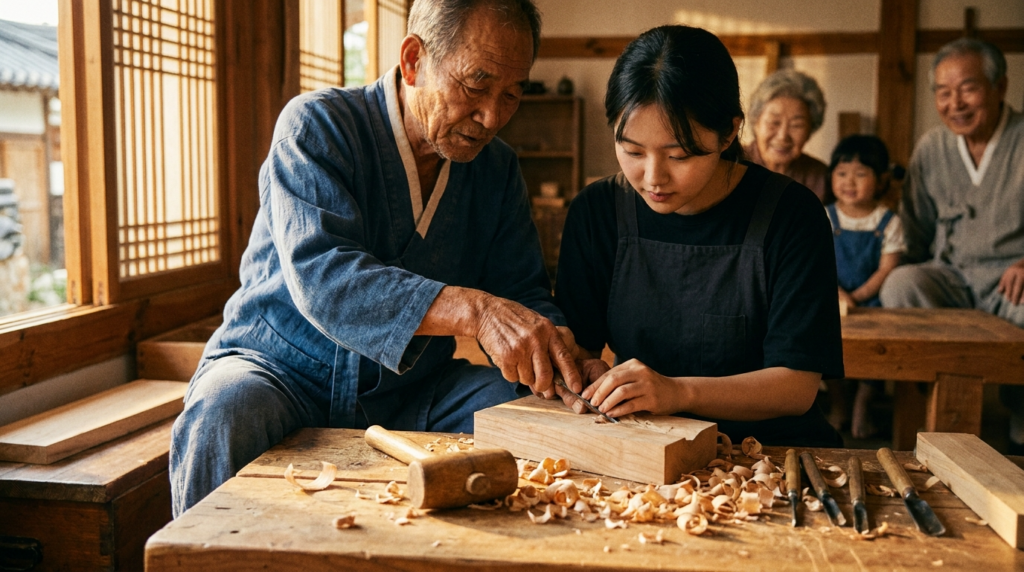
Among the participants, the oldest was Mokjogakjang (wood carving master) Jeon Ki-man, at 97 years of age. The skill of carving wood cannot be explained solely by the strength of the hand that wields the tool. It requires an eye that reads the grain of the wood, that decides which parts to preserve and which to remove, and a sense of patience that prevents the carving from being completed too quickly. Such skills are difficult to transfer entirely through the sentences of a manual. They are passed on only by watching the master’s hand movements at close range, by touching failed materials together, and through the years of repetition that eventually leave their mark on the body. The age of 97 is in itself a record. The fact that he has not let go of his tools at this age shows that the transmission of skills is sustained not only by passing them to the younger generation but also by the length of time the elder master remains in the field.
The work of Chimseonjang (sewing master) Gu Hye-ja and Jasujang (embroidery master) Kim Young-i reveals the time that needle and thread create. Chimseon refers to traditional sewing techniques, requiring delicate judgment in the process of hand-stitching the lines of hanbok or household items. Embroidery, too, is not merely decoration laid upon fabric. It involves simultaneous attention to the spacing of colors, the direction of the thread, and the grain of the base cloth. In an age where rapid production has become routine, such work is often romanticized as an aesthetic of slowness. But that slowness is not leisure; it is another name for precision, and it also represents a condition of labor where a single mistake is not easily undone.
Gat and Manggeon: Daily Tools That Have Not Vanished
The event also featured gat-il masters Park Chang-young and Kang Sun-ja, manggeonjang (headband makers) Kang Jeon-hyang and Jeon Young-in, and tanggeonjang (headband cover maker) Kim Hye-jeong. The gat is widely known as the traditional hat of Joseon-era men, but within ‘gat-il,’ the work of weaving the hat body and the work of decoration and assembly are divided. The manggeon is a net-like headgear used to hold the topknot (sangtu) of men’s hair, and the tanggeon is a cap worn over the manggeon. These items have almost disappeared from today’s daily attire, but the lines and material sensibilities they create convey how finely the division of labor sustained Korea’s clothing culture.
A common misconception when viewing traditional crafts is that they are simply a reproduction of past life. In reality, this is not the case. The skills of making gat, manggeon, and tanggeon can be preserved by finding new uses today, or they can be reinterpreted for new audiences through research, education, exhibition, and creation. But even if their use changes, the grammar of the hand that handles the material is not easily replaced—a fact reaffirmed by this demonstration. However, novelty does not arise from borrowing tradition as decoration on the surface. It can become a language for the next generation only when we understand the properties of the materials, the logic of the making, and the rights of the people who have preserved the skills.
The Light of Najeon and the Tension of the Bow
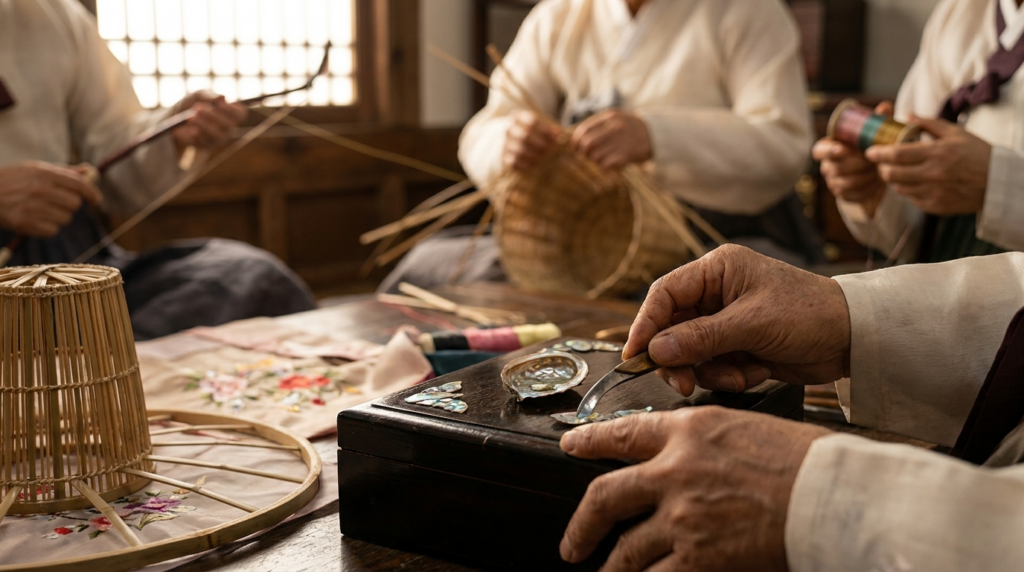
In the second and third rounds, visitors met Somyokjang (cabinet maker) Park Myung-bae, Najeonjang (mother-of-pearl inlay master) Jang Cheol-young, Gakjajang (letter-carving master) Kim Gak-han, Jogakjang (carving master) Kwak Hong-chan, and Gungsijang (bow-and-arrow makers) Park Ho-jun and Kim Yoon-kyung. Najeon is the technique of thinly processing the iridescent inner layer of abalone or conch shells for decoration. Korea’s najeon chilgi (lacquerware with mother-of-pearl inlay) is well known for its small lights that change with the angle on a dark background. In photographs, the ornate patterns catch the eye first, but in actual work, it is the long process of cutting, attaching, and smoothing the shell that sustains that light.
Gungsijang refers to masters who make bows and arrows. Here, ‘sijang’ is not a market (시장) but a combination of the character for ‘arrow’ (시, si) and ‘master’ (장, jang). The skills of the gungjang (bow maker) and sijang (arrow maker) are extremely precise, as they must handle the elasticity, weight, and balance of materials. Traditional bows have moved beyond the era of war and hunting to be newly interpreted in the contexts of sport, ritual, and cultural education. But that change does not diminish the refinement of the skill itself. Even if the use changes, the grammar of the technique is not easily omitted. The fact that eleven craft categories gathered in one place reminds us anew that intangible heritage is a sum of hand skills too diverse to be lumped into a single representative image.
From Seeing to Passing On
This joint public demonstration combined demonstration, exhibition, and hands-on experience. Gathering fourteen bearers at once in the large exhibition hall of BEXCO in Busan would have been a particularly effective scene for introducing Korea’s intangible heritage to attendees of the World Heritage Committee and to citizens. However, the true value of intangible heritage does not lie solely in being revealed once at such a grand event. Transmission continues only when a master meets a disciple, maintains a workspace, secures materials, and when the younger generation can imagine the skill as a means of livelihood and a life choice. The public demonstration is the entrance to that long process, not its conclusion.
The word ‘tradition’ (전통, jeontong) is often first attached to the meaning of ‘old,’ but the character ‘jeon’ (傳) actually carries the sense of ‘to pass on.’ A tradition that is not passed on directly to someone will hardly survive in the long run. The most important scene left by ‘LIVING HERITAGE × ICH’ in Busan was probably not the dazzling finished products, but the moments when the master explained the work and the visitor moved their hands to try it. Heritage comes from the past, but it must always be taken up by people in the present. In that brief instant when the skill begins at the fingertips of wood carving master Jeon Ki-man and moves into the questions of a young visitor, intangible heritage finally becomes present tense.
Source: National Heritage Promotion Agency, event information for the 48th session of the World Heritage Committee in Busan, July 2026.