
Table of Contents
Eight Characters Have Come Home From Japan
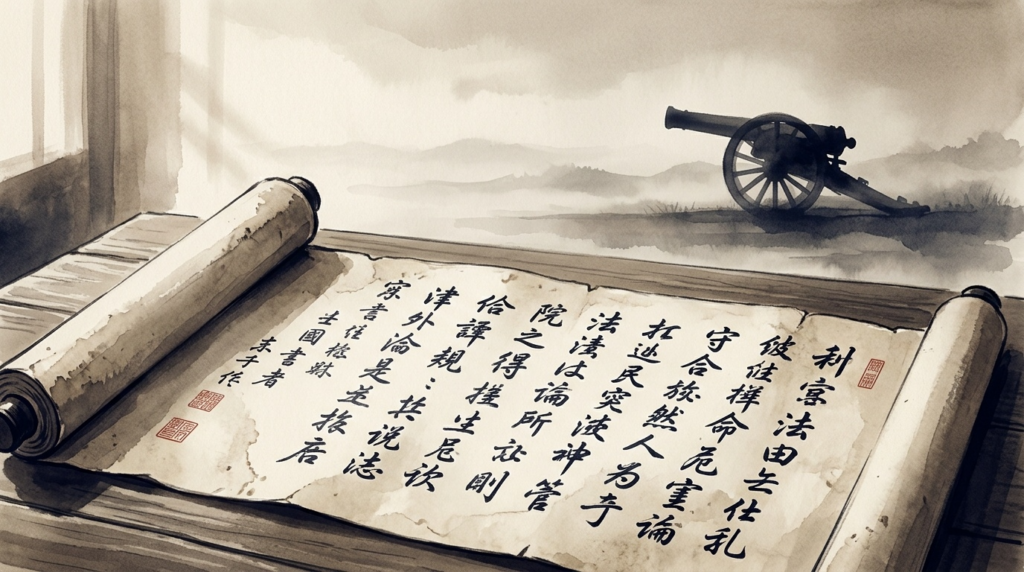
“Manguk gongbeop bulyeo daepo” (萬國公法不如大砲). Eight characters in black ink, brief as they are, carry the weight of an entire era’s despair once one considers where and when they were written. The Korea Heritage Service and the Overseas Korean Cultural Heritage Foundation have recently repatriated a piece of calligraphy by Ahn Jung-geun that had been held in Japan, and on August 13 the two institutions will hold a press briefing at Junmyeongjeon, inside Seoul’s Deoksugung Palace, to explain how it was recovered and what makes it significant.
Yumuk, a term for writing or painting left behind by someone who has since died, is the word used for this piece. It is believed to have been brushed by Ahn Jung-geun in the days before his execution at Lushun Prison in China on March 26, 1910. Since roughly 116 years separate 1910 from 2026, it would be more accurate to describe this as calligraphy that has returned after about 116 years, rather than to round the figure down to a tidier “115 years.”
‘Manguk Gongbeop’ Was the Nineteenth-Century Word for International Law
Manguk gongbeop, literally “the common law of all nations,” is the term that corresponds to what we now call international law. It was the phrase most widely used across nineteenth-century East Asia when Western concepts of international law were being translated and introduced, and it stood for a new kind of order, one in which relations between states would be governed not by force alone but by shared rules and mutual agreement. But in the reality Ahn Jung-geun confronted, those rules did nothing to stop the military power and aggression of imperialism.
Bulyeo daepo means “no match for a cannon.” Rendered into a single sentence, the phrase reads: “International law is no match for a single cannon.” This is less a mockery of international law itself than an irony that indicts the great powers who spoke of law and justice while, in the face of actual invasion, left the logic of force unchecked. A short line of classical Chinese sharply exposes the gap between diplomacy and violence.
Ahn Jung-geun Was a Man Who Spoke of Peace in Asia
To remember Ahn Jung-geun only as the independence activist who shot Ito Hirobumi at Harbin Station is to miss half of what this phrase means. During his trial, he argued that his act was not personal vengeance but a stand for the independence of the Korean Empire and for peace in East Asia; in prison, he tried to set down a vision in which Korea, China, and Japan would build an order of cooperation rather than one of invasion and domination.
That such a man wrote that a cannon outmatched international law does not mean he had given up on peace. If anything, it points to just how hollow the language of peace becomes when the institutions and states that invoke it prove powerless in the face of violence. It was precisely because he believed in the ideal that he could write its betrayal by reality with such a sharp edge.
Why Junmyeongjeon Is Where It Will Be Unveiled
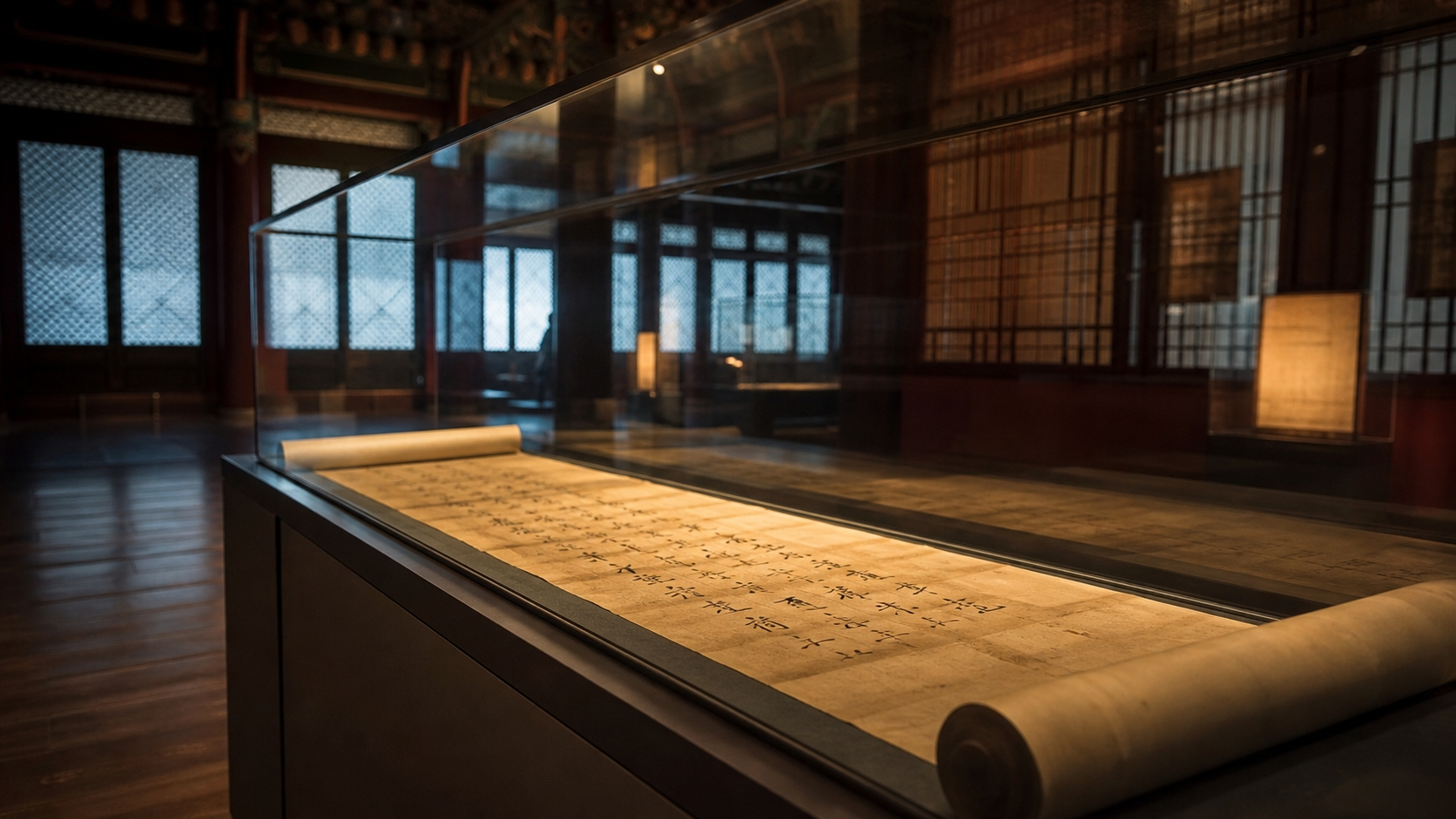
The chosen venue, Junmyeongjeon at Deoksugung Palace, is tied to the history of the 1905 Eulsa Treaty, forced upon Korea at that very site. It is at the scene of the event that stripped the Korean Empire of its diplomatic sovereignty that the calligraphy criticizing that same imperial order will now be unveiled. When a single artifact meets the memory of a place, and not merely the glass of a display case, viewers come to read not only the shape of the characters but also the political context in which the sentence was born.
Still, the August 13 event is announced as a press briefing ahead of the public unveiling. What the Korea Heritage Service has confirmed so far is limited to the repatriation itself and the schedule of that briefing; the specific circumstances of how the piece was held in Japan, the process of its return, and any future exhibition plans are expected to be explained at the event. That is exactly why the purchase price or the identity of any donor, neither of which has been disclosed, should not be guessed at.
Not the Last Work, But a Testament From His Last Days
Ahn Jung-geun left behind multiple pieces of calligraphy while in prison, some stamped alongside his name with the print of his own palm. It is therefore safer to understand this newly returned piece not as “the” final work, definitively singular, but as one among the calligraphy he produced in the final period before his execution. The work’s precise dimensions, its seals, and the particulars of its script are likewise matters to be confirmed through expert commentary at the briefing.
What is already clear, however, is the weight of the sentence itself. The question of what law is for, when it falls silent in the face of armed force, does not remain fixed in 1910. Eight characters, returned after 116 years, are at once the handwriting of an independence activist and a question addressed to a world that still speaks of peace: how, in practice, will it restrain actual violence? It is a moment when ink from the past is read again in the language of the present.
Source: Korea Heritage Service and Overseas Korean Cultural Heritage Foundation announcement, August 5, 2026; Kim Ye-na, Yonhap News Agency, August 5, 2026; Noh Hyung-seok, The Hankyoreh, August 6, 2026.